Text to imageSpace & architectureStyle guide
Small Reading Nook · Sheer-Curtain Diffusion
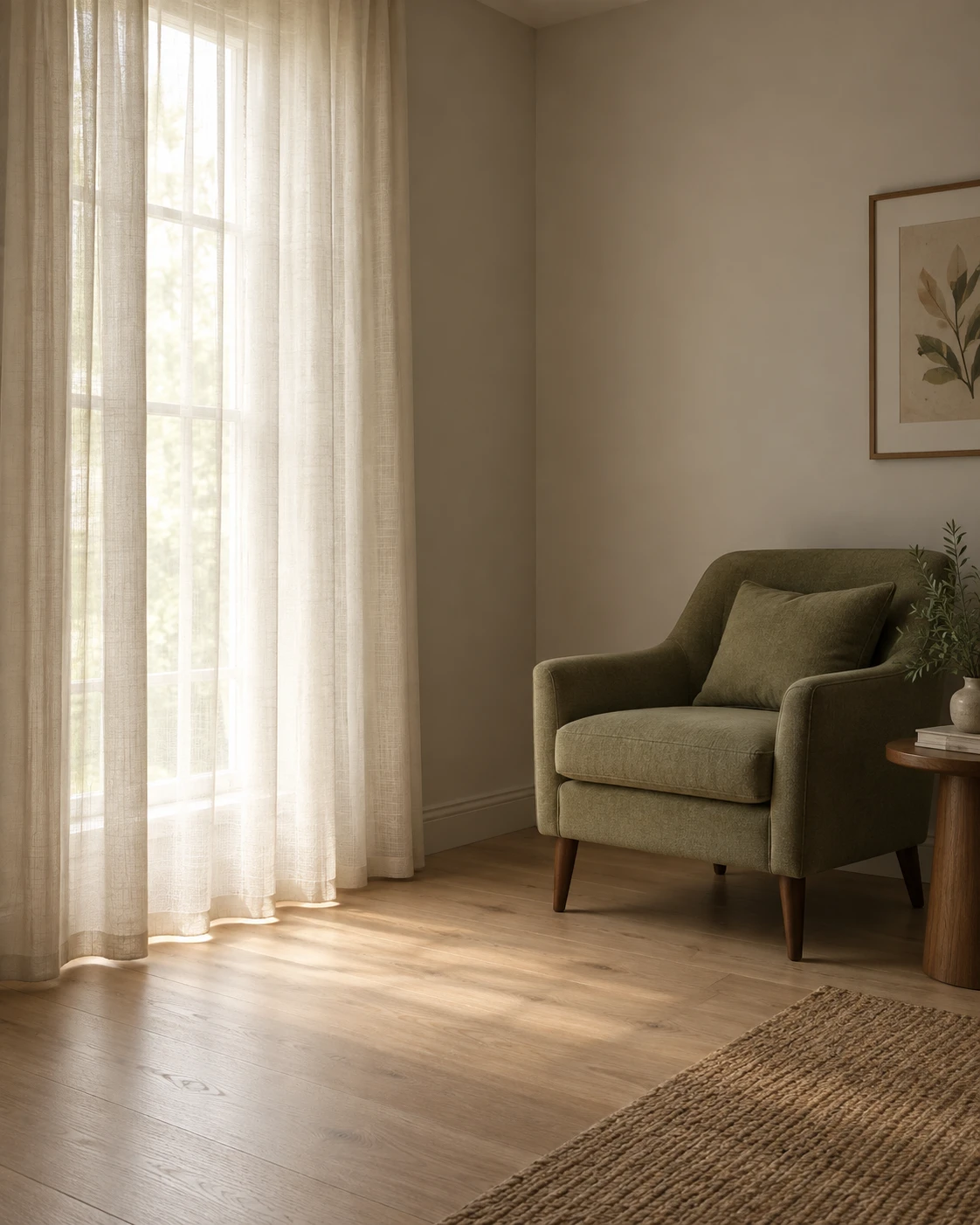
Use light filtered through a sheer curtain and faintly visible window framing to give a small reading nook soft depth.
Small Reading Nook · Sheer-Curtain Diffusion
- Shape & line
- Keep the window and room edges straight, and shape the curtain into a few broad vertical folds with rounded ridges and recessed valleys. Let the window frame remain faintly readable through the thin fabric, becoming less distinct where folds overlap.
- Color & light
- Bring daylight from behind the image-left curtain: make its thin, window-backed sections luminous ivory and its overlapping folds a quieter warm gray. Spread a broad, softly fading pool of light onto the floor beside the window, while the image-right chair and wall remain gently darker.
- Texture & material
- Render the curtain as lightweight matte gauze with subtle visible weave only in the closer folds; preserve translucency instead of giving it a glossy surface. Give the chair a softly textured woven upholstery and the floor subdued wood grain so their opaque surfaces contrast with the glowing fabric.
- Composition
- Place the curtain across the left third and the chair within the right third, leaving an open strip of floor between them. Keep the curtain clear of the chair silhouette and expose the rear wall corner so the filtered light remains the focal point within a readable room.
Priority
Prioritize translucent folds and the broad, softened daylight they admit into the room.
What to avoid & what to check
Avoid opaque curtain fabric, clipped white highlights, and crisp window-grid shadows.
Check that the window frame shows faintly through the curtain and the room becomes gently darker toward image-right.
Exact prompt for this example
SUBJECT
A small reading nook with one tall window on the image-left wall, one ivory sheer curtain covering the window, and one muted olive armchair against the image-right wall. The curtain hangs slightly above a pale wood floor; the chair faces inward toward the empty center.

COMPOSITION
Show the nook from its open front at seated eye level in a restrained three-quarter view. Include the full curtain, the entire chair, the rear wall corner, and enough foreground floor to make the separation between window and chair clear.

STYLE GUIDE
1. Shape & line
Keep the window and room edges straight, and shape the curtain into a few broad vertical folds with rounded ridges and recessed valleys. Let the window frame remain faintly readable through the thin fabric, becoming less distinct where folds overlap.

2. Color & light
Bring daylight from behind the image-left curtain: make its thin, window-backed sections luminous ivory and its overlapping folds a quieter warm gray. Spread a broad, softly fading pool of light onto the floor beside the window, while the image-right chair and wall remain gently darker.

3. Texture & material
Render the curtain as lightweight matte gauze with subtle visible weave only in the closer folds; preserve translucency instead of giving it a glossy surface. Give the chair a softly textured woven upholstery and the floor subdued wood grain so their opaque surfaces contrast with the glowing fabric.

4. Composition
Place the curtain across the left third and the chair within the right third, leaving an open strip of floor between them. Keep the curtain clear of the chair silhouette and expose the rear wall corner so the filtered light remains the focal point within a readable room.

PRIORITY
Preserve the requested identity, count, action, composition and output settings. Apply the style rules within those constraints; a style reference must not replace the subject or layout. Within the style: Prioritize translucent folds and the broad, softened daylight they admit into the room.

AVOID
Avoid opaque curtain fabric, clipped white highlights, and crisp window-grid shadows.

OUTPUT
Create one architectural photograph in a vertical 4:5 aspect ratio, with no text, labels, logos, or watermark.

SELF-CHECK
Check that the window frame shows faintly through the curtain and the room becomes gently darker toward image-right.
Model information comes from image provenance. The same prompt may produce a different result.