Text to imageCalligraphyStyle guide
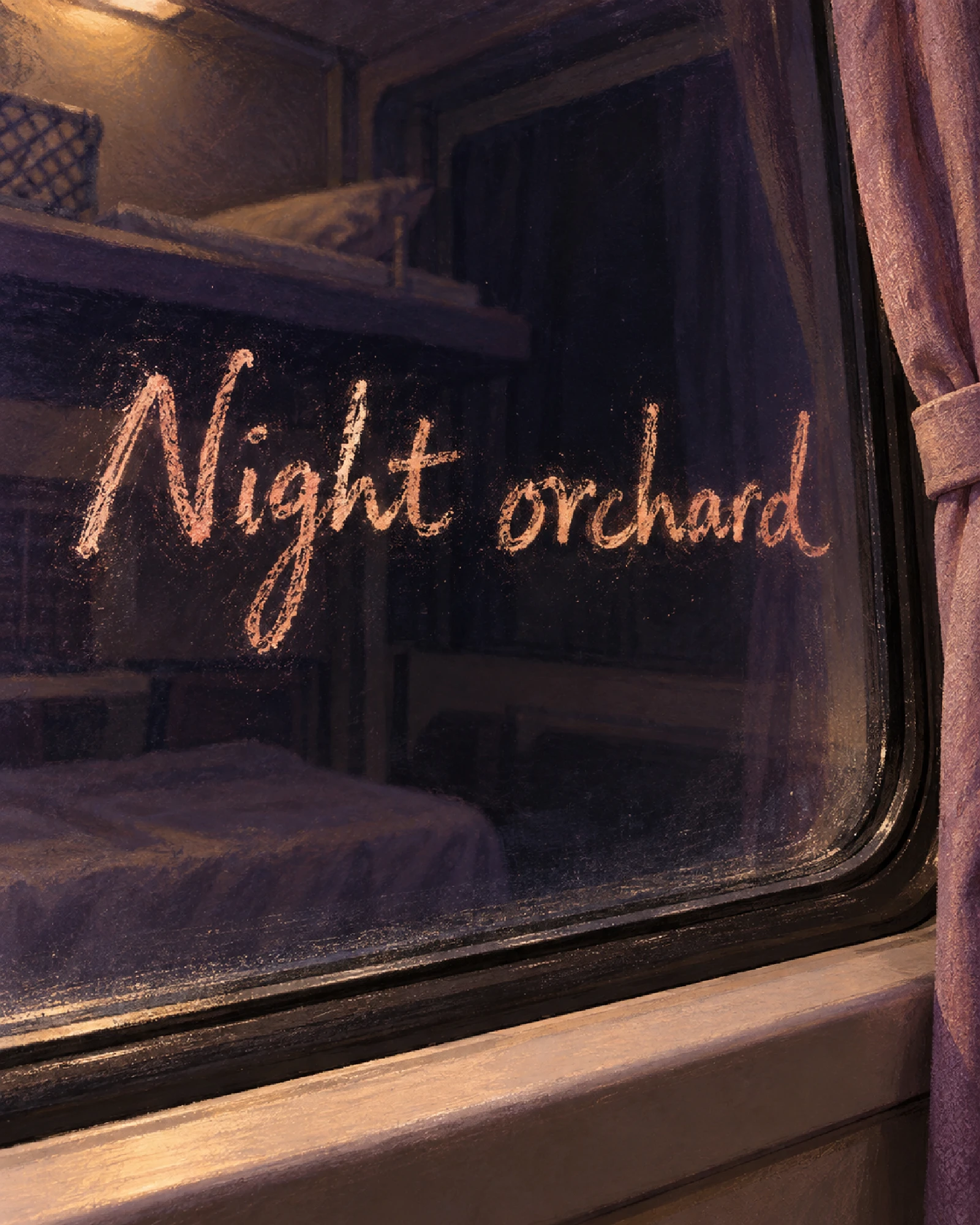
Handwriting on a Sleeper Window
Wax handwriting crosses a dark sleeper window, its looping rhythm suspended among faint reflections of the compartment.
Remix this referenceHandwriting on a Sleeper Window
- Form language
- Use relaxed handwritten forms with springy loops, brief compressed joins and generous releases; simplify surrounding forms into quiet masses.
- Contour
- Keep the lettering essentially monoline, with rounded turns and softly crumbly edges; allow modest natural variation without broad-nib contrast.
- Mark-making
- Build wax-pencil strokes from continuous passes, occasional tiny skips and slightly denser overlaps; let loop lengths vary coherently.
- Surface rendering
- Render the surroundings with rubbed translucent pastel veils and softened tonal transitions, preserving the wax lettering's tactile, granular edge.
Priority
Make lively, readable monoline handwriting the defining rendering emphasis.
What to avoid & what to check
Exact prompt for this example
MODULE OWNERSHIP
subject: Subject count, type, stable proportions and landmarks, resting face geometry, hair shape, physical materials, garment construction and permanent marks. No emotion, movement, color assignment or rendering recipe.
expression: Facial soft-tissue displacement and pupil direction, muscle coordination, regional intensity, asymmetry and onset/peak/release. No head/body pose, stable appearance, skin color or rendering.
gesture: Head/neck/body/limb orientation, joint movement, support, contact and pose-caused occlusion using existing anatomy. No eye/pupil movement, emotion, identity, props inventory or camera.
props: Prop count, type, construction, physical material and scale relative to the subject. Holding/contact belongs to gesture, position to composition, color to palette.
scene: Environment elements, terrain, backdrop/floor presence and structural detail. No canvas positions, camera, lighting, assigned colors or render texture.
camera: Projection, focal-length impression, camera elevation/yaw/roll, viewing distance and crop. No actor pose, world placement, lighting or canvas aspect ratio.
composition: Normalized 0-100% canvas positions, scale in frame, depth/overlap, focal hierarchy and margins. No joint pose, camera projection, rendering, subject/prop inventory or emotion.
palette: Color anchors, hue/saturation/value ranges, colors assigned to parts and approximate color coverage. No illumination direction, shading algorithm, physical material or layout.
lighting: Light-source direction/softness/intensity, ambient illumination, physical shadow direction/length and highlight position. Absence of directional illumination is allowed. No shading technique, palette or material changes.
style: Reusable form abstraction, contour weight/taper/edge quality, medium and mark scale/density/direction, surface rendering and tonal transition technique. No fixed subject proportions, anatomy, identity, expression, pose, palette, light-source direction, camera or layout.
output: Image count, aspect ratio, size, file/alpha requirements and global lettering/logo/watermark restrictions. No background scenery, crop, style, identity or pose.

SUBJECT
inventory: One original handwritten inscription made with a wax pencil on window glass; no figures.
geometry: Write "Night orchard" as one readable line, with a recognizable capital N, open counters and distinct word separation.
resting-face: No face or facial geometry applies.
appearance: The inscription consists of wax deposits directly on glass, without a label, backing sheet or raised lettering.

PRIORITY


AVOID


CHECK


PROPS
inventory: No separate props.
construction: No prop construction applies.

PRIORITY


AVOID


CHECK


SCENE
inventory: A sleeper compartment window, its rubber seal, a narrow sill and a gathered curtain edge.
structure: The glass reflects an empty berth and a curtain fold; the exterior offers no distinct landmarks.

PRIORITY


AVOID


CHECK


CAMERA
projection: Natural perspective with a normal-lens impression and restrained depth compression.
viewpoint: View from close inside the compartment, nearly level with the inscription and slightly oblique to the glass.
crop: An intimate detail crop cuts through the window frame and curtain while retaining every letter.

PRIORITY


AVOID


CHECK


COMPOSITION
placement: The inscription spans roughly 12–88% of the width around the upper middle; the curtain enters at the right edge.
depth: Lettering leads the hierarchy, with berth reflections receding behind it and the frame forming a near boundary.
spacing: Leave a generous interval below the words; keep reflected edges from crossing the letter counters.

PRIORITY


AVOID


CHECK


PALETTE
colors: Use deep aubergine, muted peach, smoky mauve and a restrained charcoal anchor.
assignment: Peach belongs to the handwriting, aubergine to the glass, mauve to reflections and curtain, charcoal to the seal.
balance: Dark low-saturation colors dominate; keep the glass low in value and the pale inscription in clear value contrast.

PRIORITY


AVOID


CHECK


LIGHTING
sources: Soft compartment light arrives from the upper left, with very weak ambient light beyond the window.
shadows: The curtain and seal cast short, diffuse shadows toward the lower right.
highlights: Keep berth and curtain reflections faint, with small highlights along the upper-left edges of wax deposits.

PRIORITY


AVOID


CHECK


STYLE GUIDE
form-language: Use relaxed handwritten forms with springy loops, brief compressed joins and generous releases; simplify surrounding forms into quiet masses.
contour: Keep the lettering essentially monoline, with rounded turns and softly crumbly edges; allow modest natural variation without broad-nib contrast.
mark-making: Build wax-pencil strokes from continuous passes, occasional tiny skips and slightly denser overlaps; let loop lengths vary coherently.
surface-rendering: Render the surroundings with rubbed translucent pastel veils and softened tonal transitions, preserving the wax lettering's tactile, granular edge.

PRIORITY
Make lively, readable monoline handwriting the defining rendering emphasis.

AVOID


CHECK


OUTPUT
format: One portrait image, 4:5 aspect ratio, 1600 × 2000 pixels, opaque PNG.
restrictions: Allow primary lettering; forbid additional text, logos and watermarks.

PRIORITY


AVOID


CHECK


FINAL INTEGRATION
style + lighting: Let the soft illumination remain legible through the rubbed tonal treatment without erasing the wax marks.
subject + output: The sole permitted primary lettering is "Night orchard", using the inscription defined by subject.
Model information comes from image provenance. The same prompt may produce a different result.