Text to imageCharacterStyle guide
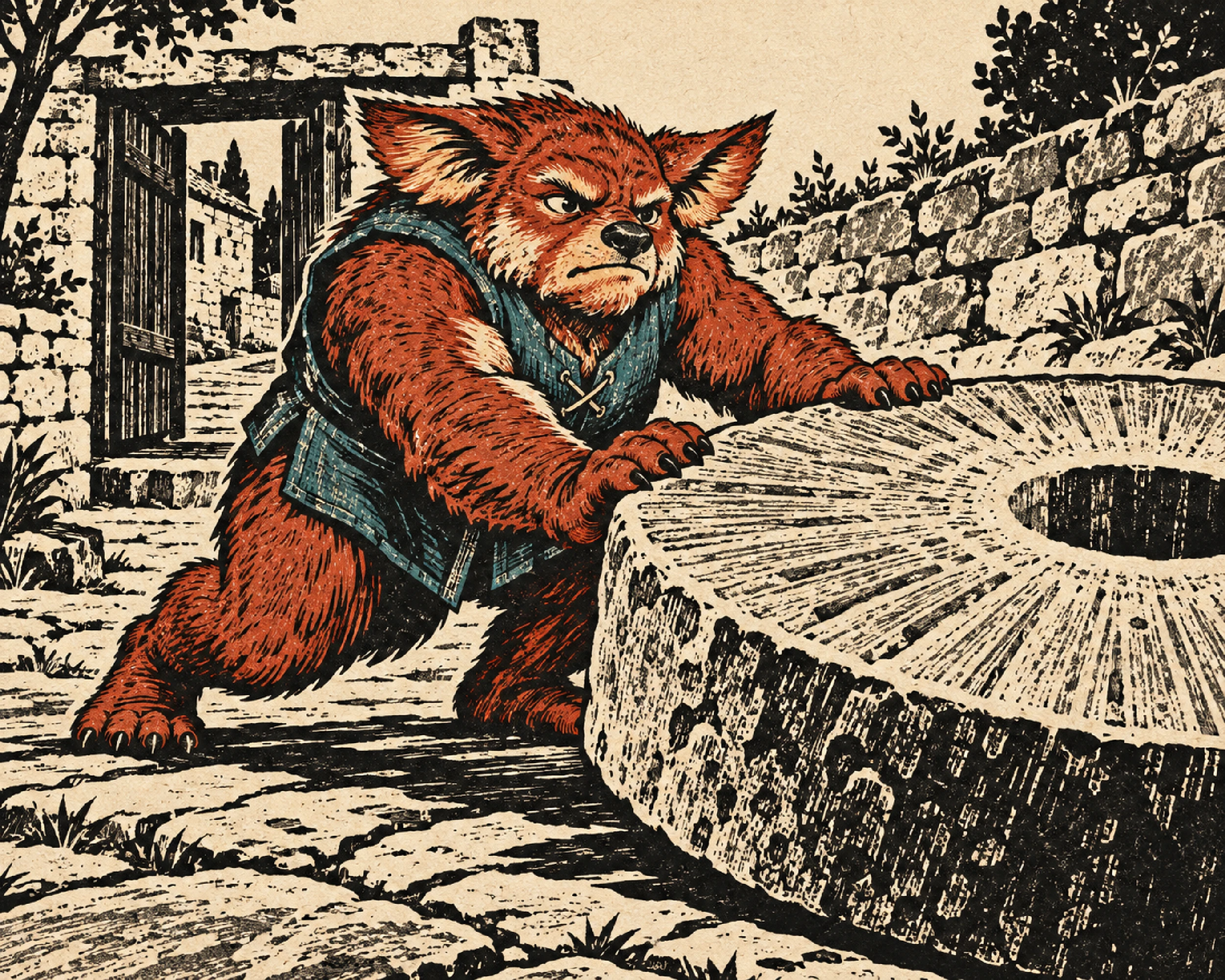
A Fan-Eared Creature Catching a Millstone
A fan-eared creature braces its whole body against a millstone in a sloping mill yard. Overlapping masses and rhythmic carved marks give the bold linocut its tension.
Remix this referenceA Fan-Eared Creature Catching a Millstone
- Form language
- Reduce forms to interlocking wedges, rounded blocks and forceful arcs; let small shapes vary within this vocabulary.
- Contour
- Use thick, slightly bitten silhouettes with abrupt carved notches and occasional broken internal edges.
- Mark-making
- Carve rhythmic gouges that bend around volumes; alternate broad cuts with irregular short teeth and quiet reserves.
- Surface rendering
- Build tone through ink masses and exposed paper cuts; retain uneven ink transfer and modest color-block misregistration.
Priority
The image must visibly read as a bold linocut with rhythmic carved marks.
What to avoid & what to check
Exact prompt for this example
MODULE OWNERSHIP
subject: Subject count, type, stable proportions and landmarks, resting face geometry, hair shape, physical materials, garment construction and permanent marks. No emotion, movement, color assignment or rendering recipe.
expression: Facial soft-tissue displacement and pupil direction, muscle coordination, regional intensity, asymmetry and onset/peak/release. No head/body pose, stable appearance, skin color or rendering.
gesture: Head/neck/body/limb orientation, joint movement, support, contact and pose-caused occlusion using existing anatomy. No eye/pupil movement, emotion, identity, props inventory or camera.
props: Prop count, type, construction, physical material and scale relative to the subject. Holding/contact belongs to gesture, position to composition, color to palette.
scene: Environment elements, terrain, backdrop/floor presence and structural detail. No canvas positions, camera, lighting, assigned colors or render texture.
camera: Projection, focal-length impression, camera elevation/yaw/roll, viewing distance and crop. No actor pose, world placement, lighting or canvas aspect ratio.
composition: Normalized 0-100% canvas positions, scale in frame, depth/overlap, focal hierarchy and margins. No joint pose, camera projection, rendering, subject/prop inventory or emotion.
palette: Color anchors, hue/saturation/value ranges, colors assigned to parts and approximate color coverage. No illumination direction, shading algorithm, physical material or layout.
lighting: Light-source direction/softness/intensity, ambient illumination, physical shadow direction/length and highlight position. Absence of directional illumination is allowed. No shading technique, palette or material changes.
style: Reusable form abstraction, contour weight/taper/edge quality, medium and mark scale/density/direction, surface rendering and tonal transition technique. No fixed subject proportions, anatomy, identity, expression, pose, palette, light-source direction, camera or layout.
output: Image count, aspect ratio, size, file/alpha requirements and global lettering/logo/watermark restrictions. No background scenery, crop, style, identity or pose.

SUBJECT
inventory: One original adult fantasy creature, actor A, with a furred body and humanlike limbs.
geometry: A barrel torso, short sturdy legs, broad hands, trapezoid head and two fan-shaped ears define the build.
resting-face: A low broad muzzle sits beneath widely spaced eyes; a blunt nose and thick lower lip anchor the face.
appearance: Coarse cheek tufts frame the face; a sleeveless woven vest has a simple overlapping front.

PRIORITY


AVOID


CHECK


EXPRESSION — ACTOR A
brows: Inner brow ends draw down and inward, with one slightly lower.
lids: Upper lids narrow while lower lids tighten against the eyes.
cheeks: Cheeks bunch slightly toward the nose without a smile lift.
nose: Nostrils widen subtly under sustained effort.
mouth: Lips press together, with one corner drawn sideways.
jaw: The jaw closes firmly, making the lower face compact.
gaze: Pupils aim toward the millstone's upper rim.
coordination: Brow compression and lip pressure carry effort without an angry snarl.
timing: Capture the apex of effort, with facial tension fully gathered.

PRIORITY


AVOID


CHECK


GESTURE
head: The neck extends forward and the chin tucks slightly toward the chest.
torso: The torso leans into the stone with a rounded, weight-bearing back.
limbs: One knee bears weight on the ground; the opposite foot braces behind as both elbows remain bent.
contact: Both palms press the upper rim; the stone hides part of the nearer forearm and lower torso.

PRIORITY


AVOID


CHECK


PROPS
inventory: One millstone, with a diameter roughly matching the creature's hip-to-shoulder length.
construction: The thick stone disk has a central bore, a worn rim and shallow radial dressing grooves.

PRIORITY


AVOID


CHECK


SCENE
inventory: A sloping outdoor mill yard contains a stone paving surface, a low retaining wall and an open gateway.
structure: Uneven paving meets a broken threshold; the gateway suggests a narrow passage beyond.

PRIORITY


AVOID


CHECK


CAMERA
projection: Use a natural perspective with a moderately wide lens impression.
viewpoint: View obliquely across the yard from just below the creature's eye level, with no roll.
crop: Show the complete figure and millstone with enough surrounding yard to establish the encounter.

PRIORITY


AVOID


CHECK


COMPOSITION
placement: Place the face near 36% width and 30% height; let the millstone occupy the lower-right region.
depth: The stone overlaps the figure, which overlaps the gateway; the face leads, followed by the hands and rim.
spacing: Keep an open wedge above the stone and breathing room around the ears; compress the lower overlaps.

PRIORITY


AVOID


CHECK


PALETTE
colors: Use soot black, warm paper cream, brick red and a restrained dull teal.
assignment: Give the fur brick red, the vest dull teal, and the stone and architecture black-and-cream contrasts.
balance: Black and cream dominate; red carries the largest chromatic mass and teal remains a small counterpoint.

PRIORITY


AVOID


CHECK


LIGHTING
sources: Broad daylight enters from the upper left with moderate strength and a soft edge.
shadows: Short shadows fall to the lower right, deepening where palms and knee meet their supports.
highlights: The upper-left ear edges, muzzle bridge and stone rim receive the clearest highlights.

PRIORITY


AVOID


CHECK


STYLE GUIDE
form-language: Reduce forms to interlocking wedges, rounded blocks and forceful arcs; let small shapes vary within this vocabulary.
contour: Use thick, slightly bitten silhouettes with abrupt carved notches and occasional broken internal edges.
mark-making: Carve rhythmic gouges that bend around volumes; alternate broad cuts with irregular short teeth and quiet reserves.
surface-rendering: Build tone through ink masses and exposed paper cuts; retain uneven ink transfer and modest color-block misregistration.

PRIORITY
The image must visibly read as a bold linocut with rhythmic carved marks.

AVOID


CHECK


OUTPUT
format: One finished image, landscape 5:4, 2500 × 2000 pixels, PNG with an opaque background.
restrictions: No lettering, logos, signatures or watermarks.

PRIORITY


AVOID


CHECK


FINAL INTEGRATION
gesture + composition: Use the contact-driven overlaps to connect the action while keeping its essential silhouette readable.
lighting + style: Translate the established illumination into the print's carved tonal vocabulary.
Model information comes from image provenance. The same prompt may produce a different result.