Text to imagePortraitStyle guide
Weaver Between the Warp Threads
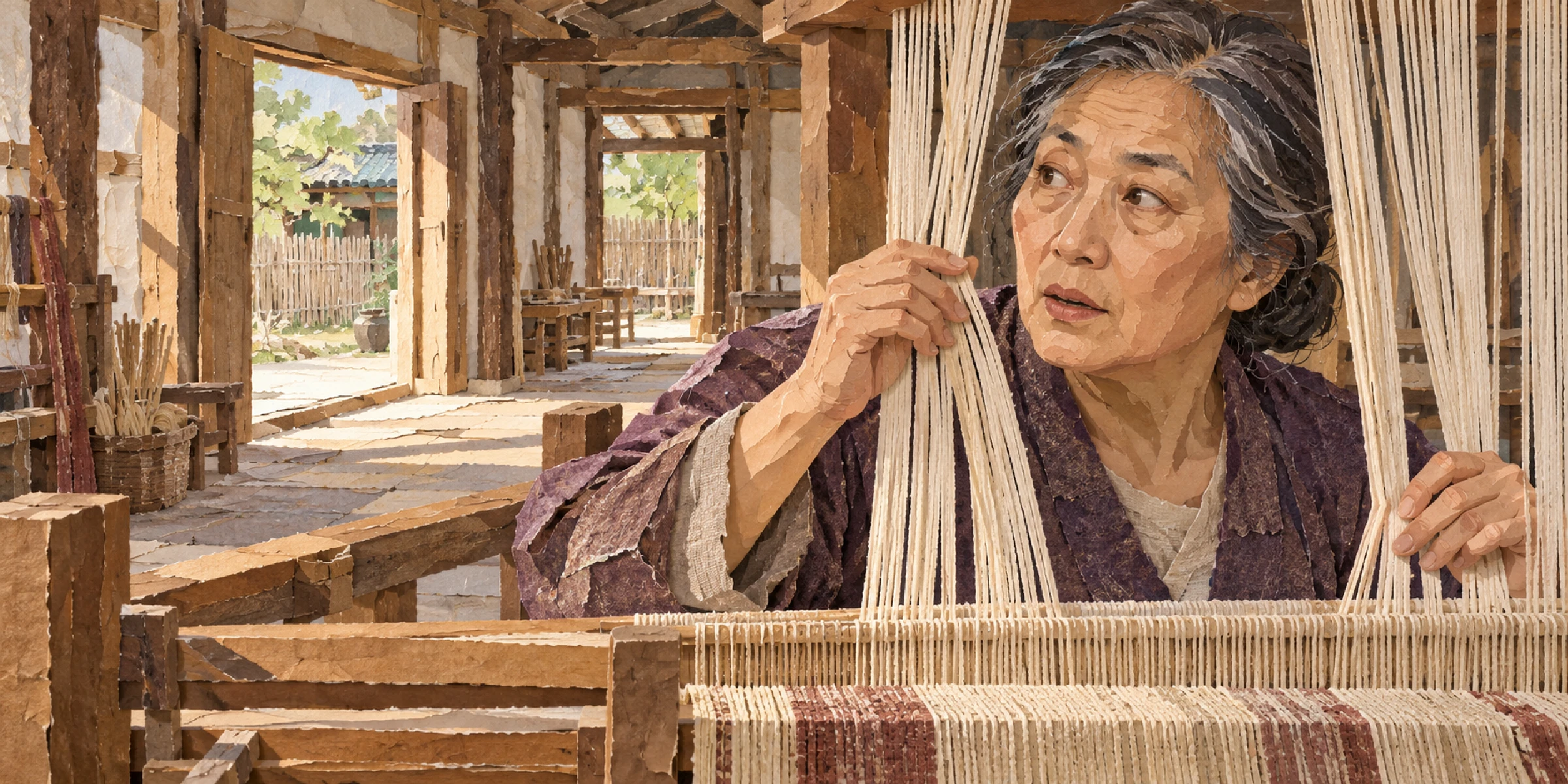
A tactile paper-collage portrait leads from a weaver parting the warp threads through a long workshop into a reed-fenced courtyard.
Remix this referenceWeaver Between the Warp Threads
- Form language
- Build forms from overlapping cut-paper masses, using broad planes for volume and narrow strips for linear structures.
- Contour
- Let scissor-cut edges alternate with occasional torn edges; small irregularities replace a uniform enclosing outline.
- Mark-making
- Sparse rubbed pigment and broad dry-brush sweeps remain visible within the paper pieces; their placement may vary naturally.
- Surface rendering
- Visible paper thickness, lifted corners and nested value shapes create tactile relief; retain occasional translucent tissue overlaps.
Priority
Make actual-looking layered paper edges the defining surface event.
What to avoid & what to check
Exact prompt for this example
MODULE OWNERSHIP
subject: Subject count, type, stable proportions and landmarks, resting face geometry, hair shape, physical materials, garment construction and permanent marks. No emotion, movement, color assignment or rendering recipe.
expression: Facial soft-tissue displacement and pupil direction, muscle coordination, regional intensity, asymmetry and onset/peak/release. No head/body pose, stable appearance, skin color or rendering.
gesture: Head/neck/body/limb orientation, joint movement, support, contact and pose-caused occlusion using existing anatomy. No eye/pupil movement, emotion, identity, props inventory or camera.
props: Prop count, type, construction, physical material and scale relative to the subject. Holding/contact belongs to gesture, position to composition, color to palette.
scene: Environment elements, terrain, backdrop/floor presence and structural detail. No canvas positions, camera, lighting, assigned colors or render texture.
camera: Projection, focal-length impression, camera elevation/yaw/roll, viewing distance and crop. No actor pose, world placement, lighting or canvas aspect ratio.
composition: Normalized 0-100% canvas positions, scale in frame, depth/overlap, focal hierarchy and margins. No joint pose, camera projection, rendering, subject/prop inventory or emotion.
palette: Color anchors, hue/saturation/value ranges, colors assigned to parts and approximate color coverage. No illumination direction, shading algorithm, physical material or layout.
lighting: Light-source direction/softness/intensity, ambient illumination, physical shadow direction/length and highlight position. Absence of directional illumination is allowed. No shading technique, palette or material changes.
style: Reusable form abstraction, contour weight/taper/edge quality, medium and mark scale/density/direction, surface rendering and tonal transition technique. No fixed subject proportions, anatomy, identity, expression, pose, palette, light-source direction, camera or layout.
output: Image count, aspect ratio, size, file/alpha requirements and global lettering/logo/watermark restrictions. No background scenery, crop, style, identity or pose.

SUBJECT
inventory: One older adult woman, actor A, with no other people.
geometry: An elongated oval face, prominent straight nose, broad hands and a compact, sturdy build.
resting-face: Deep-set eyes, gently arched brows, a broad upper lip and permanent folds beside the mouth.
appearance: Hair gathered into a compact low coil; a collarless linen jacket with overlapping fronts and loose sleeves.

PRIORITY


AVOID


CHECK


EXPRESSION — ACTOR A
brows: One brow rises slightly more than the other, without a central furrow.
lids: Upper lids lift modestly; lower lids remain loose.
cheeks: Cheeks remain relaxed, with no smile-driven lift.
nose: The nose remains unwrinkled and the nostrils unflared.
mouth: Lips separate softly, with neither corner pulled outward.
jaw: The jaw releases just enough to leave a narrow mouth opening.
gaze: Pupils turn left.
coordination: The unequal brow lift leads the expression while the lower face stays quiet.
timing: Catch the onset of recognition, before a smile develops.

PRIORITY


AVOID


CHECK


GESTURE
head: Her neck extends gently and her head turns left into the opening between the threads.
torso: The upper torso inclines forward slightly, with one shoulder nearer the loom.
limbs: One elbow rises beside her cheek; the other arm reaches lower, creating unequal hand heights.
contact: Her fingertips separate two bundles of warp, leaving both eyes and the mouth unobstructed.

PRIORITY


AVOID


CHECK


PROPS
inventory: One working handloom, wider than her shoulders, with a partly woven textile and exposed warp.
construction: A substantial timber frame supports parallel cotton warp and a thick cloth beam.

PRIORITY


AVOID


CHECK


SCENE
inventory: A long weaving workshop with timber flooring, open doorways and a reed-fenced courtyard.
structure: Successive door openings connect the working hall to a covered passage and the open courtyard beyond.

PRIORITY


AVOID


CHECK


CAMERA
projection: Natural perspective with a normal-lens impression and restrained near-to-far enlargement.
viewpoint: Eye-height view obliquely across the loom, with a level horizon and no roll.
crop: A chest-up environmental portrait; retain both hands while cropping the lower loom.

PRIORITY


AVOID


CHECK


COMPOSITION
placement: The large face occupies the right third; the workshop opens generously across the left two-thirds.
depth: Foreground threads overlap the hands; staggered doorways carry the eye from the face toward the distant yard.
spacing: The face leads, the threads follow, and the courtyard provides a spacious final pause.

PRIORITY


AVOID


CHECK


PALETTE
colors: Chalk cream, smoky aubergine, burnt sienna and muted celery green form a restrained warm-cool palette.
assignment: Warm sienna skin, aubergine jacket, cream warp and celery courtyard; timber shares the sienna family.
balance: Cream and muted middle values dominate; aubergine supplies compact dark anchors.

PRIORITY


AVOID


CHECK


LIGHTING
sources: Broad, soft daylight enters from the left, supported by gentle indoor ambient light.
shadows: Soft shadows fall rightward from the face, fingers and loom posts; thread shadows remain delicate.
highlights: Quiet highlights touch the left cheek, fingertips and left-facing edges of the posts.

PRIORITY


AVOID


CHECK


STYLE GUIDE
form-language: Build forms from overlapping cut-paper masses, using broad planes for volume and narrow strips for linear structures.
contour: Let scissor-cut edges alternate with occasional torn edges; small irregularities replace a uniform enclosing outline.
mark-making: Sparse rubbed pigment and broad dry-brush sweeps remain visible within the paper pieces; their placement may vary naturally.
surface-rendering: Visible paper thickness, lifted corners and nested value shapes create tactile relief; retain occasional translucent tissue overlaps.

PRIORITY
Make actual-looking layered paper edges the defining surface event.

AVOID


CHECK


OUTPUT
format: One finished image, panoramic 2:1 aspect ratio, 2400 × 1200 pixels, opaque PNG.
restrictions: No lettering, logos or watermarks.

PRIORITY


AVOID


CHECK


FINAL INTEGRATION
scene + composition + lighting: Coordinate the courtyard opening with the incoming daylight so the courtyard supplies the prescribed illumination.
Model information comes from image provenance. The same prompt may produce a different result.