Text to imageArt stylesStyle guide
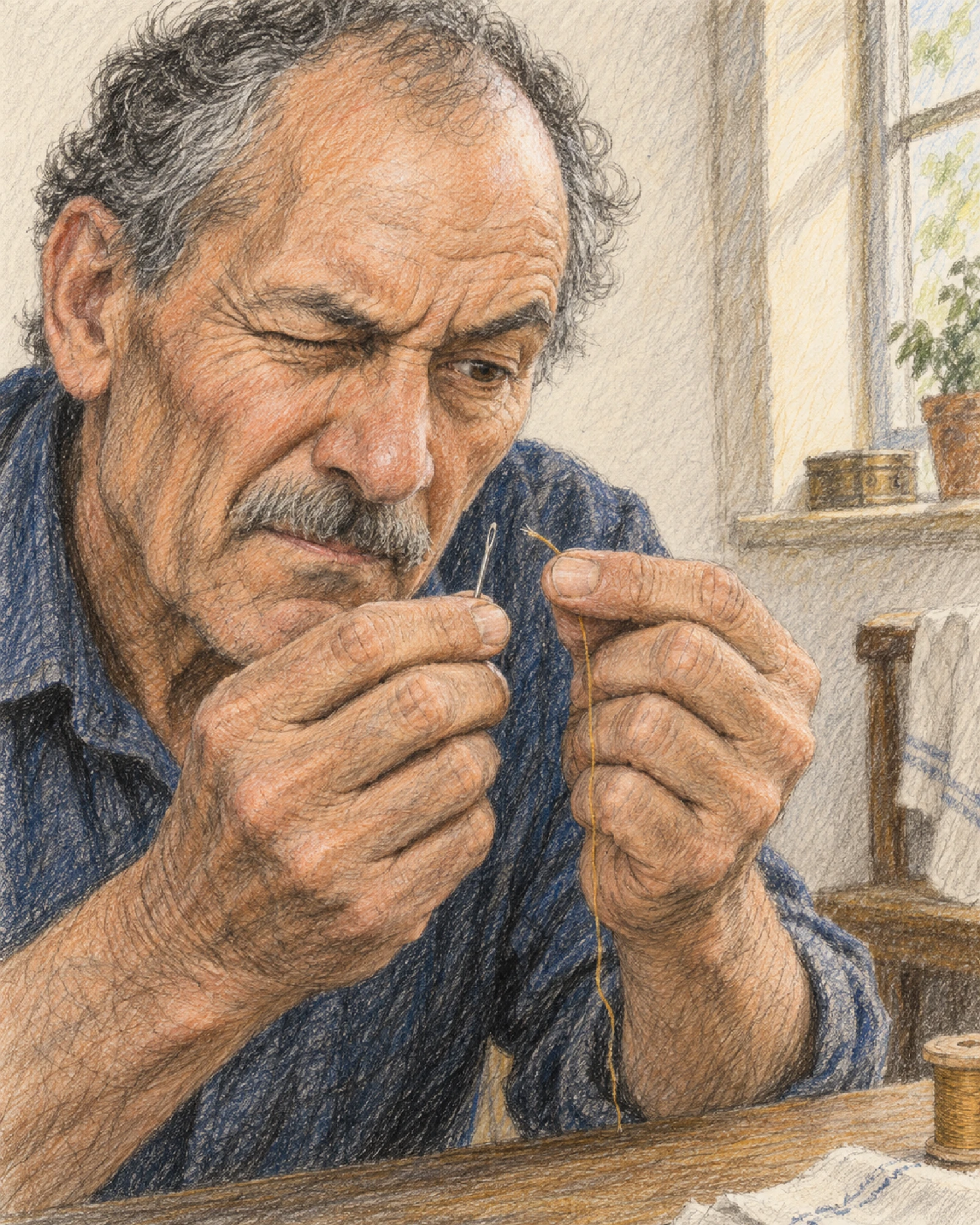
Man Threading a Needle
An intimate glimpse of an older man closing one eye as he guides thread toward a needle. Searching pencil lines and loose colored-pencil layers give his concentrated face and hands a vivid sketchbook presence.
Remix this referenceMan Threading a Needle
- Form language
- Simplify volumes into overlapping rounded masses and a few angular planes; let minor shapes vary within an observational sketch language.
- Contour
- Use searching graphite contours with uneven pressure, broken edges and occasional doubled lines; tighten only selected junctions.
- Mark-making
- Build colored-pencil passages from loose, changing-length strokes that follow surfaces; allow stray strokes and graphite to remain visible.
- Surface rendering
- Let paper tooth break the pigment; deepen tones through overlapping hatching and light graphite rubbing, leaving luminous passages partly bare.
Priority
Preserve the visibly rough pencil and colored-pencil sketchbook treatment throughout.
What to avoid & what to check
Exact prompt for this example
MODULE OWNERSHIP
subject: Subject count, type, stable proportions and landmarks, resting face geometry, hair shape, physical materials, garment construction and permanent marks. No emotion, movement, color assignment or rendering recipe.
expression: Facial soft-tissue displacement and pupil direction, muscle coordination, regional intensity, asymmetry and onset/peak/release. No head/body pose, stable appearance, skin color or rendering.
gesture: Head/neck/body/limb orientation, joint movement, support, contact and pose-caused occlusion using existing anatomy. No eye/pupil movement, emotion, identity, props inventory or camera.
props: Prop count, type, construction, physical material and scale relative to the subject. Holding/contact belongs to gesture, position to composition, color to palette.
scene: Environment elements, terrain, backdrop/floor presence and structural detail. No canvas positions, camera, lighting, assigned colors or render texture.
camera: Projection, focal-length impression, camera elevation/yaw/roll, viewing distance and crop. No actor pose, world placement, lighting or canvas aspect ratio.
composition: Normalized 0-100% canvas positions, scale in frame, depth/overlap, focal hierarchy and margins. No joint pose, camera projection, rendering, subject/prop inventory or emotion.
palette: Color anchors, hue/saturation/value ranges, colors assigned to parts and approximate color coverage. No illumination direction, shading algorithm, physical material or layout.
lighting: Light-source direction/softness/intensity, ambient illumination, physical shadow direction/length and highlight position. Absence of directional illumination is allowed. No shading technique, palette or material changes.
style: Reusable form abstraction, contour weight/taper/edge quality, medium and mark scale/density/direction, surface rendering and tonal transition technique. No fixed subject proportions, anatomy, identity, expression, pose, palette, light-source direction, camera or layout.
output: Image count, aspect ratio, size, file/alpha requirements and global lettering/logo/watermark restrictions. No background scenery, crop, style, identity or pose.

SUBJECT
inventory: A is one older adult man with natural human skin, hair and nails.
geometry: A long face, prominent cheekbones, a broad nose and substantial, work-worn hands define his construction.
resting-face: At rest, the lips meet evenly, the eyelids sit naturally and shallow folds frame the mouth.
appearance: Receding short curls, a small moustache and a woven shirt with a turned collar and rolled cuffs.

PRIORITY


AVOID


CHECK


EXPRESSION — ACTOR A
brows: The brow above the open eye draws slightly inward; the other remains looser.
lids: One eye closes deliberately; the working eye narrows without shutting.
cheeks: A small cheek lift supports the closed eye; the opposite cheek stays relaxed.
nose: The nose remains relaxed, without wrinkling or nostril flare.
mouth: Closed lips press lightly together, with one corner tucked subtly inward.
jaw: The jaw stays gently set, without a visible clench.
gaze: The visible pupil fixes on the needle's eye.
coordination: The asymmetric eye effort leads; mouth tension remains quieter.
timing: Hold the facial apex of asymmetric eye effort and mild lip tension.

PRIORITY


AVOID


CHECK


GESTURE
head: The head dips toward the hands, with the neck gently inclined forward.
torso: The seated torso bends slightly forward while the shoulders remain loose.
limbs: Both forearms rise near the face; bent elbows stay close and the wrists make small opposing turns.
contact: Fingertips gather close: one thumb and fingertip steady the needle; the opposite fingertips pinch the thread end just short of the eye.

PRIORITY


AVOID


CHECK


PROPS
inventory: One sewing needle and one loose length of thread, both at ordinary handwork scale.
construction: The slender steel needle has a small elongated eye; the cotton thread has a softly frayed end.

PRIORITY


AVOID


CHECK


SCENE
inventory: A modest sewing nook with a wooden table, a recessed window and a plain plaster wall.
structure: Only fragments of the continuous tabletop and deep window reveal establish the room.

PRIORITY


AVOID


CHECK


CAMERA
projection: Natural perspective with a mild portrait-lens impression.
viewpoint: Close viewing distance, eye-level elevation and a slight three-quarter yaw; no roll.
crop: Crop through the crown and below the upper chest, retaining both working hands.

PRIORITY


AVOID


CHECK


COMPOSITION
placement: The face fills the left half; the needle and fingertips occupy the lower middle.
depth: The hands overlap the lower face in front of the room; the thread-to-eye gap leads, followed by the eye region.
spacing: Leave an open wedge at upper right and breathing room around the tiny threading gap.

PRIORITY


AVOID


CHECK


PALETTE
colors: Warm ivory, graphite gray, muted indigo, skin peach and a small ochre accent.
assignment: Ivory paper and wall, peach skin, gray hair and needle, indigo shirt, ochre thread and table.
balance: Ivory dominates; peach and indigo remain subdued, with ochre used sparingly.

PRIORITY


AVOID


CHECK


LIGHTING
sources: Broad, soft window daylight enters from upper left, with gentle room ambient light.
shadows: Soft shadows fall down and right beneath the nose, fingertips and collar.
highlights: Restrained highlights touch the upper-left cheek, finger ridges and needle edge.

PRIORITY


AVOID


CHECK


STYLE GUIDE
form-language: Simplify volumes into overlapping rounded masses and a few angular planes; let minor shapes vary within an observational sketch language.
contour: Use searching graphite contours with uneven pressure, broken edges and occasional doubled lines; tighten only selected junctions.
mark-making: Build colored-pencil passages from loose, changing-length strokes that follow surfaces; allow stray strokes and graphite to remain visible.
surface-rendering: Let paper tooth break the pigment; deepen tones through overlapping hatching and light graphite rubbing, leaving luminous passages partly bare.

PRIORITY
Preserve the visibly rough pencil and colored-pencil sketchbook treatment throughout.

AVOID


CHECK


OUTPUT
format: One finished illustration, portrait 4:5, 1600 × 2000 pixels, opaque PNG.
restrictions: No lettering, logos or watermarks.

PRIORITY


AVOID


CHECK
Model information comes from image provenance. The same prompt may produce a different result.