Text to imageCharacterStyle guide
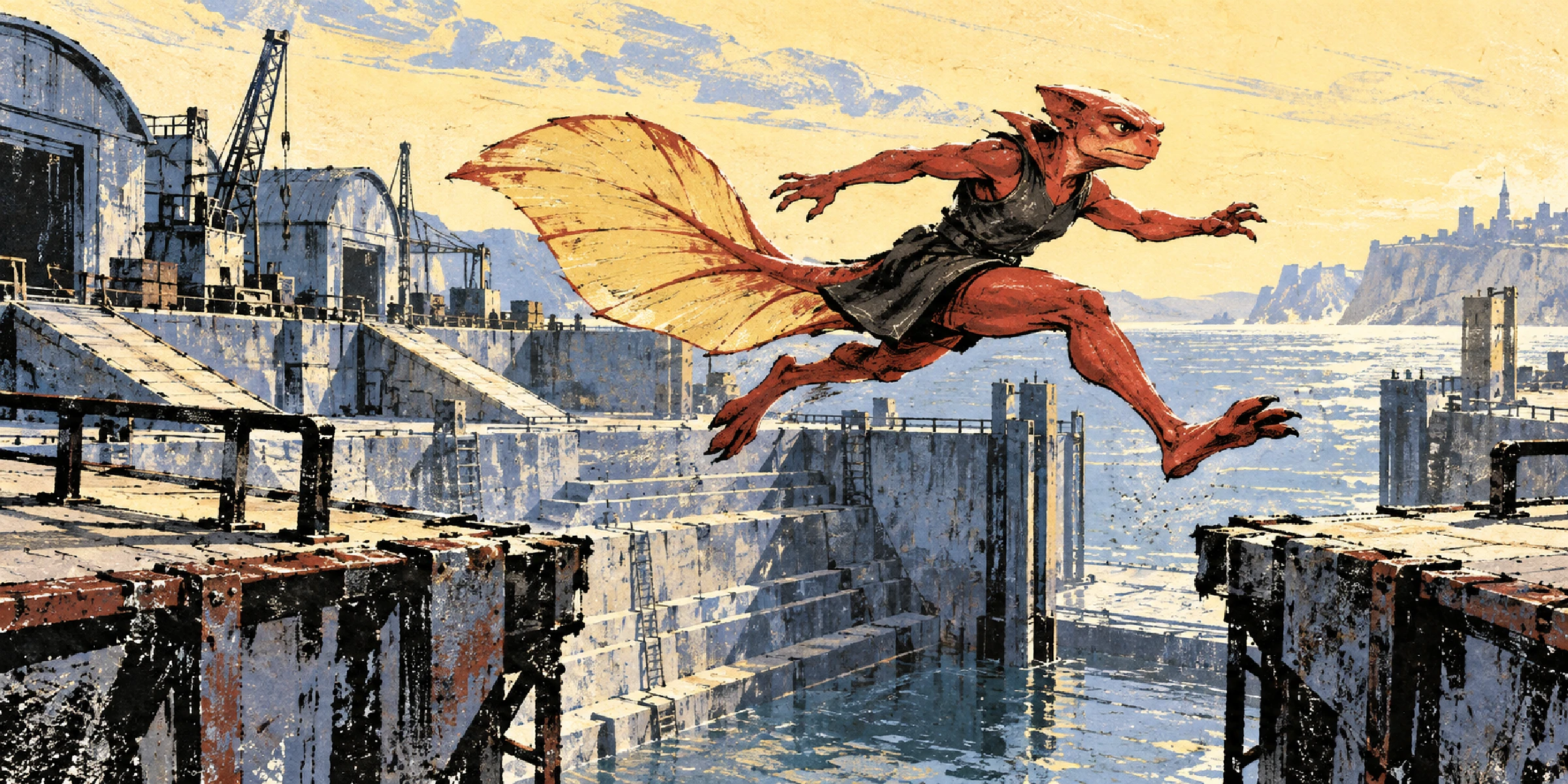
Sail-Tailed Creature Leaping the Drydock
A broad sail-tailed creature jumps a break in a maintenance walkway. Rough ink and offset printed planes animate a panorama leading from dock workshops to the open sea.
Remix this referenceSail-Tailed Creature Leaping the Drydock
- Form language
- Reduce forms to elastic ink silhouettes and interlocking printed slabs; allow angular cuts to interrupt broad curves without fragmenting the whole.
- Contour
- Alternate swollen brush edges, dry skips and abrupt carved-looking cuts; contours may disappear where adjacent printed masses meet.
- Mark-making
- Combine dragged ink streaks with sparse roller scuffs and uneven stamp impressions; vary pressure and mark length rather than repeating a texture.
- Surface rendering
- Build tone with translucent overprinting, broken opaque deposits and selective registration slips; retain exposed paper and irregular ink pooling.
Priority
Make the experimental ink-and-print process visibly active through pressure changes and imperfect overprinting.
What to avoid & what to check
Exact prompt for this example
MODULE OWNERSHIP
subject: Subject count, type, stable proportions and landmarks, resting face geometry, hair shape, physical materials, garment construction and permanent marks. No emotion, movement, color assignment or rendering recipe.
expression: Facial soft-tissue displacement and pupil direction, muscle coordination, regional intensity, asymmetry and onset/peak/release. No head/body pose, stable appearance, skin color or rendering.
gesture: Head/neck/body/limb orientation, joint movement, support, contact and pose-caused occlusion using existing anatomy. No eye/pupil movement, emotion, identity, props inventory or camera.
props: Prop count, type, construction, physical material and scale relative to the subject. Holding/contact belongs to gesture, position to composition, color to palette.
scene: Environment elements, terrain, backdrop/floor presence and structural detail. No canvas positions, camera, lighting, assigned colors or render texture.
camera: Projection, focal-length impression, camera elevation/yaw/roll, viewing distance and crop. No actor pose, world placement, lighting or canvas aspect ratio.
composition: Normalized 0-100% canvas positions, scale in frame, depth/overlap, focal hierarchy and margins. No joint pose, camera projection, rendering, subject/prop inventory or emotion.
palette: Color anchors, hue/saturation/value ranges, colors assigned to parts and approximate color coverage. No illumination direction, shading algorithm, physical material or layout.
lighting: Light-source direction/softness/intensity, ambient illumination, physical shadow direction/length and highlight position. Absence of directional illumination is allowed. No shading technique, palette or material changes.
style: Reusable form abstraction, contour weight/taper/edge quality, medium and mark scale/density/direction, surface rendering and tonal transition technique. No fixed subject proportions, anatomy, identity, expression, pose, palette, light-source direction, camera or layout.
output: Image count, aspect ratio, size, file/alpha requirements and global lettering/logo/watermark restrictions. No background scenery, crop, style, identity or pose.

SUBJECT
inventory: A is one original bipedal creature with a broad, sail-shaped tail.
geometry: Give it a pear-shaped torso, long shins, broad split feet and a wedge-shaped head; the tail ends in a leaflike membrane.
resting-face: Its face has low brow ridges, forward-set eyes, a blunt nasal pad and a wide mouth beneath small cheek pouches.
appearance: Leathery skin meets a thin tail membrane; a woven sleeveless tunic has a side opening for the tail. Minor folds may vary.

PRIORITY


AVOID


CHECK


EXPRESSION — ACTOR A
brows: Brow ridges draw inward with a shallow central crease.
lids: Upper lids lower slightly; lower lids stay firm rather than squeezed.
cheeks: Cheek pouches remain uninflated with slight tension beside the mouth.
nose: The nasal pad stays smooth, with a small opening of the nostrils.
mouth: Press the lips together, slightly tighter at one corner.
jaw: The jaw is closed and lightly braced.
gaze: Direct both pupils toward the landing ledge.
coordination: Concentrate effort around brows and lids; keep the lower face comparatively restrained.
timing: Hold the peak of focused tension before the lips and brows release.

PRIORITY


AVOID


CHECK


GESTURE
head: A extends its neck slightly and angles its head toward the landing.
torso: The torso pitches forward through the jump while the tail opens in a broad counterbalancing sweep.
limbs: One leg reaches ahead with an open foot; the trailing knee folds back and the arms spread unequally.
contact: Both feet are airborne between the broken walkway ends; keep the leading foot visibly short of contact.

PRIORITY


AVOID


CHECK


PROPS
inventory: No separate props.
construction: No prop construction applies.

PRIORITY


AVOID


CHECK


SCENE
inventory: An empty coastal drydock includes stepped basin walls, a broken maintenance walkway, workshops and an estuary opening.
structure: Service ramps link the workshops to the recessed basin; dock gates open toward tidal water and the sea.

PRIORITY


AVOID


CHECK


CAMERA
projection: Use broad perspective with a moderate wide-angle impression and little edge distortion.
viewpoint: Look slightly downward across the basin, oblique to the walkway, with a level horizon.
crop: Use a panoramic full-body view retaining the complete tail and the surrounding dock route.

PRIORITY


AVOID


CHECK


COMPOSITION
placement: A occupies the right-center at a generous scale; workshops begin the journey at far left and the sea opens at far right.
depth: Overlapping ramps lead into the basin and toward A; A's silhouette is primary, the broken crossing secondary.
spacing: Leave clear air around the head and tail, a visible landing gap, and broad breathing room over the distant water.

PRIORITY


AVOID


CHECK


PALETTE
colors: Use carbon black, oxidized red, pale butter yellow and muted periwinkle.
assignment: Give A red skin, a butter-yellow tail and black tunic; use periwinkle for dock planes and butter yellow for sky.
balance: Keep the broad environment pale and subdued, with red concentrated on A and black punctuating structural accents.

PRIORITY


AVOID


CHECK


LIGHTING
sources: Broad daylight comes from upper right through thin cloud, supported by open ambient light.
shadows: Loose-edged shadows extend left beneath ledges; A casts a detached shadow onto the basin wall below.
highlights: Favor the upper-right head ridge, shoulder and tail rim with broad, modest highlights.

PRIORITY


AVOID


CHECK


STYLE GUIDE
form-language: Reduce forms to elastic ink silhouettes and interlocking printed slabs; allow angular cuts to interrupt broad curves without fragmenting the whole.
contour: Alternate swollen brush edges, dry skips and abrupt carved-looking cuts; contours may disappear where adjacent printed masses meet.
mark-making: Combine dragged ink streaks with sparse roller scuffs and uneven stamp impressions; vary pressure and mark length rather than repeating a texture.
surface-rendering: Build tone with translucent overprinting, broken opaque deposits and selective registration slips; retain exposed paper and irregular ink pooling.

PRIORITY
Make the experimental ink-and-print process visibly active through pressure changes and imperfect overprinting.

AVOID


CHECK


OUTPUT
format: Deliver one opaque image, 2:1 aspect ratio, 2400 × 1200 pixels.
restrictions: No lettering, logos, watermarks or poster typography.

PRIORITY


AVOID


CHECK


FINAL INTEGRATION
gesture + composition + scene: The jump interrupts the environmental journey while the dock route gives the action a readable destination.
expression + style: Reserve enough clarity within the rough printing for the controlled facial effort to survive.
Model information comes from image provenance. The same prompt may produce a different result.