Text to imageArt stylesStyle guide
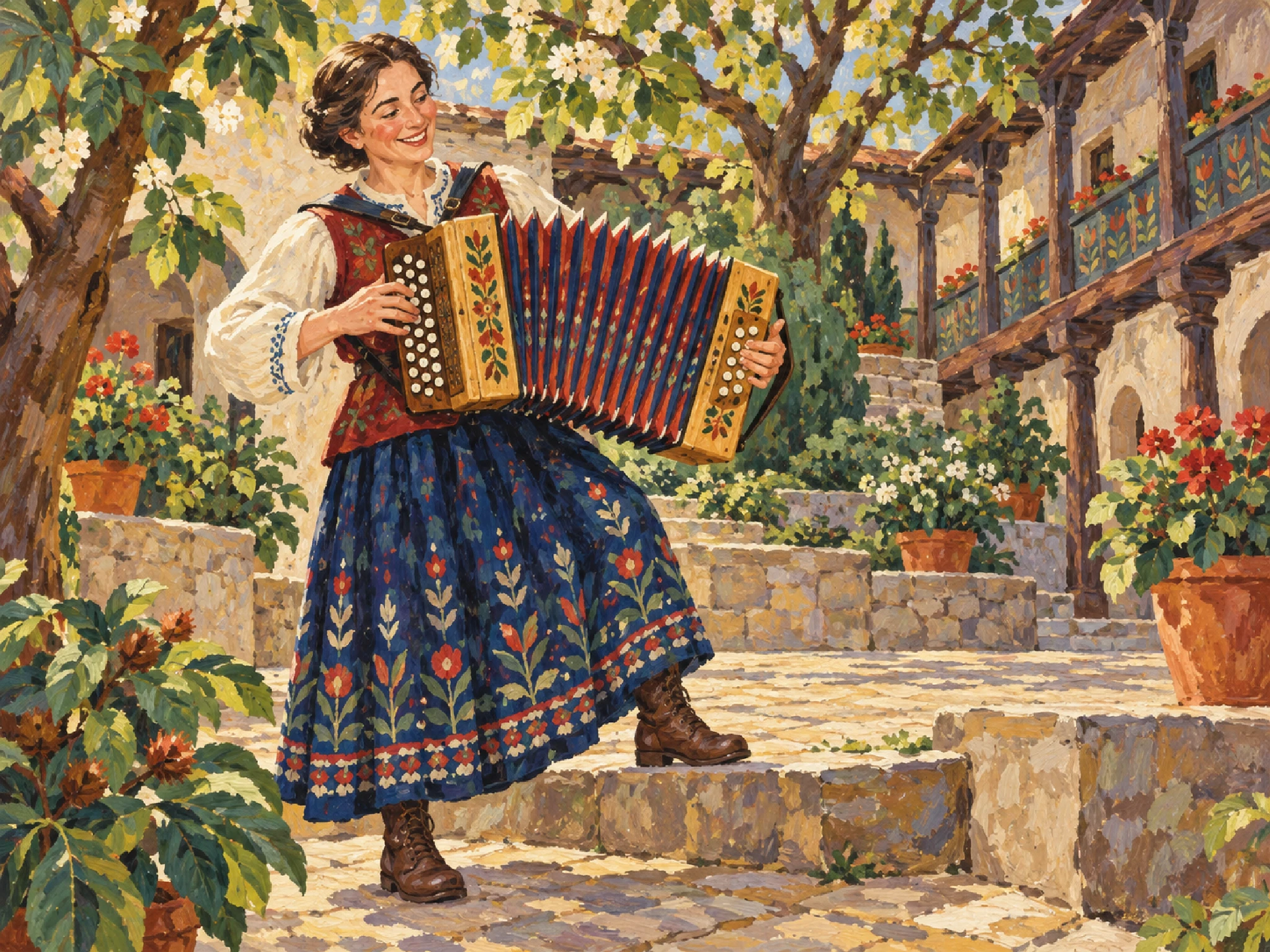
Accordion Player in the Chestnut Courtyard
An accordion player opens the bellows among chestnut branches and layered galleries. Uneven brush contours and decorative leaf rhythms give this folk painting a musical pulse.
Remix this referenceAccordion Player in the Chestnut Courtyard
- Form language
- Simplify forms into rounded masses and playful decorative repeats; retain recognizable construction while allowing intuitive distortions.
- Contour
- Brush contours wobble and change weight with pressure; occasionally merge an edge into the neighboring painted shape.
- Mark-making
- Use comma dabs, petal loops and scalloped strokes with uneven spacing; small motifs may vary within the same handmade vocabulary.
- Surface rendering
- Opaque tempera-like layers show dry-brushed underpainting and occasional corrections; overlapping tonal patches build gentle volume.
Priority
Keep lively decorative simplification and irregular brushwork central to the folk-painting treatment
What to avoid & what to check
Exact prompt for this example
MODULE OWNERSHIP
subject: Subject count, type, stable proportions and landmarks, resting face geometry, hair shape, physical materials, garment construction and permanent marks. No emotion, movement, color assignment or rendering recipe.
expression: Facial soft-tissue displacement and pupil direction, muscle coordination, regional intensity, asymmetry and onset/peak/release. No head/body pose, stable appearance, skin color or rendering.
gesture: Head/neck/body/limb orientation, joint movement, support, contact and pose-caused occlusion using existing anatomy. No eye/pupil movement, emotion, identity, props inventory or camera.
props: Prop count, type, construction, physical material and scale relative to the subject. Holding/contact belongs to gesture, position to composition, color to palette.
scene: Environment elements, terrain, backdrop/floor presence and structural detail. No canvas positions, camera, lighting, assigned colors or render texture.
camera: Projection, focal-length impression, camera elevation/yaw/roll, viewing distance and crop. No actor pose, world placement, lighting or canvas aspect ratio.
composition: Normalized 0-100% canvas positions, scale in frame, depth/overlap, focal hierarchy and margins. No joint pose, camera projection, rendering, subject/prop inventory or emotion.
palette: Color anchors, hue/saturation/value ranges, colors assigned to parts and approximate color coverage. No illumination direction, shading algorithm, physical material or layout.
lighting: Light-source direction/softness/intensity, ambient illumination, physical shadow direction/length and highlight position. Absence of directional illumination is allowed. No shading technique, palette or material changes.
style: Reusable form abstraction, contour weight/taper/edge quality, medium and mark scale/density/direction, surface rendering and tonal transition technique. No fixed subject proportions, anatomy, identity, expression, pose, palette, light-source direction, camera or layout.
output: Image count, aspect ratio, size, file/alpha requirements and global lettering/logo/watermark restrictions. No background scenery, crop, style, identity or pose.

SUBJECT
inventory: One original adult accordion player, actor A.
geometry: An ordinary adult build with broad shoulders, a long skirt silhouette and sturdy booted feet.
resting-face: An oval face with broad cheekbones, a straight nose and a naturally wide mouth.
appearance: Short swept-back hair; a wool vest over a cuffed cotton blouse, a woven skirt and leather boots.

PRIORITY


AVOID


CHECK


EXPRESSION — ACTOR A
brows: Both brows lift gently, with one slightly higher.
lids: Lower lids rise with the cheeks; upper lids remain comfortably open.
cheeks: Cheeks lift into rounded mounds beside the mouth.
nose: Nose wings stay relaxed without wrinkling.
mouth: A broad parted smile, with one corner pulled slightly farther outward.
jaw: The jaw releases slightly beneath the smile.
gaze: Pupils turn toward the accordion's nearer end.
coordination: Cheek lift, lower-lid compression and outward mouth corners work together.
timing: Catch the sustained peak of delight, before the smile relaxes.

PRIORITY


AVOID


CHECK


GESTURE
head: A inclines the head slightly toward the instrument, keeping the face visible.
torso: The torso turns gently across the hips as the shoulders open with the bellows.
limbs: Bent elbows spread apart; one boot rests on the low stair and the other supports the body below.
contact: Both hands engage the accordion ends; shoulder straps support it against the torso.

PRIORITY


AVOID


CHECK


PROPS
inventory: One accordion, broad enough to span the player's torso when its bellows open.
construction: Wooden end cases, pleated fabric bellows, metal buttons and leather shoulder straps.

PRIORITY


AVOID


CHECK


SCENE
inventory: A chestnut courtyard with raised planting beds, a low stone stair, paved ground and two open galleries.
structure: Branches interlace above the stepped courtyard; gallery posts and garden walls form successive enclosures.

PRIORITY


AVOID


CHECK


CAMERA
projection: A gently compressed perspective with the natural impression of a normal lens.
viewpoint: View from the player's chest height, slightly toward the instrument side, with a level horizon.
crop: Include the whole player and enough surrounding architecture to feel immersed in the courtyard.

PRIORITY


AVOID


CHECK


COMPOSITION
placement: Place A left of center; the expanded accordion reaches into the more spacious right half.
depth: Foreground leaves overlap the stair; A precedes nested galleries and canopy, with face and bellows leading attention.
spacing: Keep breathing room around the hands and face; let peripheral branches and paving run beyond the frame.

PRIORITY


AVOID


CHECK


PALETTE
colors: Leaf green, brick red, indigo, honey yellow and warm ivory; mostly earthy, with a few saturated accents.
assignment: Green foliage, ivory architecture and blouse, red vest, indigo skirt, and honey-yellow accordion cases.
balance: Green and ivory carry the broad areas; red, indigo and yellow make smaller, lively counterweights.

PRIORITY


AVOID


CHECK


LIGHTING
sources: Soft daylight enters from upper left, with generous ambient light throughout the courtyard.
shadows: Short, soft shadows fall toward the right beneath boots, foliage and projecting stonework.
highlights: Broad highlights touch the left shoulder, upper cheeks and exposed bellows ridges.

PRIORITY


AVOID


CHECK


STYLE GUIDE
form-language: Simplify forms into rounded masses and playful decorative repeats; retain recognizable construction while allowing intuitive distortions.
contour: Brush contours wobble and change weight with pressure; occasionally merge an edge into the neighboring painted shape.
mark-making: Use comma dabs, petal loops and scalloped strokes with uneven spacing; small motifs may vary within the same handmade vocabulary.
surface-rendering: Opaque tempera-like layers show dry-brushed underpainting and occasional corrections; overlapping tonal patches build gentle volume.

PRIORITY
Keep lively decorative simplification and irregular brushwork central to the folk-painting treatment

AVOID


CHECK


OUTPUT
format: One finished image, 4:3 landscape, 2048 × 1536 pixels, opaque PNG.
restrictions: No lettering, logos or watermarks.

PRIORITY


AVOID


CHECK


FINAL INTEGRATION
expression + gesture + composition: Keep the facial performance readable within the broader instrumental gesture and layered setting.
style + lighting: Translate the illumination through the chosen painted vocabulary without losing its visible direction.
Model information comes from image provenance. The same prompt may produce a different result.