Text to imageComicsStyle guide
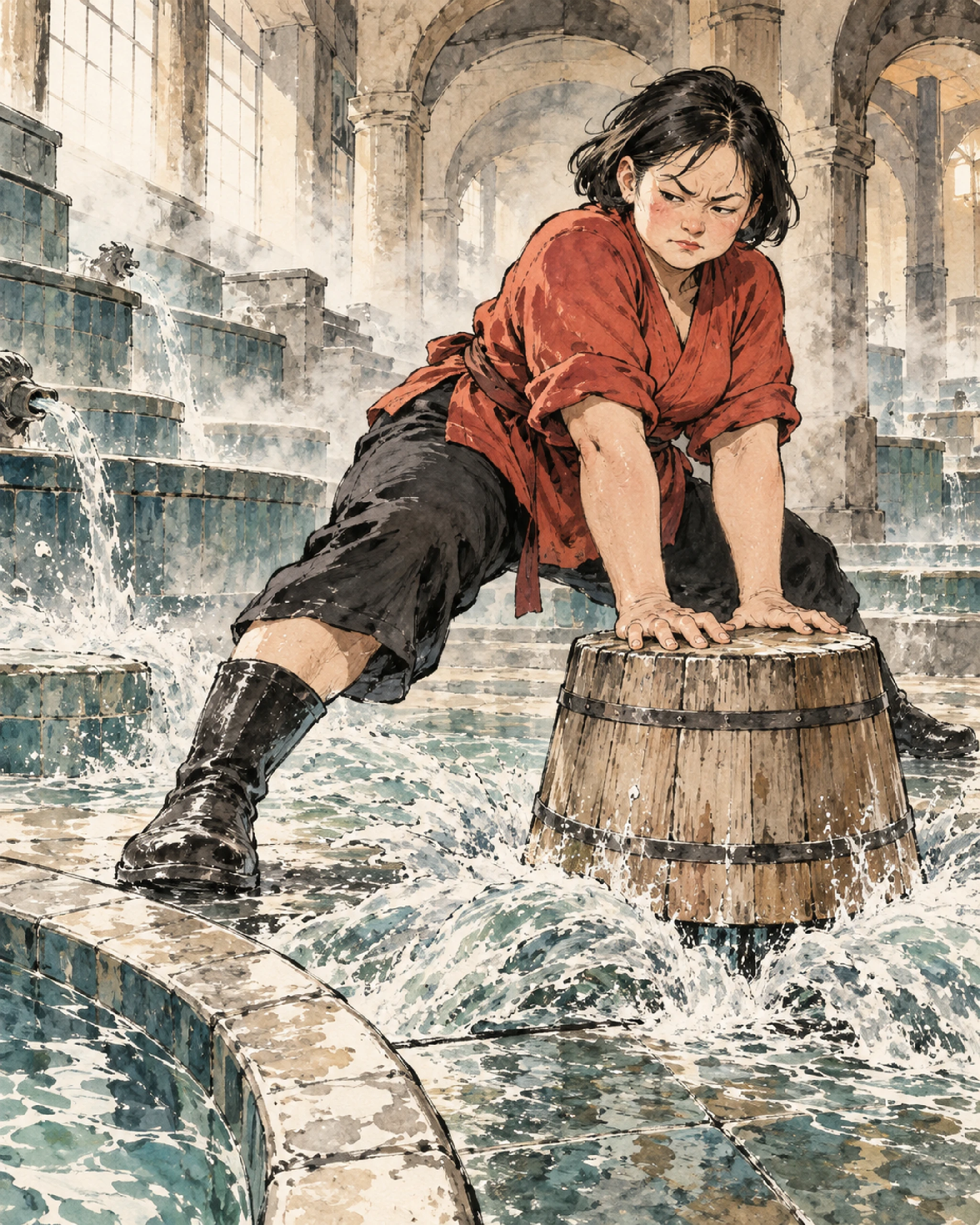
An Attendant Blocking a Bathhouse Geyser
An attendant presses an overturned wooden bucket over a bathhouse geyser. Layered bathing chambers and bursting spray become an expressive comic illustration in ragged brush ink.
Remix this referenceAn Attendant Blocking a Bathhouse Geyser
- Form language
- Simplify volumes into forceful wedges and elastic curves; let small architectural details vary within the same economical language.
- Contour
- Use pressure-swollen brush contours that taper sharply, break into dry bristles, and occasionally disappear into adjoining ink masses.
- Mark-making
- Alternate broad loaded strokes with quick, uneven flicks and sparse scratch hatching; preserve spontaneous differences between marks.
- Surface rendering
- Set pooled ink against translucent wash blooms and exposed paper; move between tones through broken wash edges rather than uniform gradients.
Priority
Rendering medium: expressive brush-ink manga illustration with hand-brushed ink and selective watercolor washes on paper.
What to avoid & what to check
Exact prompt for this example
MODULE OWNERSHIP
subject: Subject count, type, stable proportions and landmarks, resting face geometry, hair shape, physical materials, garment construction and permanent marks. No emotion, movement, color assignment or rendering recipe.
expression: Facial soft-tissue displacement and pupil direction, muscle coordination, regional intensity, asymmetry and onset/peak/release. No head/body pose, stable appearance, skin color or rendering.
gesture: Head/neck/body/limb orientation, joint movement, support, contact and pose-caused occlusion using existing anatomy. No eye/pupil movement, emotion, identity, props inventory or camera.
props: Prop count, type, construction, physical material and scale relative to the subject. Holding/contact belongs to gesture, position to composition, color to palette.
scene: Environment elements, terrain, backdrop/floor presence and structural detail. No canvas positions, camera, lighting, assigned colors or render texture.
camera: Projection, focal-length impression, camera elevation/yaw/roll, viewing distance and crop. No actor pose, world placement, lighting or canvas aspect ratio.
composition: Normalized 0-100% canvas positions, scale in frame, depth/overlap, focal hierarchy and margins. No joint pose, camera projection, rendering, subject/prop inventory or emotion.
palette: Color anchors, hue/saturation/value ranges, colors assigned to parts and approximate color coverage. No illumination direction, shading algorithm, physical material or layout.
lighting: Light-source direction/softness/intensity, ambient illumination, physical shadow direction/length and highlight position. Absence of directional illumination is allowed. No shading technique, palette or material changes.
style: Reusable form abstraction, contour weight/taper/edge quality, medium and mark scale/density/direction, surface rendering and tonal transition technique. No fixed subject proportions, anatomy, identity, expression, pose, palette, light-source direction, camera or layout.
output: Image count, aspect ratio, size, file/alpha requirements and global lettering/logo/watermark restrictions. No background scenery, crop, style, identity or pose.

SUBJECT
inventory: A is one adult woman working as a bathhouse attendant; no other people are present.
geometry: A has a sturdy everyday build, broad palms, and a rounded face with a short, broad nose.
resting-face: At rest, straight brows sit above almond-shaped eyes; a broad upper lip meets a fuller lower lip.
appearance: A has a blunt bob tucked behind the ears, a cotton wrap tunic, loose cropped trousers, and rubber work boots.

PRIORITY


AVOID


CHECK


EXPRESSION — ACTOR A
brows: Brows pull down and inward, with a deeper pinch above the left eye.
lids: The left eye squeezes nearly shut; the right eye remains narrowly open.
cheeks: Cheeks lift slightly beneath the tightened lower lids.
nose: Nostrils widen slightly without a pronounced bridge wrinkle.
mouth: Lips compress into an uneven line, with the left corner drawn farther back.
jaw: The jaw stays closed with visible tension at its corners.
gaze: The visible pupil aims down toward the bucket's upper surface.
coordination: The asymmetric squint and compressed lips read as concentrated effort.
timing: Hold the first sustained peak of effort, before any release.

PRIORITY


AVOID


CHECK


GESTURE
head: A tucks her chin and turns her head slightly toward her right, keeping her face exposed beside her shoulder.
torso: Her torso pitches forward from the hips, shoulders driving down over the bucket.
limbs: Both arms extend with soft elbows; one knee bends forward while the other leg stretches back in a wide brace.
contact: Both palms press the inverted bucket's base; both boots bear on the floor as its rim meets the drain surround.

PRIORITY


AVOID


CHECK


PROPS
inventory: One wooden wash bucket, broad enough for A to spread both palms across its base.
construction: The bucket has a tapered stave body, a solid circular base, and simple metal binding hoops.

PRIORITY


AVOID


CHECK


SCENE
inventory: An old communal bathhouse contains tiled pools, wet flooring, a floor drain, steam, and a forceful burst of water.
structure: Stepped bathing chambers connect through thick arches beneath high windows; water escapes around the capped drain in curling sheets.

PRIORITY


AVOID


CHECK


CAMERA
projection: Use perspective with a moderately wide lens impression and lively near-to-far expansion.
viewpoint: View from knee height at a three-quarter angle, looking slightly upward with a level roll.
crop: Show the complete figure and bucket from a medium-wide distance, with nearby architecture cut by the frame.

PRIORITY


AVOID


CHECK


COMPOSITION
placement: A occupies the right two-thirds; the bucket sits below center, with her face above and to its right.
depth: A cropped pool rim overlaps the lower left; successive arches recede behind A through intermittent steam.
spacing: Make the hand-bucket contact the first focus and the face the second; leave open room for spray on the left.

PRIORITY
Keep one continuous composition without panel divisions.

AVOID


CHECK


PALETTE
colors: Anchor the image in ink black and warm ivory, with diluted blue-green and one restrained vermilion accent.
assignment: Give A's tunic vermilion, water and tiles blue-green, trousers near-black, and the bucket an ivory-dominant range.
balance: Keep ivory dominant, black substantial, blue-green broad but pale, and vermilion confined to the tunic.

PRIORITY


AVOID


CHECK


LIGHTING
sources: Broad, soft daylight enters from high windows at the left, supported by gentle ambient fill.
shadows: Soft shadows fall rightward and back; contact shadows deepen beneath the bucket and boots.
highlights: Light catches the upper-left edges of the water sheets and the left-facing planes of A's face.

PRIORITY


AVOID


CHECK


STYLE GUIDE
form-language: Simplify volumes into forceful wedges and elastic curves; let small architectural details vary within the same economical language.
contour: Use pressure-swollen brush contours that taper sharply, break into dry bristles, and occasionally disappear into adjoining ink masses.
mark-making: Alternate broad loaded strokes with quick, uneven flicks and sparse scratch hatching; preserve spontaneous differences between marks.
surface-rendering: Set pooled ink against translucent wash blooms and exposed paper; move between tones through broken wash edges rather than uniform gradients.

PRIORITY
Rendering medium: expressive brush-ink manga illustration with hand-brushed ink and selective watercolor washes on paper.

AVOID


CHECK


OUTPUT
format: One finished illustration, portrait 4:5 aspect ratio, 2048 × 2560 pixels, opaque PNG.
restrictions: No lettering, dialogue balloons, logos, signatures, or watermarks.

PRIORITY


AVOID


CHECK


FINAL INTEGRATION
gesture + composition + style: Let the pose establish the force, the arrangement keep contact readable, and the brushwork amplify its rhythm.
Model information comes from image provenance. The same prompt may produce a different result.