Text to imageArt stylesStyle guide
A Chestnut Tree Split Open
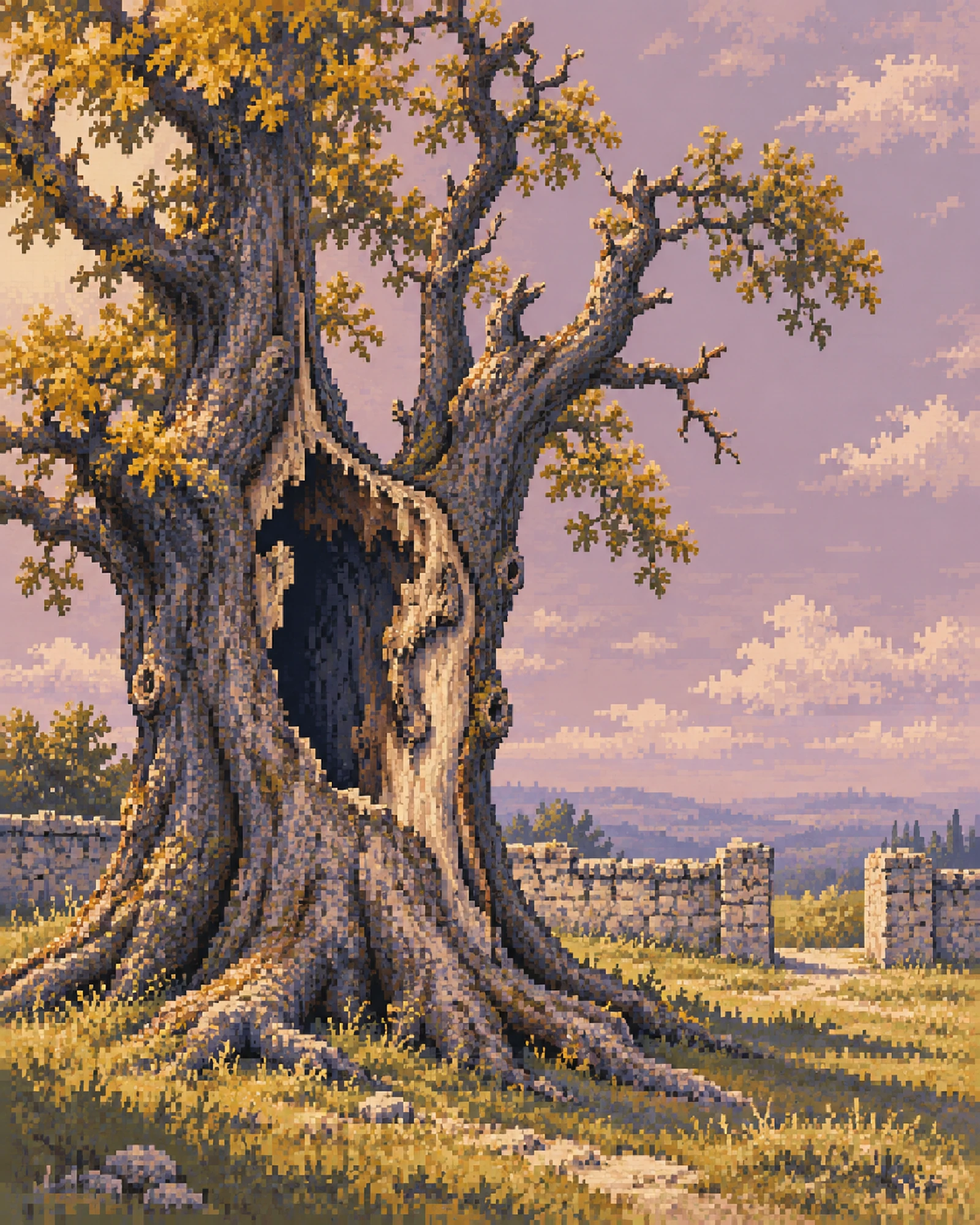
A split chestnut tree and an expansive empty sky interlock through woven pixel shapes in a graphic illustration.
Remix this referenceA Chestnut Tree Split Open
- Form language
- Build forms from interlocking pixel clusters, using deliberate stair-step edges and unequal blocks rather than smooth curves.
- Contour
- Use pixel-cluster borders of varying thickness, interrupted by open notches so contours never become uniform enclosing lines.
- Mark-making
- Alternate short horizontal and vertical pixel runs like an over-under weave; allow irregular gaps and changing local density.
- Surface rendering
- Resolve tones through stepped, interpenetrating color bands; occasional exposed cells give the digital surface a woven rhythm.
Priority
Keep the low-resolution silhouette and woven pixel structure visible at normal viewing size.
What to avoid & what to check
Exact prompt for this example
MODULE OWNERSHIP
subject: Subject count, type, stable proportions and landmarks, resting face geometry, hair shape, physical materials, garment construction and permanent marks. No emotion, movement, color assignment or rendering recipe.
expression: Facial soft-tissue displacement and pupil direction, muscle coordination, regional intensity, asymmetry and onset/peak/release. No head/body pose, stable appearance, skin color or rendering.
gesture: Head/neck/body/limb orientation, joint movement, support, contact and pose-caused occlusion using existing anatomy. No eye/pupil movement, emotion, identity, props inventory or camera.
props: Prop count, type, construction, physical material and scale relative to the subject. Holding/contact belongs to gesture, position to composition, color to palette.
scene: Environment elements, terrain, backdrop/floor presence and structural detail. No canvas positions, camera, lighting, assigned colors or render texture.
camera: Projection, focal-length impression, camera elevation/yaw/roll, viewing distance and crop. No actor pose, world placement, lighting or canvas aspect ratio.
composition: Normalized 0-100% canvas positions, scale in frame, depth/overlap, focal hierarchy and margins. No joint pose, camera projection, rendering, subject/prop inventory or emotion.
palette: Color anchors, hue/saturation/value ranges, colors assigned to parts and approximate color coverage. No illumination direction, shading algorithm, physical material or layout.
lighting: Light-source direction/softness/intensity, ambient illumination, physical shadow direction/length and highlight position. Absence of directional illumination is allowed. No shading technique, palette or material changes.
style: Reusable form abstraction, contour weight/taper/edge quality, medium and mark scale/density/direction, surface rendering and tonal transition technique. No fixed subject proportions, anatomy, identity, expression, pose, palette, light-source direction, camera or layout.
output: Image count, aspect ratio, size, file/alpha requirements and global lettering/logo/watermark restrictions. No background scenery, crop, style, identity or pose.

SUBJECT
inventory: One old chestnut tree with an exposed trunk hollow and sparse surviving foliage.
geometry: A broad root flare supports two unequal trunk spars, with hooked branches enclosing an irregular opening.
resting-face: No face-bearing subjects.
appearance: Thick fissured bark surrounds exposed heartwood; broad serrated leaves gather in loose clusters.

PRIORITY


AVOID


CHECK


PROPS
inventory: No separate props.
construction: No prop construction applies.

PRIORITY


AVOID


CHECK


SCENE
inventory: A neglected hilltop garden with rough grass, a low boundary wall, and open sky.
structure: The ground forms a shallow terrace; the boundary wall has a broken coping and an unfilled gateway.

PRIORITY


AVOID


CHECK


CAMERA
projection: Near-orthographic projection with little apparent depth compression or expansion.
viewpoint: View from standing height, nearly level, with a slight oblique view into the trunk hollow.
crop: Show the root flare and upper spars; let a few peripheral branch tips leave the frame.

PRIORITY


AVOID


CHECK


COMPOSITION
placement: Set the hollow near 35% across the canvas; the tree dominates the left while open sky expands to the right.
depth: The hollow is the first focal point; the wall passes behind the trunk as a quiet secondary layer.
spacing: Keep a generous sky margin around the tallest spar and a clear opening between the branch masses.

PRIORITY


AVOID


CHECK


PALETTE
colors: Use dusty mauve, deep indigo, ochre yellow, and warm chalk with mostly restrained saturation.
assignment: Mauve belongs to sky, indigo to bark, hollow, and contour pixels, ochre to foliage, and chalk to exposed wood and garden surfaces.
balance: Let mauve and indigo carry the broad areas, with ochre as the strongest chromatic accent.

PRIORITY


AVOID


CHECK


LIGHTING
sources: Broad, soft daylight arrives from the upper left with ample ambient fill.
shadows: A short, soft ground shadow extends rightward; the trunk hollow remains substantially darker.
highlights: Gentle highlights follow the upper-left branch edges and exposed heartwood.

PRIORITY


AVOID


CHECK


STYLE GUIDE
form-language: Build forms from interlocking pixel clusters, using deliberate stair-step edges and unequal blocks rather than smooth curves.
contour: Use pixel-cluster borders of varying thickness, interrupted by open notches so contours never become uniform enclosing lines.
mark-making: Alternate short horizontal and vertical pixel runs like an over-under weave; allow irregular gaps and changing local density.
surface-rendering: Resolve tones through stepped, interpenetrating color bands; occasional exposed cells give the digital surface a woven rhythm.

PRIORITY
Keep the low-resolution silhouette and woven pixel structure visible at normal viewing size.

AVOID


CHECK


OUTPUT
format: One finished image, portrait 4:5, 1600 × 2000 pixels, opaque PNG.
restrictions: No lettering, logos, signatures, or watermarks.

PRIORITY


AVOID


CHECK
Model information comes from image provenance. The same prompt may produce a different result.