Text to imageArt stylesStyle guide
One Sunflower · Punch-Needle Loops
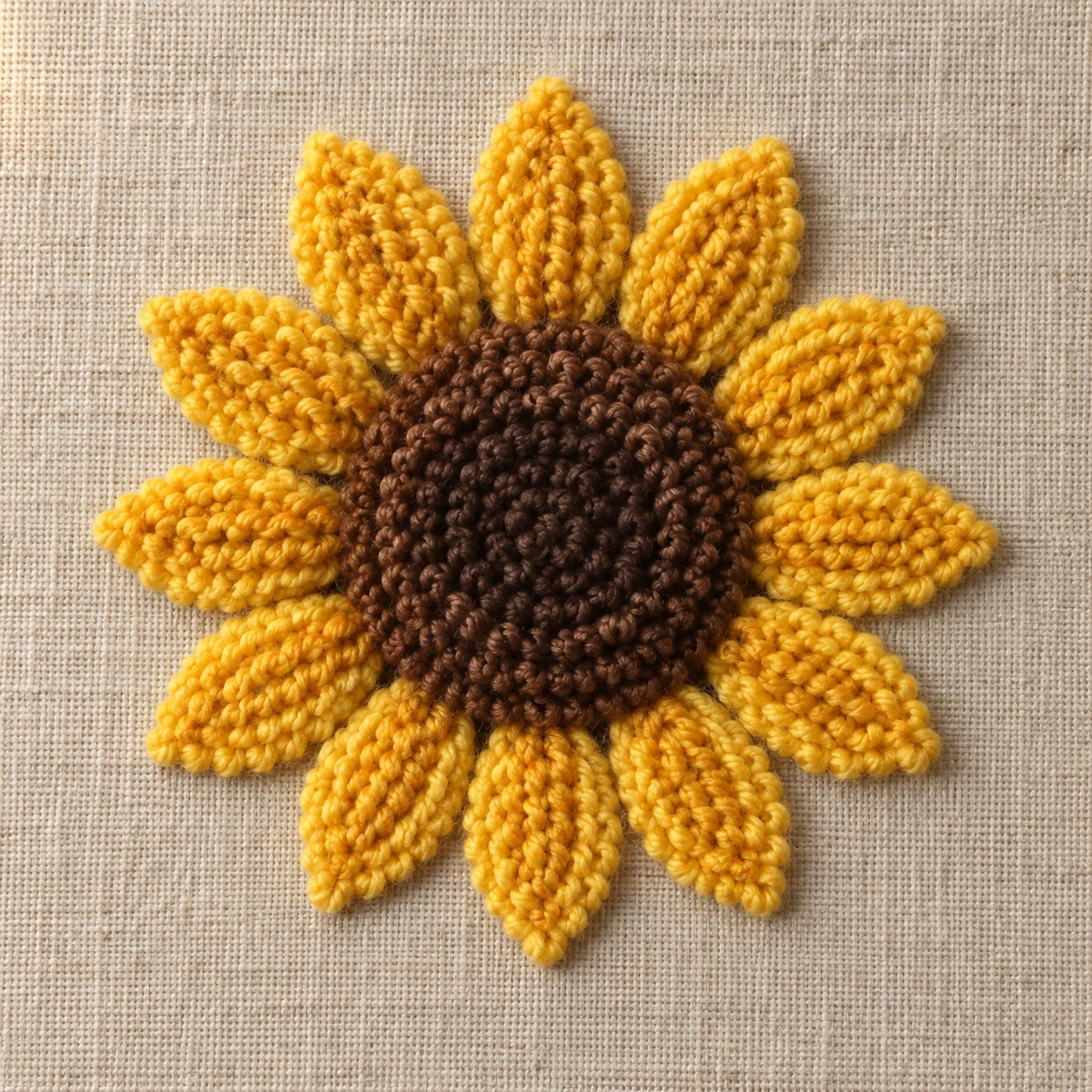
A punch-needle sunflower whose dense yarn loops and directional fills distinguish petals from its seed center.
One Sunflower · Punch-Needle Loops
- Shape & line
- Build each petal as a rounded, elongated wedge with a gently tapered tip. Fill it with closely packed rows of loops running from the brown center toward the tip, so the row direction explains the petal shape without a drawn outline.
- Color & light
- Use golden yellow petals, an ochre inner ring, and a deep brown center against warm unbleached linen. Light from the upper-left image corner so loop tops catch soft highlights and their lower-right bases hold small shadows that reveal the pile.
- Texture & material
- Keep individual rounded yarn loops visible, with slight variations in height and soft fibrous edges. Pack the center in concentric loop rows and keep the exposed linen flatter, showing its woven grid between the raised flower and the panel edges.
- Composition
- Arrange the petals radially with narrow linen gaps between their outer halves, while their bases disappear beneath the continuous brown disk. Keep every tip inside the frame and use the surrounding empty fabric to make the loop-built silhouette easy to read.
Priority
Prioritize visible yarn loops and distinct radial and concentric filling directions.
What to avoid & what to check
Avoid smooth satin stitches, flat printed texture, and realistic botanical shading.
Check that the petals read as raised loop pile and the linen remains visible around the complete flower.
Exact prompt for this example
SUBJECT
One sunflower head made from punch-needle yarn loops on natural linen, with a round brown seed center surrounded by a single ring of golden petals; the petals meet beneath the center.

COMPOSITION
Show the entire flower centered on a square linen panel, viewed nearly overhead with a slight oblique angle that reveals the height of the yarn loops. Leave a generous linen margin around every petal.

STYLE GUIDE
1. Shape & line
Build each petal as a rounded, elongated wedge with a gently tapered tip. Fill it with closely packed rows of loops running from the brown center toward the tip, so the row direction explains the petal shape without a drawn outline.

2. Color & light
Use golden yellow petals, an ochre inner ring, and a deep brown center against warm unbleached linen. Light from the upper-left image corner so loop tops catch soft highlights and their lower-right bases hold small shadows that reveal the pile.

3. Texture & material
Keep individual rounded yarn loops visible, with slight variations in height and soft fibrous edges. Pack the center in concentric loop rows and keep the exposed linen flatter, showing its woven grid between the raised flower and the panel edges.

4. Composition
Arrange the petals radially with narrow linen gaps between their outer halves, while their bases disappear beneath the continuous brown disk. Keep every tip inside the frame and use the surrounding empty fabric to make the loop-built silhouette easy to read.

PRIORITY
Preserve the requested identity, count, action, composition and output settings. Apply the style rules within those constraints; a style reference must not replace the subject or layout. Within the style: Prioritize visible yarn loops and distinct radial and concentric filling directions.

AVOID
Avoid smooth satin stitches, flat printed texture, and realistic botanical shading.

OUTPUT
One square image, 1:1 aspect ratio, with no lettering, labels, watermark, or instructional overlays.

SELF-CHECK
Check that the petals read as raised loop pile and the linen remains visible around the complete flower.
Model information comes from image provenance. The same prompt may produce a different result.