Text to imageAnimationStyle guide
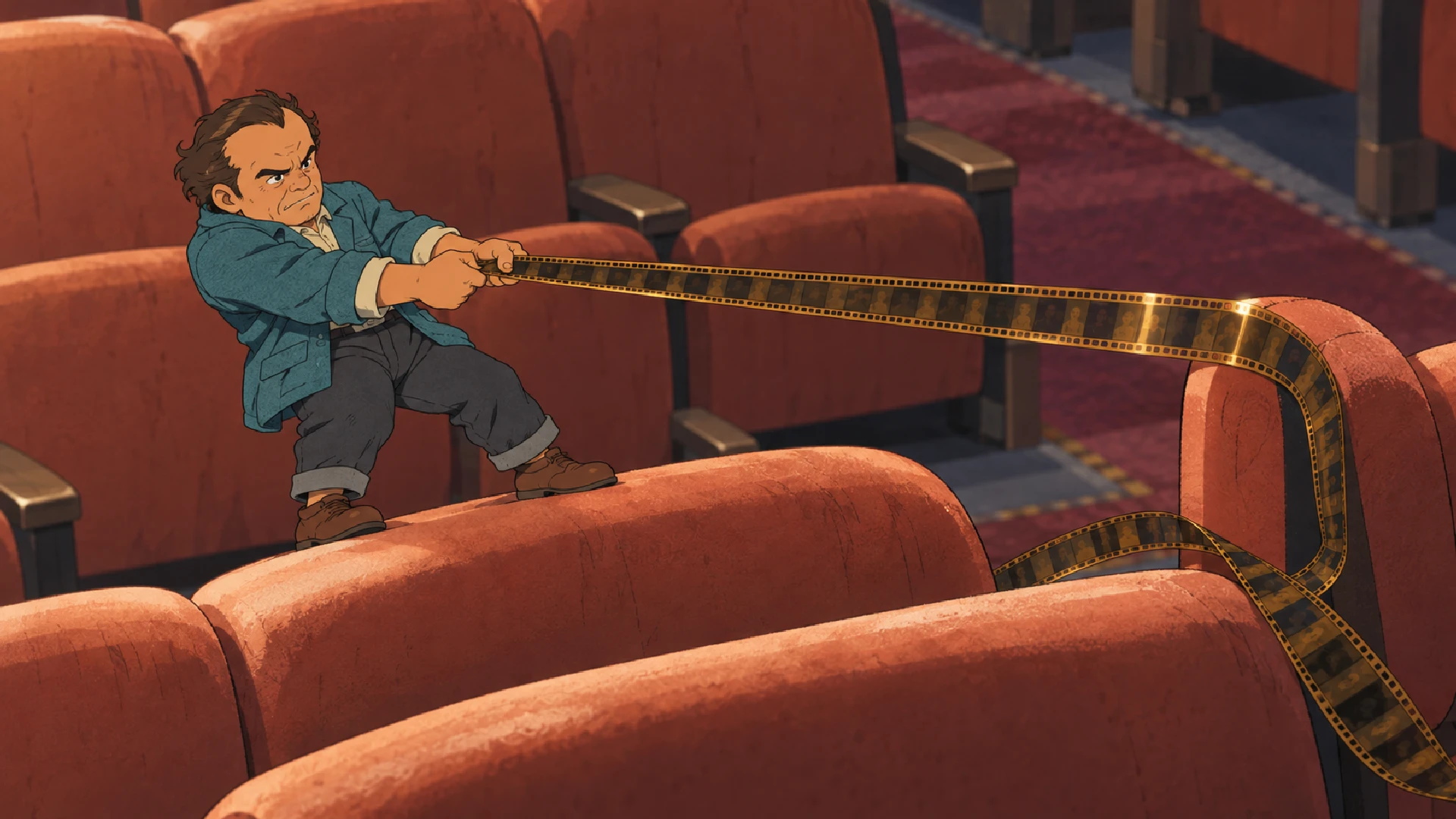
Tiny Projectionist Pulling Film Across the Seats
A palm-sized projectionist pulls a film strip from atop a seat in an empty cinema. Familiar upholstery becomes enormous terrain, with taut film and a hanging loop turning a routine task into a small adventure.
Remix this referenceTiny Projectionist Pulling Film Across the Seats
- Form language
- Combine rounded masses with wedge-like facets; simplify small details into readable shapes and permit modest irregularity.
- Contour
- Use continuous ink exterior contours with finer interior separators, gentle weight changes and tapered line endings.
- Mark-making
- Use short tapered crease strokes and sparse interior marks; let hand-drawn spacing vary naturally.
- Surface rendering
- Use hard-edged base and single secondary tonal planes, with faint cel-surface texture and softly brushed variation within broad fills.
Priority
Rendering medium: 2D Japanese television-anime cel illustration; formal rendering reference: Toei Animation · 1980s · Dragon Ball (1986)
What to avoid & what to check
Exact prompt for this example
MODULE OWNERSHIP
subject: Subject count, type, stable proportions and landmarks, resting face geometry, hair shape, physical materials, garment construction and permanent marks. No emotion, movement, color assignment or rendering recipe.
expression: Facial soft-tissue displacement and pupil direction, muscle coordination, regional intensity, asymmetry and onset/peak/release. No head/body pose, stable appearance, skin color or rendering.
gesture: Head/neck/body/limb orientation, joint movement, support, contact and pose-caused occlusion using existing anatomy. No eye/pupil movement, emotion, identity, props inventory or camera.
props: Prop count, type, construction, physical material and scale relative to the subject. Holding/contact belongs to gesture, position to composition, color to palette.
scene: Environment elements, terrain, backdrop/floor presence and structural detail. No canvas positions, camera, lighting, assigned colors or render texture.
camera: Projection, focal-length impression, camera elevation/yaw/roll, viewing distance and crop. No actor pose, world placement, lighting or canvas aspect ratio.
composition: Normalized 0-100% canvas positions, scale in frame, depth/overlap, focal hierarchy and margins. No joint pose, camera projection, rendering, subject/prop inventory or emotion.
palette: Color anchors, hue/saturation/value ranges, colors assigned to parts and approximate color coverage. No illumination direction, shading algorithm, physical material or layout.
lighting: Light-source direction/softness/intensity, ambient illumination, physical shadow direction/length and highlight position. Absence of directional illumination is allowed. No shading technique, palette or material changes.
style: Reusable form abstraction, contour weight/taper/edge quality, medium and mark scale/density/direction, surface rendering and tonal transition technique. No fixed subject proportions, anatomy, identity, expression, pose, palette, light-source direction, camera or layout.
output: Image count, aspect ratio, size, file/alpha requirements and global lettering/logo/watermark restrictions. No background scenery, crop, style, identity or pose.

SUBJECT
inventory: A is one original, palm-sized adult human projectionist; no other living subjects.
geometry: A has a compact, broad-shouldered build, substantial hands and short, sturdy legs with ordinary adult proportions.
resting-face: A has a broad rectangular face, a blunt nose, low-set ears and a naturally uneven upper lip.
appearance: A has receding, side-swept wavy hair and wears a woven work jacket, cuffed trousers and soft leather shoes.

PRIORITY


AVOID


CHECK


EXPRESSION — ACTOR A
brows: Brows draw together slightly, with one inner brow lower.
lids: Upper lids lower in concentration; lower lids firm gently.
cheeks: Cheeks tense subtly beside the compressed mouth.
nose: Nostrils widen slightly without wrinkling the bridge.
mouth: Lips press together, one corner drawn a little sideways.
jaw: Jaw stays closed with a modest tightening at its corners.
gaze: Pupils fix on the film just beyond the hands.
coordination: Restrained eye tension supports the firmer mouth; keep the asymmetry slight.
timing: Hold the apex of sustained effort, before any release.

PRIORITY


AVOID


CHECK


GESTURE
head: A tips the head slightly down toward the hands, keeping the neck extended from the backward lean.
torso: A leans backward from the hips with a small twist through the shoulders.
limbs: Both elbows bend into the pull; knees flex and the feet stagger along the seat-back crest.
contact: Both hands grip one film edge and pull it taut against a bend caught around another backrest corner; both soles press into the upholstery.

PRIORITY


AVOID


CHECK


PROPS
inventory: One continuous cinema film strip, wide enough to span A's torso; no separate tools.
construction: Flexible translucent acetate has rectangular edge perforations and repeated photographic frames without legible imagery.

PRIORITY


AVOID


CHECK


SCENE
inventory: A neighborhood cinema contains upholstered seats, a narrow aisle and a carpeted floor.
structure: Repeated rows have rounded seat backs with narrow crests, simple armrests and large upholstery folds.

PRIORITY


AVOID


CHECK


CAMERA
projection: Use moderate perspective with a natural standard-lens impression.
viewpoint: Look obliquely across the seat backs from slightly above A, with a level horizon.
crop: A medium-wide view includes A's full figure and cuts through the nearest seats, including the foreground backrest.

PRIORITY


AVOID


CHECK


COMPOSITION
placement: A occupies the left third at roughly one-third of canvas height; the film reaches across the open right half.
depth: The loose film loop is below the taut span, partly overlapped by a foreground backrest; staggered rows recede behind A.
spacing: A's face and hands lead the hierarchy, followed by the film; leave clear space around the face.

PRIORITY


AVOID


CHECK


PALETTE
colors: Anchor the image in muted terracotta, dusty turquoise, amber and charcoal, with restrained cream accents.
assignment: Seats are terracotta; A's jacket is turquoise, trousers charcoal, skin warm tan and hair dark brown; film is amber.
balance: Muted seat colors dominate; the jacket and amber film provide smaller, clearer color accents.

PRIORITY


AVOID


CHECK


LIGHTING
sources: A broad work light from upper left illuminates the seats, supported by soft ambient fill.
shadows: Short, soft cast shadows fall toward lower right, with deeper contact shadows beneath the shoes.
highlights: Place narrow highlights on the upper-left film edges and a broad highlight across the nearest seat crest.

PRIORITY


AVOID


CHECK


STYLE GUIDE
form-language: Combine rounded masses with wedge-like facets; simplify small details into readable shapes and permit modest irregularity.
contour: Use continuous ink exterior contours with finer interior separators, gentle weight changes and tapered line endings.
mark-making: Use short tapered crease strokes and sparse interior marks; let hand-drawn spacing vary naturally.
surface-rendering: Use hard-edged base and single secondary tonal planes, with faint cel-surface texture and softly brushed variation within broad fills.

PRIORITY
Rendering medium: 2D Japanese television-anime cel illustration; formal rendering reference: Toei Animation · 1980s · Dragon Ball (1986)

AVOID


CHECK


OUTPUT
format: One finished 16:9 image, 1920 × 1080 pixels, opaque PNG.
restrictions: No lettering, logos, signatures or watermarks.

PRIORITY


AVOID


CHECK


FINAL INTEGRATION
subject + scene + composition: Familiar cinema construction makes A's unusual scale legible while composition preserves readable acting.
expression + gesture + props: Facial effort and the pulling action should agree with the film's visible tension.
Art direction
토에이 애니메이션 / Toei Animation · 1980s · 드래곤볼(1986) / Dragon Ball (1986) ↗- Combine rounded masses and wedge-like facets into readable form abstractions
- Continuous ink exterior contours with finer interior separators
- Short tapered crease marks and sparse marks inside filled areas
- Hard-edged base and single secondary tonal planes with restrained cel-surface texture
Model information comes from image provenance. The same prompt may produce a different result.