Text to imageCalligraphyStyle guide
Broad-Nib Lettering with a Returning Loop
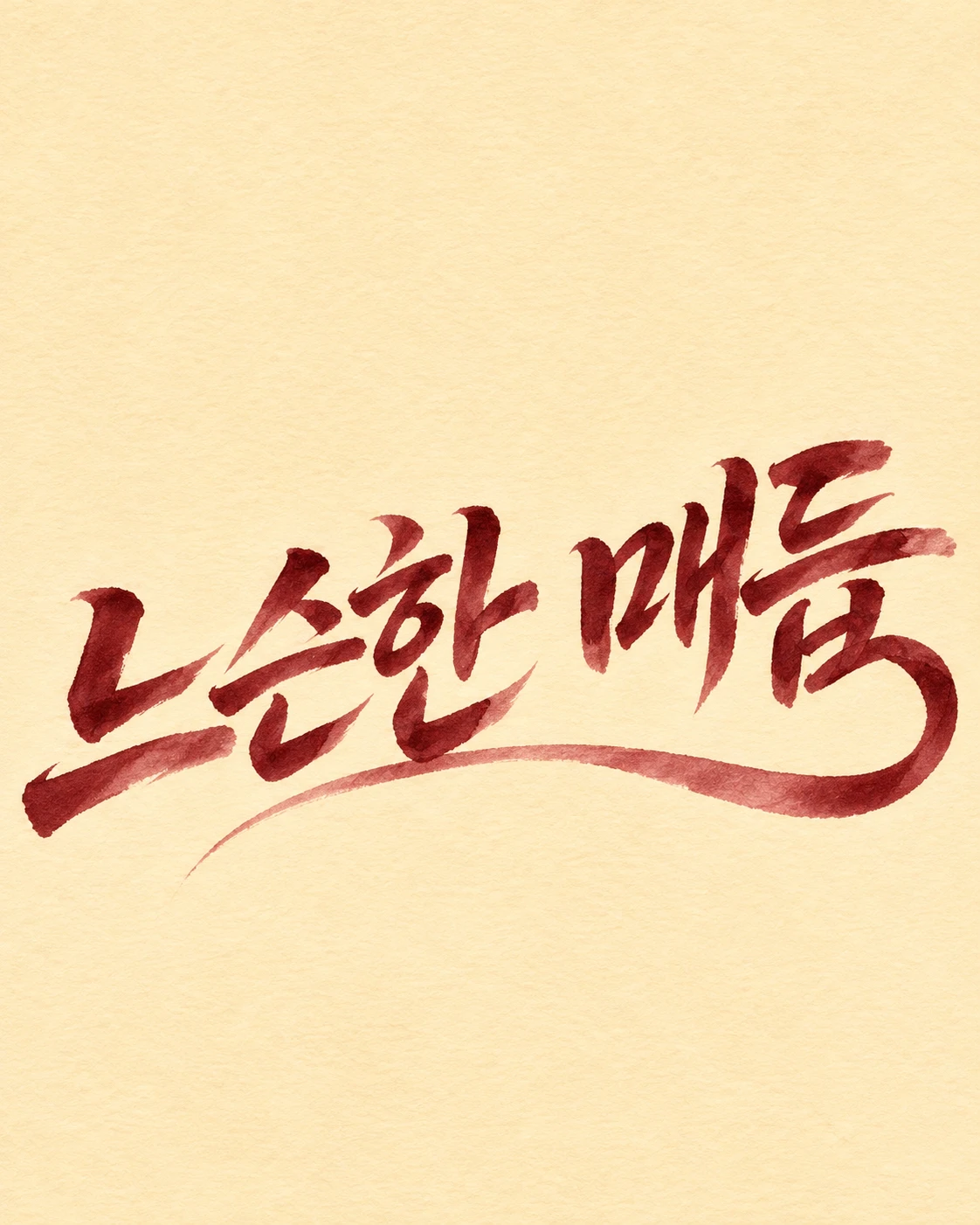
Broad-nib Hangul flows obliquely across the page, its final stroke returning in a loose loop. Deep pomegranate lettering opens against generous butter-colored paper.
Remix this referenceBroad-Nib Lettering with a Returning Loop
- Form language
- Abstract forms into generous ribbon bands, firm shoulders, and supple returns; allow natural irregularity within a coherent calligraphic vocabulary.
- Contour
- Use chisel-defined edges with confident broad-to-hairline changes, subtly feathered edges, and decisive lifted terminals.
- Mark-making
- Build strokes through continuous broad-nib pulls and brief pivots; retain visible starts and occasional ink skips instead of repeated bristle marks.
- Surface rendering
- Let ink thin translucently through swift passages and pool gently at pauses; overlaps deepen naturally while paper tooth interrupts selected edges.
Priority
Make confident broad-nib ribbon strokes visibly drive the lettering rhythm.
What to avoid & what to check
Exact prompt for this example
MODULE OWNERSHIP
subject: Subject count, type, stable proportions and landmarks, resting face geometry, hair shape, physical materials, garment construction and permanent marks. No emotion, movement, color assignment or rendering recipe.
expression: Facial soft-tissue displacement and pupil direction, muscle coordination, regional intensity, asymmetry and onset/peak/release. No head/body pose, stable appearance, skin color or rendering.
gesture: Head/neck/body/limb orientation, joint movement, support, contact and pose-caused occlusion using existing anatomy. No eye/pupil movement, emotion, identity, props inventory or camera.
props: Prop count, type, construction, physical material and scale relative to the subject. Holding/contact belongs to gesture, position to composition, color to palette.
scene: Environment elements, terrain, backdrop/floor presence and structural detail. No canvas positions, camera, lighting, assigned colors or render texture.
camera: Projection, focal-length impression, camera elevation/yaw/roll, viewing distance and crop. No actor pose, world placement, lighting or canvas aspect ratio.
composition: Normalized 0-100% canvas positions, scale in frame, depth/overlap, focal hierarchy and margins. No joint pose, camera projection, rendering, subject/prop inventory or emotion.
palette: Color anchors, hue/saturation/value ranges, colors assigned to parts and approximate color coverage. No illumination direction, shading algorithm, physical material or layout.
lighting: Light-source direction/softness/intensity, ambient illumination, physical shadow direction/length and highlight position. Absence of directional illumination is allowed. No shading technique, palette or material changes.
style: Reusable form abstraction, contour weight/taper/edge quality, medium and mark scale/density/direction, surface rendering and tonal transition technique. No fixed subject proportions, anatomy, identity, expression, pose, palette, light-source direction, camera or layout.
output: Image count, aspect ratio, size, file/alpha requirements and global lettering/logo/watermark restrictions. No background scenery, crop, style, identity or pose.

SUBJECT
inventory: One original Hangul calligraphic phrase; no figures or depicted objects.
geometry: Write exactly "느슨한 매듭" with recognizable syllable blocks, one word space, and an extended final terminal.
resting-face: No face or facial geometry applies.
appearance: The lettering consists of deposited ink, without attached ornaments or permanent pictorial marks.

PRIORITY


AVOID


CHECK


PROPS
inventory: No separate props.
construction: No prop construction applies.

PRIORITY


AVOID


CHECK


SCENE
inventory: An uninterrupted sheet of uncoated paper provides the entire setting.
structure: The paper field has no visible outer edges, folds, floor, or horizon.

PRIORITY


AVOID


CHECK


CAMERA
projection: Use a parallel, undistorted view of the paper plane.
viewpoint: Look squarely at the paper, with no camera yaw or roll.
crop: Frame closely enough to reveal stroke edges while retaining the entire inscription and terminal.

PRIORITY


AVOID


CHECK


COMPOSITION
placement: Let the phrase rise gently from lower left toward middle right; return the terminal into the lower-right opening.
depth: Keep the words foremost; the returning terminal passes beneath them with a single restrained overlap.
spacing: Leave the upper third spacious and an open island inside the terminal loop; keep syllables clearly separated.

PRIORITY


AVOID


CHECK


PALETTE
colors: Use deep pomegranate, muted rose, and pale butter as the small color family.
assignment: Assign pomegranate to the lettering, rose to its thinner passages, and butter to the paper.
balance: Let the light paper dominate, with concentrated dark lettering and only quiet rose variation.

PRIORITY


AVOID


CHECK


LIGHTING
sources: Use soft, even frontal illumination with no visible directional source.
shadows: No cast shadows or relief shadows appear on the paper.
highlights: Keep highlights subdued, without a glossy glare across the ink.

PRIORITY


AVOID


CHECK


STYLE GUIDE
form-language: Abstract forms into generous ribbon bands, firm shoulders, and supple returns; allow natural irregularity within a coherent calligraphic vocabulary.
contour: Use chisel-defined edges with confident broad-to-hairline changes, subtly feathered edges, and decisive lifted terminals.
mark-making: Build strokes through continuous broad-nib pulls and brief pivots; retain visible starts and occasional ink skips instead of repeated bristle marks.
surface-rendering: Let ink thin translucently through swift passages and pool gently at pauses; overlaps deepen naturally while paper tooth interrupts selected edges.

PRIORITY
Make confident broad-nib ribbon strokes visibly drive the lettering rhythm.

AVOID


CHECK


OUTPUT
format: One image.
restrictions: Deliver one opaque PNG, portrait 4:5, 2048 × 2560 pixels. Allow primary lettering; forbid additional text, logos, and watermarks.

PRIORITY


AVOID


CHECK


FINAL INTEGRATION
subject + output: The primary lettering permitted by output is exactly "느슨한 매듭", as specified by subject.
Model information comes from image provenance. The same prompt may produce a different result.