Text to imageCharacterStyle guide
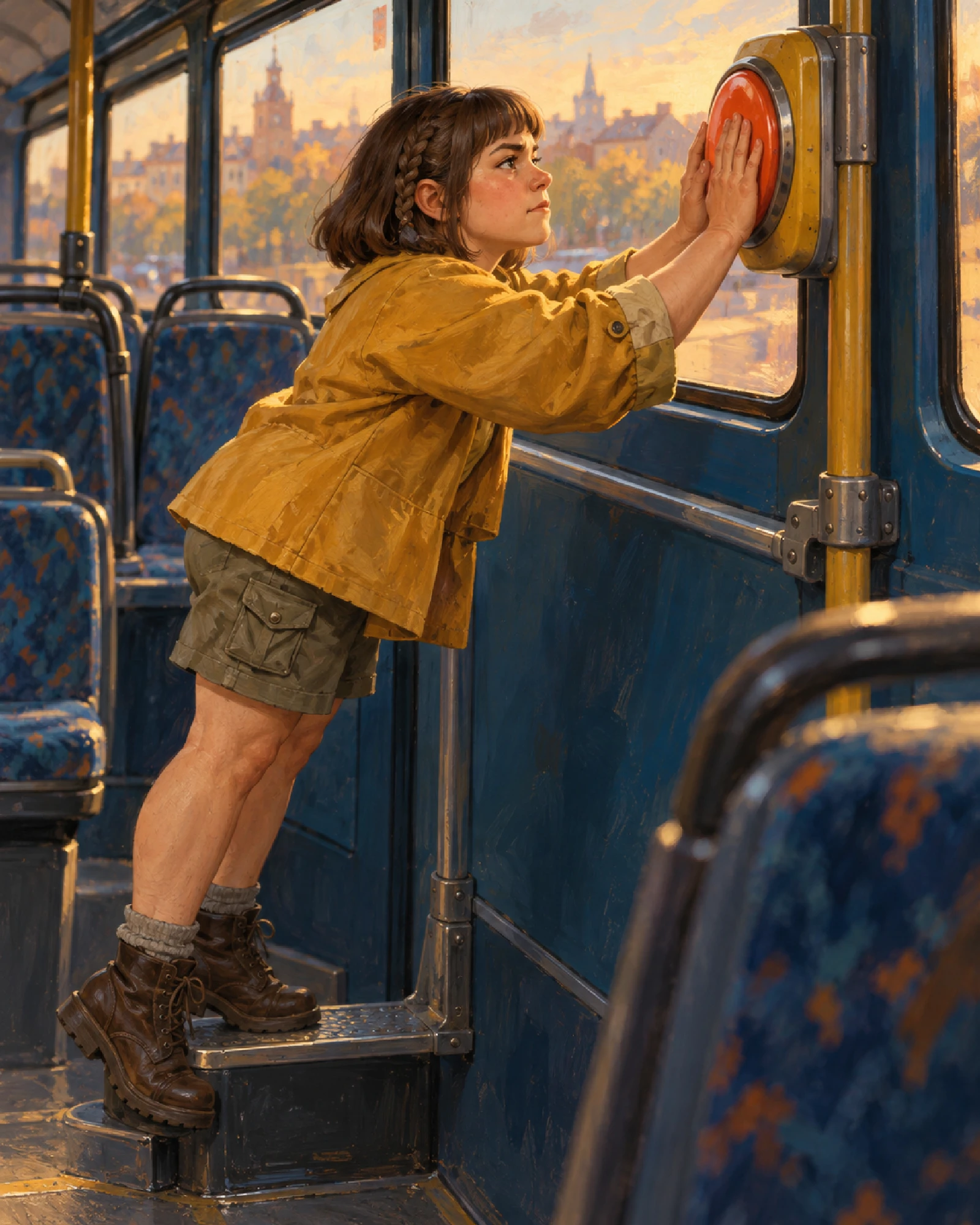
Tiny Commuter Pressing the Bus Button
A palm-sized woman stands on a bus rail bracket and presses the stop button with both hands. Evening window light and translucent painted layers illuminate her small act of effort.
Remix this referenceTiny Commuter Pressing the Bus Button
- Form language
- Simplify forms into gently bowed masses and broad connected planes, allowing small irregularities within a coherent painted language.
- Contour
- Let contours emerge through changing edge firmness: dissolve long stretches and reserve short, crisp edges for surface junctions.
- Mark-making
- Use broad brushed passages with occasional bristle trails; shorten and turn strokes around form changes without evenly texturing everything.
- Surface rendering
- Build luminous continuous tones with translucent oil-like glazes over opaque underpainting; blend tonal swells while leaving broken passages exposed.
Priority
Preserve luminous continuous-tone painting with visible variation between glazed and openly brushed.
What to avoid & what to check
Exact prompt for this example
MODULE OWNERSHIP
subject: Subject count, type, stable proportions and landmarks, resting face geometry, hair shape, physical materials, garment construction and permanent marks. No emotion, movement, color assignment or rendering recipe.
expression: Facial soft-tissue displacement and pupil direction, muscle coordination, regional intensity, asymmetry and onset/peak/release. No head/body pose, stable appearance, skin color or rendering.
gesture: Head/neck/body/limb orientation, joint movement, support, contact and pose-caused occlusion using existing anatomy. No eye/pupil movement, emotion, identity, props inventory or camera.
props: Prop count, type, construction, physical material and scale relative to the subject. Holding/contact belongs to gesture, position to composition, color to palette.
scene: Environment elements, terrain, backdrop/floor presence and structural detail. No canvas positions, camera, lighting, assigned colors or render texture.
camera: Projection, focal-length impression, camera elevation/yaw/roll, viewing distance and crop. No actor pose, world placement, lighting or canvas aspect ratio.
composition: Normalized 0-100% canvas positions, scale in frame, depth/overlap, focal hierarchy and margins. No joint pose, camera projection, rendering, subject/prop inventory or emotion.
palette: Color anchors, hue/saturation/value ranges, colors assigned to parts and approximate color coverage. No illumination direction, shading algorithm, physical material or layout.
lighting: Light-source direction/softness/intensity, ambient illumination, physical shadow direction/length and highlight position. Absence of directional illumination is allowed. No shading technique, palette or material changes.
style: Reusable form abstraction, contour weight/taper/edge quality, medium and mark scale/density/direction, surface rendering and tonal transition technique. No fixed subject proportions, anatomy, identity, expression, pose, palette, light-source direction, camera or layout.
output: Image count, aspect ratio, size, file/alpha requirements and global lettering/logo/watermark restrictions. No background scenery, crop, style, identity or pose.

SUBJECT
inventory: A is one miniature adult human woman, an original everyday commuter.
geometry: Compact adult proportions, a sturdy trunk, broad palms and substantial boots give her a practical silhouette.
resting-face: Her resting features have wide-set eyes, a long wedge-shaped nose, rounded jaw corners and a full lower lip.
appearance: A blunt bob includes one temple braid; a waxed-cotton smock has broad cuffs over canvas shorts and leather boots.

PRIORITY


AVOID


CHECK


EXPRESSION — ACTOR A
brows: Inner brow ends draw slightly down and together.
lids: Lower lids tighten while the upper lids remain open enough for intent attention.
cheeks: Cheeks draw faintly taut without rising into a smile.
nose: Nostrils remain relaxed, with no nose wrinkle.
mouth: Lips press firmly together, with one corner tucked slightly farther inward.
jaw: The jaw stays closed with a small visible tightening at its corners.
gaze: Both pupils aim toward the button immediately beyond her fingertips.
coordination: Let the firm mouth carry more effort than the brow, preserving attentive concentration.
timing: Capture the held apex of effort before the facial tension releases.

PRIORITY


AVOID


CHECK


GESTURE
head: Her neck reaches forward and her chin lifts slightly toward the button.
torso: She leans forward from the ankles, bringing her upper body behind the push.
limbs: Both elbows remain bent; her feet share the narrow mounting ledge with one heel raised.
contact: Both palms flatten against the button; the ledge supports her boots, leaving her face clear of her forearms.

PRIORITY


AVOID


CHECK


PROPS
inventory: One rail-mounted stop-button assembly has a button face approximately as wide as A's torso.
construction: A convex plastic push surface sits in a rounded housing secured by a metal collar.

PRIORITY


AVOID


CHECK


SCENE
inventory: An ordinary city-bus interior includes a side window, molded wall panel, grab rail and upholstered seat backs.
structure: The rail has a projecting mounting ledge; a window gasket and receding seat backs establish familiar bus construction.

PRIORITY


AVOID


CHECK


CAMERA
projection: Use natural perspective with a normal-lens impression and restrained foreshortening.
viewpoint: Look from the aisle obliquely toward the sidewall at A's shoulder height, with no camera roll.
crop: Use a close environmental full-body view, retaining the supporting bracket and enough window and seating for recognition.

PRIORITY


AVOID


CHECK


COMPOSITION
placement: A occupies the lower-left middle, the button sits above her to the right, and the window opens across the upper field.
depth: Her face leads, followed by the hands and button; a cropped seat back overlaps the lower-right foreground.
spacing: Let A fill roughly half the frame height, with generous space above her and a clear gap around the facial silhouette.

PRIORITY


AVOID


CHECK


PALETTE
colors: Use petrol blue, muted saffron, coral and pale apricot, supported by small deep-brown accents.
assignment: Assign petrol blue to the bus interior, saffron to the smock, coral to the button and apricot to skin and window passages.
balance: Keep the broad interior subdued; concentrate richer saturation in the small smock and button areas.

PRIORITY


AVOID


CHECK


LIGHTING
sources: Broad evening light enters from the upper-left window, supported by gentle ambient illumination inside the bus.
shadows: Soft shadows fall down and right, with tighter contact shadows beneath the boots and palms.
highlights: Broad highlights touch the window-facing cheek and sleeve; a narrow highlight follows the button's upper rim.

PRIORITY


AVOID


CHECK


STYLE GUIDE
form-language: Simplify forms into gently bowed masses and broad connected planes, allowing small irregularities within a coherent painted language.
contour: Let contours emerge through changing edge firmness: dissolve long stretches and reserve short, crisp edges for surface junctions.
mark-making: Use broad brushed passages with occasional bristle trails; shorten and turn strokes around form changes without evenly texturing everything.
surface-rendering: Build luminous continuous tones with translucent oil-like glazes over opaque underpainting; blend tonal swells while leaving broken passages exposed.

PRIORITY
Preserve luminous continuous-tone painting with visible variation between glazed and openly brushed.

AVOID


CHECK


OUTPUT
format: Produce one finished image in a vertical 4:5 aspect ratio, 1600 × 2000 pixels, as an opaque PNG.
restrictions: No lettering, logos, watermarks or signatures.

PRIORITY


AVOID


CHECK
Model information comes from image provenance. The same prompt may produce a different result.