Text to imageProductStyle guide
Shipping Corner Guard · Crush-Zone Construction
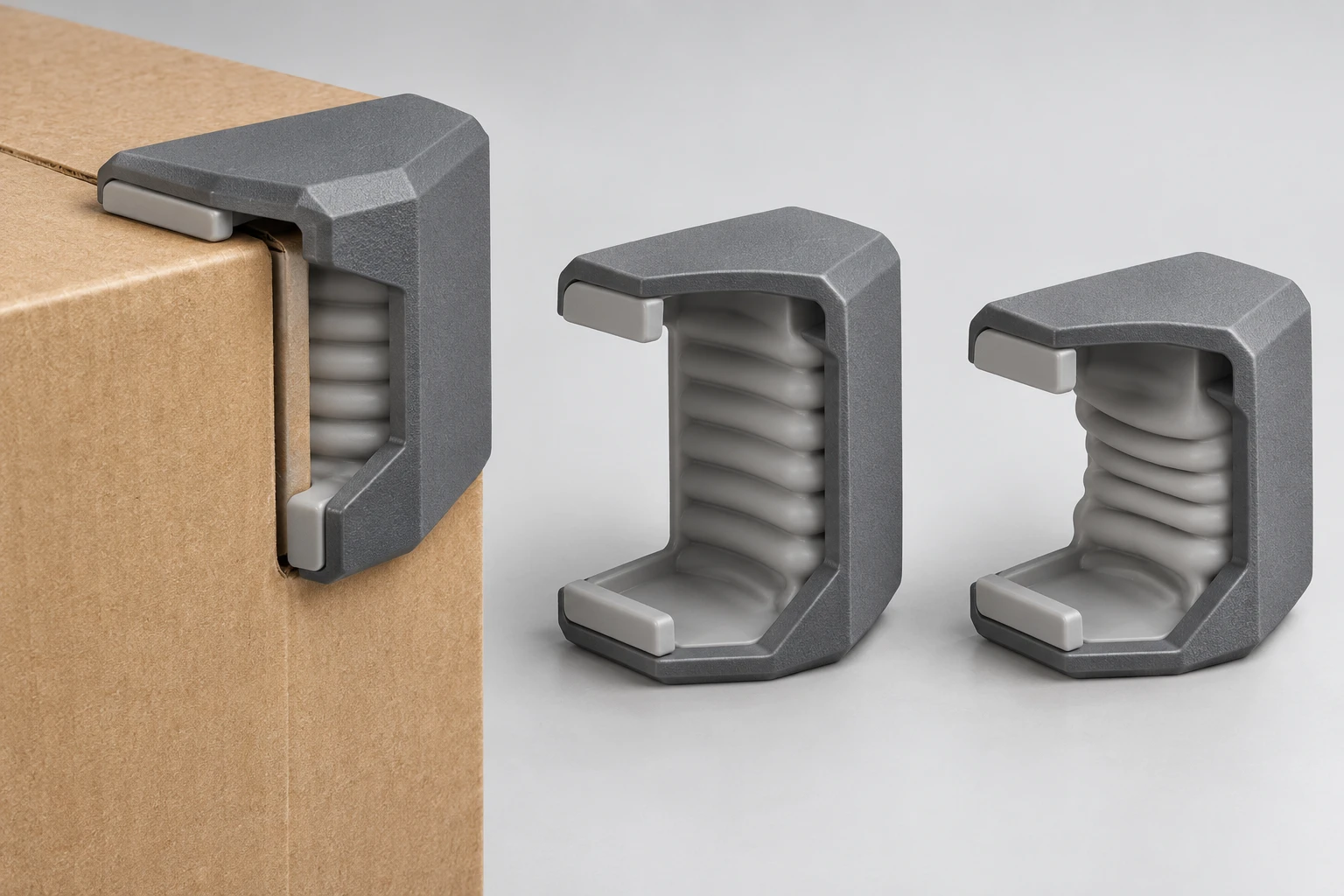
Show how a reusable corner guard deforms in a designated crush zone while protecting a box.
Remix this referenceShipping Corner Guard · Crush-Zone Construction
- Shape & line
- Use precise plausible industrial geometry: a tough outer shell, a softer ribbed inner zone and two short gripping flanges with visibly separate functions.
- Color & light
- Use restrained neutral colors and broad soft studio light; keep cut surfaces and contact shadows distinct without dramatic glare.
- Texture & material
- Show honest matte rigid shell, softer compressible ribs and cardboard fibers as distinct material surfaces.
- Composition
- Keep fitted, detached sectional and compressed sectional views separated by whitespace, with matching design geometry across all three and visible deformation only in the compressed version.
Priority
Preserve the distinctive construction and medium first, readable spatial hierarchy second, subtle surface details third.
What to avoid & what to check
Avoid extra subjects, inconsistent repeated geometry, hidden key details, crowded overlaps, unwanted text and watermarks.
Check each style rule against the finished image: visible shape construction, color and light, material treatment, and composition. Preserve the exact subject count and scene requirements.
Exact prompt for this example
SUBJECT
Present an original reusable corner protector for shipping boxes as a clear industrial-design reference image. Show one protector fitted to the upper corner of a plain cardboard box and a second detached protector in a clean cutaway view beside it. The product has a tough outer shell, a softer ribbed interior crush zone, and two short gripping flanges that hold the box without adhesive. Make the gap between shell and box visible, and show a restrained deformation diagram through a lightly compressed duplicate of the cutaway, with no arrows or labels. Use honest matte materials, precise edges, and grounded contact shadows. Keep the design plausible for repeated use and easy removal by hand. No text, branding, logos, or watermarks.

COMPOSITION
Arrange three clearly separated views: one protector fitted to a cardboard-box upper corner, one detached cutaway, and one lightly compressed duplicate cutaway. Show two short gripping flanges, a ribbed inner crush zone and the gap between shell and box; no arrows or labels.

STYLE GUIDE
1. Shape & line
Use precise plausible industrial geometry: a tough outer shell, a softer ribbed inner zone and two short gripping flanges with visibly separate functions.

2. Color & light
Use restrained neutral colors and broad soft studio light; keep cut surfaces and contact shadows distinct without dramatic glare.

3. Texture & material
Show honest matte rigid shell, softer compressible ribs and cardboard fibers as distinct material surfaces.

4. Composition
Keep fitted, detached sectional and compressed sectional views separated by whitespace, with matching design geometry across all three and visible deformation only in the compressed version.

PRIORITY
Preserve the requested identity, count, action, composition and output settings. Apply the style rules within those constraints; a style reference must not replace the subject or layout. Within the style: Preserve the distinctive construction and medium first, readable spatial hierarchy second, subtle surface details third.

AVOID
Avoid extra subjects, inconsistent repeated geometry, hidden key details, crowded overlaps, unwanted text and watermarks.

OUTPUT
One finished landscape image, aspect ratio 3:2. No lettering, captions, dimensions, unrelated logos, watermark, border or interface.

SELF-CHECK
Check each style rule against the finished image: visible shape construction, color and light, material treatment, and composition. Preserve the exact subject count and scene requirements.
Model information comes from image provenance. The same prompt may produce a different result.