Text to imageCharacterStyle guide
Creature Balancing a Feather
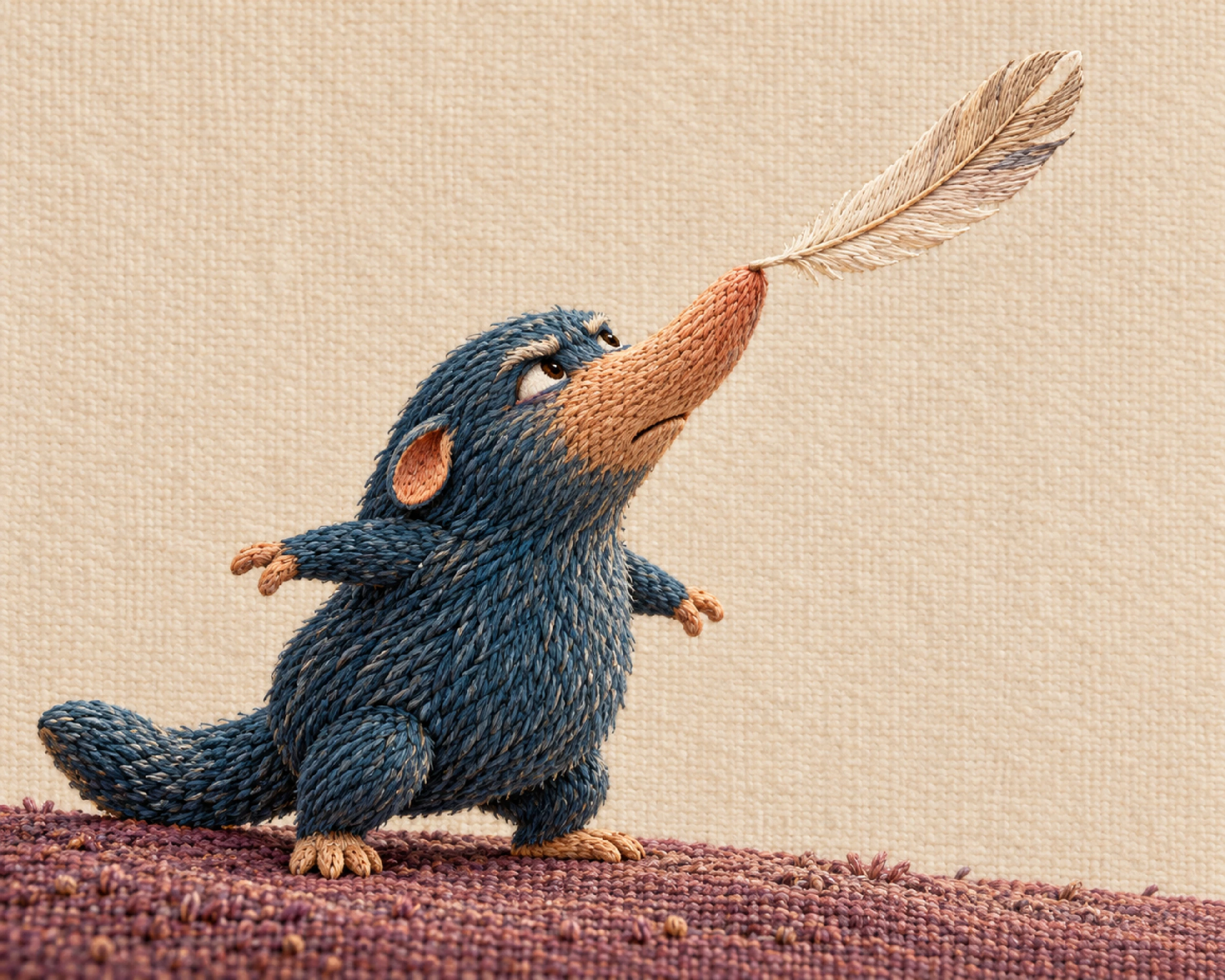
A small creature balances a feather on its broad snout. An off-center silhouette and generous negative space become a tactile textile illustration through raised thread and directional stitching.
Remix this referenceCreature Balancing a Feather
- Form language
- Translate volumes into softly padded appliqué-like lobes and broad graphic shapes; allow small shape irregularities to feel handmade.
- Contour
- Define boundaries with slightly wandering couching stitches; vary edge firmness instead of enclosing everything in a uniform cord.
- Mark-making
- Use directional long-and-short stitches in uneven fans, with sparse seed stitches and a few loose fiber ends.
- Surface rendering
- Build raised thread bundles over a visibly woven ground; overlapping stitch directions create tonal steps and tactile changes in relief.
Priority
Make the embroidery readable as raised, individually laid thread over woven cloth.
What to avoid & what to check
Exact prompt for this example
MODULE OWNERSHIP
subject: Subject count, type, stable proportions and landmarks, resting face geometry, hair shape, physical materials, garment construction and permanent marks. No emotion, movement, color assignment or rendering recipe.
expression: Facial soft-tissue displacement and pupil direction, muscle coordination, regional intensity, asymmetry and onset/peak/release. No head/body pose, stable appearance, skin color or rendering.
gesture: Head/neck/body/limb orientation, joint movement, support, contact and pose-caused occlusion using existing anatomy. No eye/pupil movement, emotion, identity, props inventory or camera.
props: Prop count, type, construction, physical material and scale relative to the subject. Holding/contact belongs to gesture, position to composition, color to palette.
scene: Environment elements, terrain, backdrop/floor presence and structural detail. No canvas positions, camera, lighting, assigned colors or render texture.
camera: Projection, focal-length impression, camera elevation/yaw/roll, viewing distance and crop. No actor pose, world placement, lighting or canvas aspect ratio.
composition: Normalized 0-100% canvas positions, scale in frame, depth/overlap, focal hierarchy and margins. No joint pose, camera projection, rendering, subject/prop inventory or emotion.
palette: Color anchors, hue/saturation/value ranges, colors assigned to parts and approximate color coverage. No illumination direction, shading algorithm, physical material or layout.
lighting: Light-source direction/softness/intensity, ambient illumination, physical shadow direction/length and highlight position. Absence of directional illumination is allowed. No shading technique, palette or material changes.
style: Reusable form abstraction, contour weight/taper/edge quality, medium and mark scale/density/direction, surface rendering and tonal transition technique. No fixed subject proportions, anatomy, identity, expression, pose, palette, light-source direction, camera or layout.
output: Image count, aspect ratio, size, file/alpha requirements and global lettering/logo/watermark restrictions. No background scenery, crop, style, identity or pose.

SUBJECT
inventory: One original small mammalian creature; no other living subjects.
geometry: A squat pear-shaped body, broad shovel snout, tiny forearms, short hind legs and a thick tapering tail.
resting-face: Small forward-facing eyes, short brows and a narrow mouth sit above and beneath the broad snout.
appearance: Dense short fur, bare leathery snout and rounded ear flaps; no clothing or permanent decorative marks.

PRIORITY


AVOID


CHECK


EXPRESSION — ACTOR A
brows: Brows draw inward, with one sitting slightly higher.
lids: Upper lids narrow unevenly in sustained concentration.
cheeks: Cheeks remain loose without swelling or a smile lift.
nose: Nostrils stay relaxed; the broad snout is not wrinkled.
mouth: Lips press into a small level line, firmer at one corner.
jaw: The jaw remains closed without a visible clench.
gaze: Pupils turn upward toward the feather's quill.
coordination: Concentrated eyes carry the effort while the lower face stays quiet.
timing: Hold the apex of the brow and lid tension before the face softens.

PRIORITY


AVOID


CHECK


GESTURE
head: Lift the snout and extend the neck slightly, keeping both ear flaps loosely lowered.
torso: Hold the torso back in a shallow countercurve to the extended snout, before any corrective body movement.
limbs: Spread the little forearms sideways and bend the hind legs in a low balancing stance.
contact: Both feet and the tail tip support the body; the feather's quill rests on the end of the snout.

PRIORITY


AVOID


CHECK


PROPS
inventory: One loose feather, roughly as long as the creature's head.
construction: A slender natural quill supports a gently uneven vane with a small split near its tip.

PRIORITY


AVOID


CHECK


SCENE
inventory: A spare earthen clearing against an uninterrupted backdrop; no additional scenery.
structure: A shallow ground lip establishes the clearing; the backdrop has no horizon or architectural divisions.

PRIORITY


AVOID


CHECK


CAMERA
projection: Near-orthographic illustration with minimal perspective convergence.
viewpoint: A low three-quarter side view reveals the face and the width of the snout; no roll.
crop: A full-body view includes the complete feather, feet and tail.

PRIORITY


AVOID


CHECK


COMPOSITION
placement: Place the creature in the lower-left portion, with its snout and feather along the boundary of the open upper-right field.
depth: Keep the ground behind the feet and leave clear background gaps beside the forearm contours.
spacing: The face-to-feather relationship leads; leave a broad uninterrupted field beyond the feather and generous edge margins.

PRIORITY


AVOID


CHECK


PALETTE
colors: Deep petrol blue, dusty apricot, pale oat and a small mulberry accent.
assignment: Petrol fur, apricot snout and ear interiors, oat feather and backdrop, mulberry ground lip.
balance: The pale field occupies most of the image; the compact dark body anchors the restrained warm accents.

PRIORITY


AVOID


CHECK


LIGHTING
sources: Soft grazing light from upper left reveals the textile relief, with ample diffuse fill.
shadows: Tiny thread shadows fall lower right; a short soft contact shadow settles beneath the creature.
highlights: Fine highlights skim upper thread ridges without glossy glare.

PRIORITY


AVOID


CHECK


STYLE GUIDE
form-language: Translate volumes into softly padded appliqué-like lobes and broad graphic shapes; allow small shape irregularities to feel handmade.
contour: Define boundaries with slightly wandering couching stitches; vary edge firmness instead of enclosing everything in a uniform cord.
mark-making: Use directional long-and-short stitches in uneven fans, with sparse seed stitches and a few loose fiber ends.
surface-rendering: Build raised thread bundles over a visibly woven ground; overlapping stitch directions create tonal steps and tactile changes in relief.

PRIORITY
Make the embroidery readable as raised, individually laid thread over woven cloth.

AVOID


CHECK


OUTPUT
format: One finished image, landscape 5:4, 2560 × 2048 pixels, opaque PNG; no lettering, logos or watermarks.
restrictions: One finished image, landscape 5:4, 2560 × 2048 pixels, opaque PNG; no lettering, logos or watermarks.

PRIORITY


AVOID


CHECK


FINAL INTEGRATION
gesture + props + composition: Keep the balancing contact readable while allowing the surrounding space to carry the pause.
lighting + style: Use illumination to reveal the stitched construction without overwhelming its graphic simplicity.
Model information comes from image provenance. The same prompt may produce a different result.