Text to imageArt stylesStyle guide
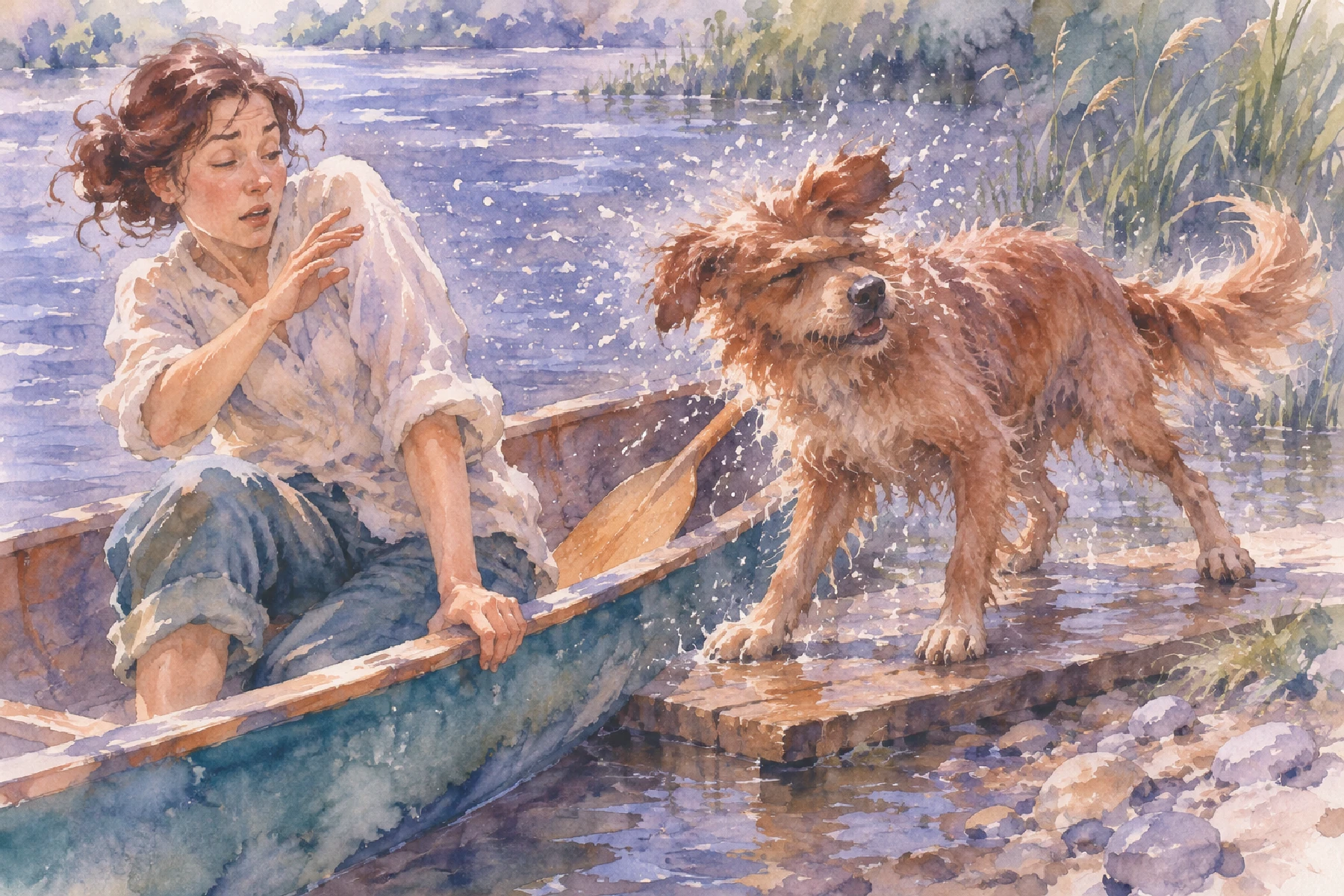
A Dog Shaking Beside a Canoe
A woman recoils in a grounded canoe as her dog shakes off river water. Overlapping silhouettes and spreading watercolor washes convey the spray and their unruly companionship.
Remix this referenceA Dog Shaking Beside a Canoe
- Form language
- Simplify forms into elastic wash masses and a few structural accents; let small details vary within the same loose vocabulary.
- Contour
- Build broken edges from brush contact rather than continuous outlines; alternate crisp fragments with feathered and entirely lost boundaries.
- Mark-making
- Use broad, uneven watercolor strokes with occasional dry-brush skips and loose splashes; vary pressure and direction without regular patterning.
- Surface rendering
- Let wet washes bloom into cauliflower rims and pooled pigment; transparent overlaps and reserved paper create tones with selective dry accents.
Priority
Make watercolor blooms and broken edges an active part of the image's expressive language.
What to avoid & what to check
Exact prompt for this example
MODULE OWNERSHIP
subject: Subject count, type, stable proportions and landmarks, resting face geometry, hair shape, physical materials, garment construction and permanent marks. No emotion, movement, color assignment or rendering recipe.
expression: Facial soft-tissue displacement and pupil direction, muscle coordination, regional intensity, asymmetry and onset/peak/release. No head/body pose, stable appearance, skin color or rendering.
gesture: Head/neck/body/limb orientation, joint movement, support, contact and pose-caused occlusion using existing anatomy. No eye/pupil movement, emotion, identity, props inventory or camera.
props: Prop count, type, construction, physical material and scale relative to the subject. Holding/contact belongs to gesture, position to composition, color to palette.
scene: Environment elements, terrain, backdrop/floor presence and structural detail. No canvas positions, camera, lighting, assigned colors or render texture.
camera: Projection, focal-length impression, camera elevation/yaw/roll, viewing distance and crop. No actor pose, world placement, lighting or canvas aspect ratio.
composition: Normalized 0-100% canvas positions, scale in frame, depth/overlap, focal hierarchy and margins. No joint pose, camera projection, rendering, subject/prop inventory or emotion.
palette: Color anchors, hue/saturation/value ranges, colors assigned to parts and approximate color coverage. No illumination direction, shading algorithm, physical material or layout.
lighting: Light-source direction/softness/intensity, ambient illumination, physical shadow direction/length and highlight position. Absence of directional illumination is allowed. No shading technique, palette or material changes.
style: Reusable form abstraction, contour weight/taper/edge quality, medium and mark scale/density/direction, surface rendering and tonal transition technique. No fixed subject proportions, anatomy, identity, expression, pose, palette, light-source direction, camera or layout.
output: Image count, aspect ratio, size, file/alpha requirements and global lettering/logo/watermark restrictions. No background scenery, crop, style, identity or pose.

SUBJECT
inventory: A is one adult woman; B is one medium-sized, shaggy dog with floppy ears.
geometry: A has an ordinary adult build; B has a deep chest, sturdy legs and a long, feathered tail.
resting-face: A has a broad oval face and rounded nose; B has a broad muzzle and pendant ears.
appearance: A has a loosely tied bob, a collarless linen shirt and rolled trousers; B has irregular shaggy locks.

PRIORITY


AVOID


CHECK


EXPRESSION — ACTOR A
brows: Both brows rise, with the nearer brow slightly higher.
lids: The nearer eye squints against spray while the farther eye stays open.
cheeks: The nearer cheek lifts gently beneath the squint.
nose: The nose wrinkles faintly on the squinting side.
mouth: Lips part in a small, uneven gasp.
jaw: The jaw releases slightly without a wide opening.
gaze: Pupils turn toward B's shoulder.
coordination: Raised brows and a protective squint combine with the small gasp.
timing: Catch the apex of the first startled reaction to the spray.

PRIORITY


AVOID


CHECK


EXPRESSION — ACTOR B
brows: Visible brow tissue stays relaxed, without an inward pinch.
lids: Eyelid displacement remains unprescribed.
cheeks: Cheek tissue remains loose, without a deliberate lift.
nose: The nose bridge stays smooth, without a snarl wrinkle.
mouth: Lips part slightly, with slack corners and no tooth-baring curl.
jaw: The jaw hangs slightly open with little muscular tension.
gaze: Pupil direction remains unprescribed.
coordination: Loose cheeks and a released jaw maintain a relaxed muzzle.
timing: At the sampled apex, facial tension remains low.

PRIORITY


AVOID


CHECK


GESTURE
head: A draws her neck back and turns partly away; B whips its head sideways, an ear obscuring its eyes.
torso: A twists away from B; B's ribcage and hips countertwist in the middle of a vigorous shake.
limbs: A raises one forearm across her chest; B braces its paws unevenly and swings its tail outward.
contact: A kneels inside the grounded canoe and grips its gunwale with her other hand; B stands on the landing plank.

PRIORITY


AVOID


CHECK


PROPS
inventory: One canoe large enough for A and B, and one paddle approximately A's height.
construction: The wooden canoe has a narrow open hull and curved gunwales; the wooden paddle has a broad leaf-shaped blade.

PRIORITY


AVOID


CHECK


SCENE
inventory: A shallow river landing with a single plank, a shingle bank, reeds and scattered airborne water droplets.
structure: The plank bridges the wet bank and shallows; reed beds follow the river's irregular edge.

PRIORITY


AVOID


CHECK


CAMERA
projection: Natural perspective with a moderate wide-lens impression.
viewpoint: Look obliquely across the landing from just above A's seated eye level, without camera roll.
crop: Include A, the whole dog and most of the canoe; let the near bow extend beyond the frame.

PRIORITY


AVOID


CHECK


COMPOSITION
placement: A occupies the left middle, B the right middle; the canoe runs diagonally through the lower portion.
depth: The near gunwale overlaps A's lower body; B overlaps the far hull, with the paddle partly concealed behind it.
spacing: The exchange between A and B leads; spray connects their silhouettes, while open river provides breathing room above.

PRIORITY


AVOID


CHECK


PALETTE
colors: Anchor the image in paper ivory, petrol blue, burnt sienna and muted violet, with restrained ochre.
assignment: Ivory shirt; petrol canoe and trousers; sienna dog and dark sienna hair; ochre skin; violet-blue river.
balance: Cool hues dominate, warm hues provide smaller accents, and predominantly light values keep the image airy.

PRIORITY


AVOID


CHECK


LIGHTING
sources: Broad, soft daylight enters from the upper left with generous ambient fill.
shadows: Short, soft shadows fall toward the lower right beneath the dog, plank and canoe.
highlights: Broad highlights touch upper shoulders and gunwales; occasional droplets catch small glints.

PRIORITY


AVOID


CHECK


STYLE GUIDE
form-language: Simplify forms into elastic wash masses and a few structural accents; let small details vary within the same loose vocabulary.
contour: Build broken edges from brush contact rather than continuous outlines; alternate crisp fragments with feathered and entirely lost boundaries.
mark-making: Use broad, uneven watercolor strokes with occasional dry-brush skips and loose splashes; vary pressure and direction without regular patterning.
surface-rendering: Let wet washes bloom into cauliflower rims and pooled pigment; transparent overlaps and reserved paper create tones with selective dry accents.

PRIORITY
Make watercolor blooms and broken edges an active part of the image's expressive language.

AVOID


CHECK


OUTPUT
format: One finished illustration, landscape 3:2, 1800 × 1200 pixels, PNG with an opaque background.
restrictions: No lettering, logos, signatures or watermarks.

PRIORITY


AVOID


CHECK


FINAL INTEGRATION
gesture + composition + style: Keep the interaction legible through the overlaps while allowing brushwork to dissolve incidental boundaries.
Model information comes from image provenance. The same prompt may produce a different result.