Text to imageCharacterStyle guide
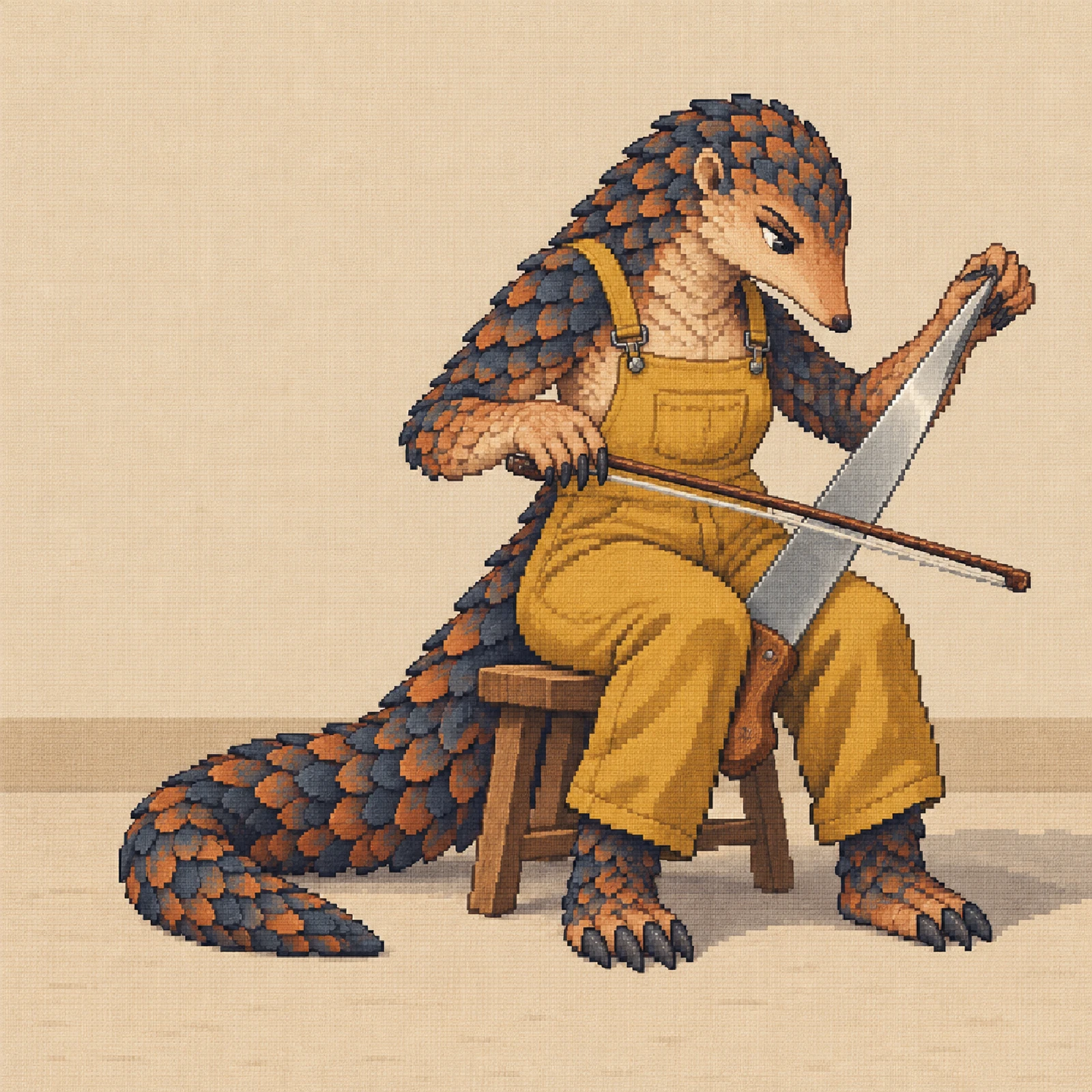
Pangolin Woman Playing a Saw
A full-body character illustration of a pangolin woman bowing a curved musical saw from a low stool. Stepped silhouettes and interlocking threadlike pixels form a small woven picture within generous negative space.
Remix this referencePangolin Woman Playing a Saw
- Form language
- Translate volumes into interlocking block shapes, preserving bold silhouettes while letting small internal shapes vary naturally.
- Contour
- Build deliberate low-resolution stair-step edges with varied step lengths; use selective broken outlines instead of a uniform border.
- Mark-making
- Interlace short horizontal and vertical pixel dashes like warp and weft, with occasional displaced stitches and open gaps.
- Surface rendering
- Build tonal changes from clustered pixel patches and sparse woven dithering; retain crisp raster edges and a textile-like surface rhythm.
Priority
The defining treatment is woven pixel art with visibly deliberate low-resolution edges.
What to avoid & what to check
Exact prompt for this example
MODULE OWNERSHIP
subject: Subject count, type, stable proportions and landmarks, resting face geometry, hair shape, physical materials, garment construction and permanent marks. No emotion, movement, color assignment or rendering recipe.
expression: Facial soft-tissue displacement and pupil direction, muscle coordination, regional intensity, asymmetry and onset/peak/release. No head/body pose, stable appearance, skin color or rendering.
gesture: Head/neck/body/limb orientation, joint movement, support, contact and pose-caused occlusion using existing anatomy. No eye/pupil movement, emotion, identity, props inventory or camera.
props: Prop count, type, construction, physical material and scale relative to the subject. Holding/contact belongs to gesture, position to composition, color to palette.
scene: Environment elements, terrain, backdrop/floor presence and structural detail. No canvas positions, camera, lighting, assigned colors or render texture.
camera: Projection, focal-length impression, camera elevation/yaw/roll, viewing distance and crop. No actor pose, world placement, lighting or canvas aspect ratio.
composition: Normalized 0-100% canvas positions, scale in frame, depth/overlap, focal hierarchy and margins. No joint pose, camera projection, rendering, subject/prop inventory or emotion.
palette: Color anchors, hue/saturation/value ranges, colors assigned to parts and approximate color coverage. No illumination direction, shading algorithm, physical material or layout.
lighting: Light-source direction/softness/intensity, ambient illumination, physical shadow direction/length and highlight position. Absence of directional illumination is allowed. No shading technique, palette or material changes.
style: Reusable form abstraction, contour weight/taper/edge quality, medium and mark scale/density/direction, surface rendering and tonal transition technique. No fixed subject proportions, anatomy, identity, expression, pose, palette, light-source direction, camera or layout.
output: Image count, aspect ratio, size, file/alpha requirements and global lettering/logo/watermark restrictions. No background scenery, crop, style, identity or pose.

SUBJECT
inventory: One original adult pangolin woman with a humanoid torso, two arms, two legs and one substantial tail.
geometry: A tapered snout, small ears, broad hips and a long narrowing tail distinguish her compact, grounded build.
resting-face: Small almond-shaped eyes sit above a long nasal ridge; a short mouth line rests beneath the snout tip.
appearance: Overlapping keratin scales cover her crown, back and tail; cloth bib overalls leave the forearms uncovered.

PRIORITY


AVOID


CHECK


EXPRESSION — ACTOR A
brows: The soft tissue above the eyes gathers slightly inward.
lids: Upper lids lower a little while the lower lids remain steady.
cheeks: Cheeks stay mostly relaxed, with a slight inward draw near the mouth.
nose: The visible nostril remains relaxed without flaring.
mouth: Lips meet in a small firm line, one corner just higher than the other.
jaw: The jaw stays lightly set without a visible clench.
gaze: Pupils aim at the point where the bow crosses the saw.
coordination: Small lid and brow changes carry the concentration; the lower face stays quiet.
timing: Hold the sustained peak of concentration during a single drawn note.

PRIORITY


AVOID


CHECK


GESTURE
head: Her neck inclines forward and her head turns slightly toward the instrument.
torso: She sits near the stool's front edge, leaning gently forward with the shoulders at different heights.
limbs: One hand bends the saw tip while the other draws the bow sideways; both feet rest apart and the tail curls beside them.
contact: Her knees secure the saw handle, the bow hair meets its smooth edge, and the stool supports her seated weight.

PRIORITY


AVOID


CHECK


PROPS
inventory: Three props: a musical saw about torso length, a slender bow and a low stool sized to the character.
construction: The saw has a flexible steel blade and wooden handle; the bow has a wood stick and hair ribbon; the stool is plain wood.

PRIORITY


AVOID


CHECK


SCENE
inventory: A bare rehearsal corner with a continuous wall and floor, without additional furnishings.
structure: A single wall-floor junction establishes the room; omit architectural decoration.

PRIORITY


AVOID


CHECK


CAMERA
projection: Use a near-orthographic illustration view with minimal size change through depth.
viewpoint: Look slightly down from a front three-quarter view, keeping the camera level.
crop: Show the entire character, tail, instrument and stool.

PRIORITY


AVOID


CHECK


COMPOSITION
placement: Group the figure and stool around 63% width and 61% height, occupying roughly the right half; place the wall-floor junction low.
depth: The bow crosses the saw in front of the torso; the curved instrument leads attention toward the face.
spacing: Leave comfortable outer margins, a broad uninterrupted field at upper left, and clear gaps around the bow, snout and tail tip.

PRIORITY


AVOID


CHECK


PALETTE
colors: Use ink navy, muted apricot, mustard and pale flax, with restrained saturation.
assignment: Give scales navy and apricot, overalls mustard, tools pale cool gray, and the room pale flax.
balance: The pale ground occupies most of the image; compact dark masses hold small warm accents.

PRIORITY


AVOID


CHECK


LIGHTING
sources: Broad diffuse light enters from the left with ample ambient fill.
shadows: A short soft shadow extends to the right beneath the stool and feet.
highlights: Keep highlights subdued, with a narrow glint along the saw's left-facing edge.

PRIORITY


AVOID


CHECK


STYLE GUIDE
form-language: Translate volumes into interlocking block shapes, preserving bold silhouettes while letting small internal shapes vary naturally.
contour: Build deliberate low-resolution stair-step edges with varied step lengths; use selective broken outlines instead of a uniform border.
mark-making: Interlace short horizontal and vertical pixel dashes like warp and weft, with occasional displaced stitches and open gaps.
surface-rendering: Build tonal changes from clustered pixel patches and sparse woven dithering; retain crisp raster edges and a textile-like surface rhythm.

PRIORITY
The defining treatment is woven pixel art with visibly deliberate low-resolution edges.

AVOID


CHECK


OUTPUT
format: Deliver one square 1600 × 1600 pixel PNG with an opaque background.
restrictions: No lettering, logos, signatures or watermarks.

PRIORITY


AVOID


CHECK


FINAL INTEGRATION
gesture + style: Let the stepped visual language simplify the performance while keeping its contact relationships legible.
Model information comes from image provenance. The same prompt may produce a different result.