Text to imageCafe & brandStyle guide
Locksmith and the Door-Height Key
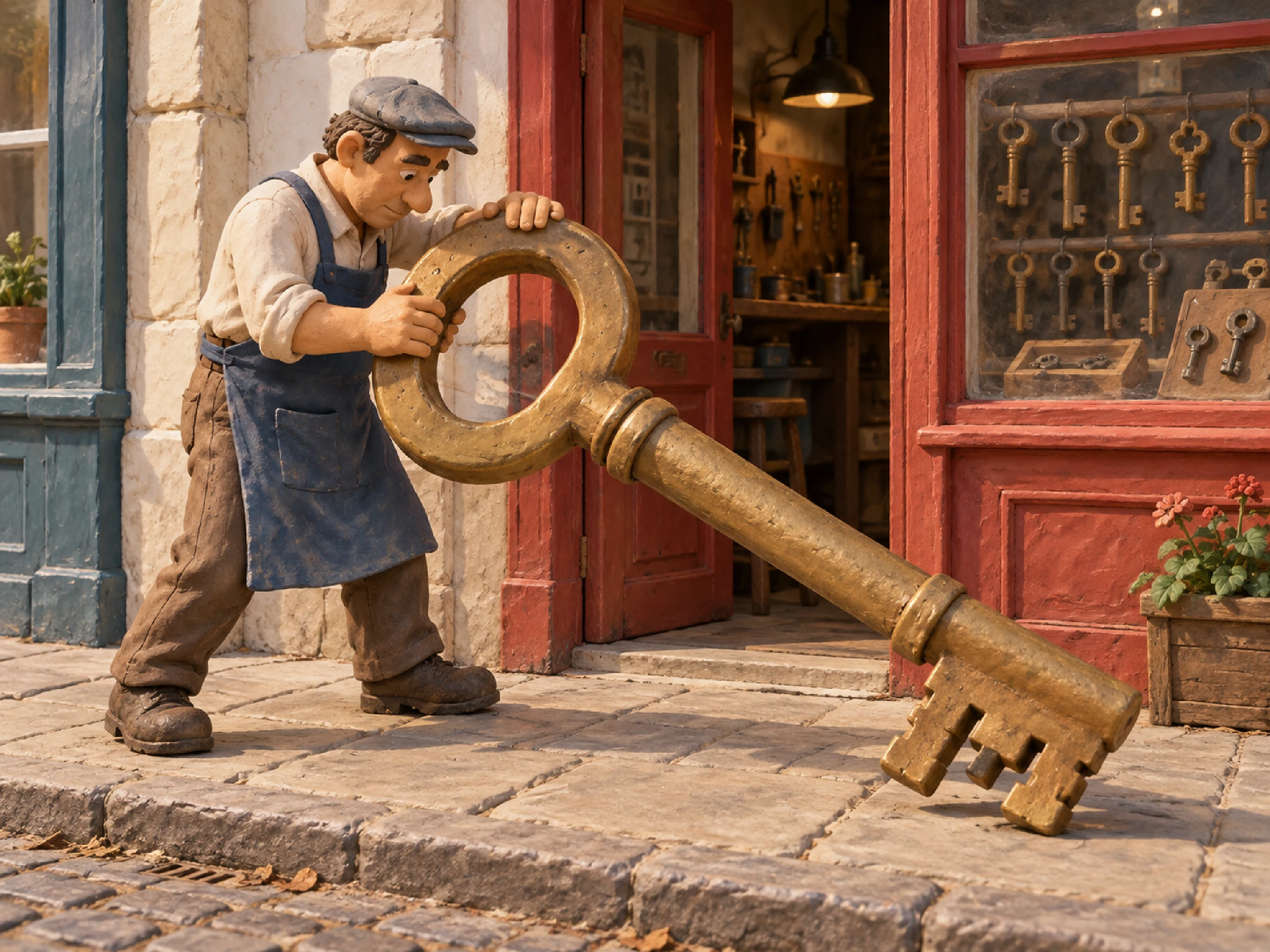
Outside a small key shop, a locksmith rolls a door-height key. Pressed clay surfaces and rounded sculptural masses turn neighborhood craftsmanship into a playful brand image.
Remix this referenceLocksmith and the Door-Height Key
- Form language
- Build a sculptural clay miniature from rounded, gently compressed masses; simplify minor detail while keeping construction readable.
- Contour
- Use substantial uninked edges with hand-shaped waviness; junctions look pressed together, with naturally varying edge irregularity.
- Mark-making
- Retain occasional thumb depressions, blunt tool drags and uneven pressed edges; vary marks freely within the handmade vocabulary.
- Surface rendering
- Use matte clay modeling with soft tonal rolls and shallow relief; rubbed patches and small dents interrupt broad surfaces.
Priority
Retain the tactile character of a handmade sculptural clay miniature.
What to avoid & what to check
Exact prompt for this example
MODULE OWNERSHIP
subject: Subject count, type, stable proportions and landmarks, resting face geometry, hair shape, physical materials, garment construction and permanent marks. No emotion, movement, color assignment or rendering recipe.
expression: Facial soft-tissue displacement and pupil direction, muscle coordination, regional intensity, asymmetry and onset/peak/release. No head/body pose, stable appearance, skin color or rendering.
gesture: Head/neck/body/limb orientation, joint movement, support, contact and pose-caused occlusion using existing anatomy. No eye/pupil movement, emotion, identity, props inventory or camera.
props: Prop count, type, construction, physical material and scale relative to the subject. Holding/contact belongs to gesture, position to composition, color to palette.
scene: Environment elements, terrain, backdrop/floor presence and structural detail. No canvas positions, camera, lighting, assigned colors or render texture.
camera: Projection, focal-length impression, camera elevation/yaw/roll, viewing distance and crop. No actor pose, world placement, lighting or canvas aspect ratio.
composition: Normalized 0-100% canvas positions, scale in frame, depth/overlap, focal hierarchy and margins. No joint pose, camera projection, rendering, subject/prop inventory or emotion.
palette: Color anchors, hue/saturation/value ranges, colors assigned to parts and approximate color coverage. No illumination direction, shading algorithm, physical material or layout.
lighting: Light-source direction/softness/intensity, ambient illumination, physical shadow direction/length and highlight position. Absence of directional illumination is allowed. No shading technique, palette or material changes.
style: Reusable form abstraction, contour weight/taper/edge quality, medium and mark scale/density/direction, surface rendering and tonal transition technique. No fixed subject proportions, anatomy, identity, expression, pose, palette, light-source direction, camera or layout.
output: Image count, aspect ratio, size, file/alpha requirements and global lettering/logo/watermark restrictions. No background scenery, crop, style, identity or pose.

SUBJECT
inventory: One original adult locksmith, actor A; no other people or animals.
geometry: An ordinary adult build with broad hands and a compact head; recognizable proportions without exaggerated anatomy.
resting-face: A broad oval face with straight brows, shallow-set eyes, a rounded nose tip and a wide, thin-lipped mouth.
appearance: A soft cap covers the hair; a canvas bib apron layers over a loose shirt, work trousers and plain closed shoes.

PRIORITY


AVOID


CHECK


EXPRESSION — ACTOR A
brows: Brows remain relaxed, with no lift or inward pinch.
lids: Upper lids stay comfortably open; lower lids carry no squeeze.
cheeks: Cheeks rest without lifting or bunching.
nose: Nostrils remain relaxed, with no flare or bridge wrinkle.
mouth: Lips meet lightly, with level corners and no smile tension.
jaw: The jaw stays loosely closed without clenching.
gaze: Visible pupils look down toward the hand.
coordination: Keep the face quietly attentive; pupil direction carries the focus.
timing: Hold a settled neutral apex, with no transitional grimace.

PRIORITY


AVOID


CHECK


GESTURE
head: A inclines the head toward the working hands, leaving the near cheek and mouth visible in three-quarter profile.
torso: A leans forward from the hips, keeping the back in one easy working curve.
limbs: One leg steps forward; bent elbows let one hand push the bow while the other steadies the shaft.
contact: Palms meet the key directly; its circular bow bears on the paving, and both feet remain grounded.

PRIORITY


AVOID


CHECK


PROPS
inventory: One oversized metal door key, slightly longer than A is tall; no separate tools.
construction: A thick circular bow joins a stout shaft and broad toothed bit, forming a recognizable old door key.

PRIORITY


AVOID


CHECK


SCENE
inventory: A neighborhood key shop exterior with a recessed doorway, display window, built-in sill and paved sidewalk.
structure: A narrow masonry frontage meets a shallow curb and gutter; the open door reveals a modest workshop recess.

PRIORITY


AVOID


CHECK


CAMERA
projection: Natural perspective with a gentle standard-lens impression and little distortion.
viewpoint: View from just above sidewalk height, oblique to the shopfront, with a level horizon.
crop: A medium-wide view includes the whole locksmith and key, cropping portions of the neighboring frontage.

PRIORITY


AVOID


CHECK


COMPOSITION
placement: The key spans the lower half toward the doorway; A occupies the left third beneath the rising shaft.
depth: Read the key first, A second and the recessed shop third; slight overlaps connect the foreground to the frontage.
spacing: Leave generous space within the bow and a quiet upper wall; separate the toothed end from competing edges.

PRIORITY


AVOID


CHECK


PALETTE
colors: Warm ochre, dusty vermilion, deep petrol blue and chalk cream, with restrained saturation.
assignment: Ochre for the key, vermilion for shop trim, petrol blue for the apron, cream for masonry and paving; warm beige for skin.
balance: Cream covers most of the image; ochre forms a substantial accent, with smaller blue and vermilion passages.

PRIORITY


AVOID


CHECK


LIGHTING
sources: A broad soft source from upper left, with gentle ambient illumination reaching into the doorway.
shadows: Short shadows fall toward lower right; contact shadows anchor the bow and shoes to the pavement.
highlights: Broad highlights gather along upper-left ridges, without sharp reflective glare.

PRIORITY


AVOID


CHECK


STYLE GUIDE
form-language: Build a sculptural clay miniature from rounded, gently compressed masses; simplify minor detail while keeping construction readable.
contour: Use substantial uninked edges with hand-shaped waviness; junctions look pressed together, with naturally varying edge irregularity.
mark-making: Retain occasional thumb depressions, blunt tool drags and uneven pressed edges; vary marks freely within the handmade vocabulary.
surface-rendering: Use matte clay modeling with soft tonal rolls and shallow relief; rubbed patches and small dents interrupt broad surfaces.

PRIORITY
Retain the tactile character of a handmade sculptural clay miniature.

AVOID


CHECK


OUTPUT
format: One finished image, landscape 4:3, 2400 × 1800 pixels, opaque PNG.
restrictions: No lettering, logos, signatures or watermarks.

PRIORITY


AVOID


CHECK


FINAL INTEGRATION
props + scene + composition: Use the relationship between the familiar architecture and the prop to make the change of scale immediately understandable.
expression + gesture: Let the facial attention and working movement describe the same continuous task.
style + lighting: Let illumination reveal the handmade surface language without overwhelming its subtle relief.
Model information comes from image provenance. The same prompt may produce a different result.