Text to imageArt stylesStyle guide
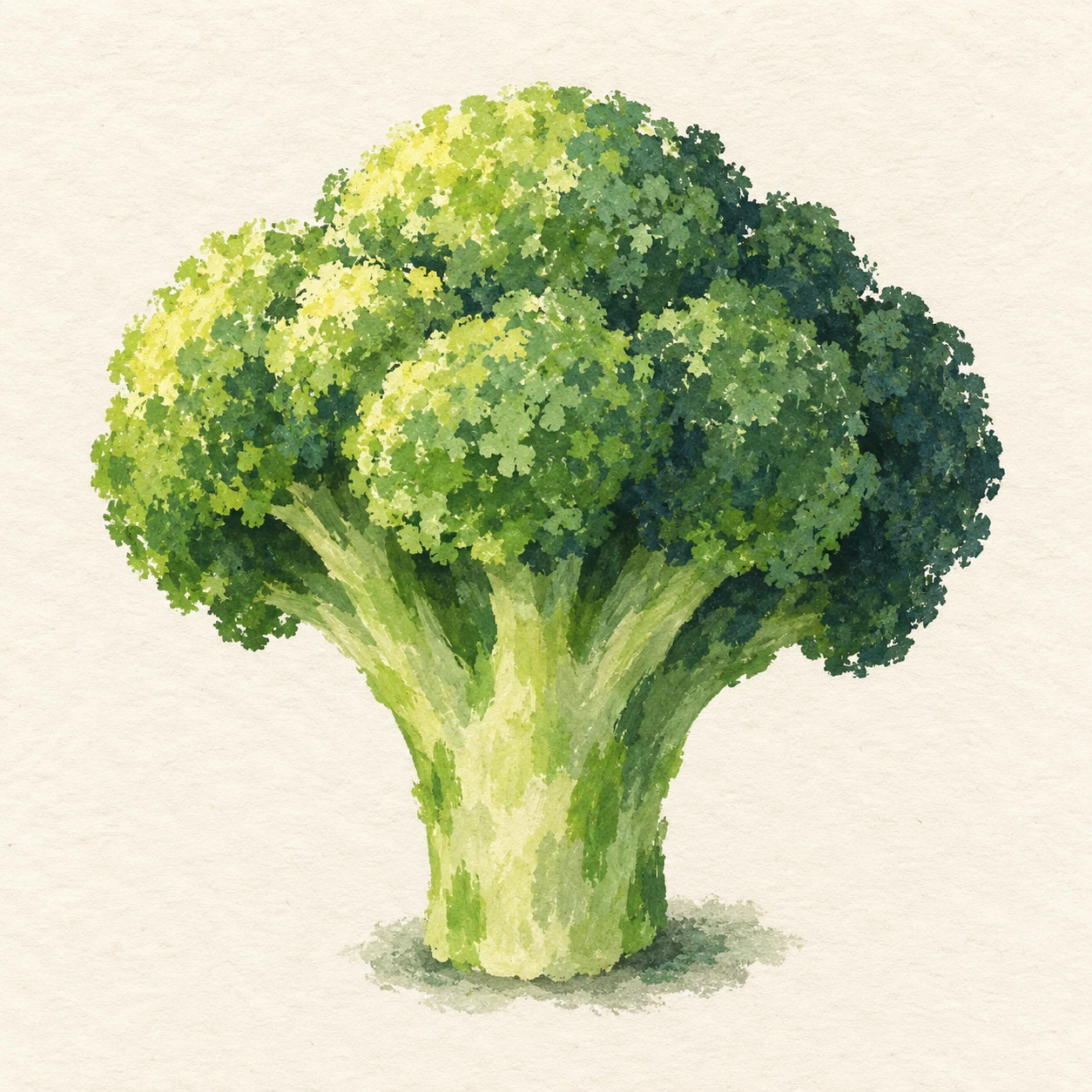
One Broccoli Floret · Sponge-Printed Gouache
A style reference using opaque gouache sponge impressions to describe the clustered forms and shading of one broccoli floret.
One Broccoli Floret · Sponge-Printed Gouache
- Shape & line
- Build the crown from several overlapping rounded lobes, using broken sponge impressions along their outer edges; paint the stalk as a simple tapering shape with a few broad brush marks that join visibly beneath the crown.
- Color & light
- Place the light toward the upper left of the image: stamp pale yellow-green onto the upper-left faces of the lobes, retain middle green across their centers, and gather deep blue-green beneath overlapping lobes and along the image-right underside.
- Texture & material
- Use opaque, matte gouache applied with a coarse sponge, leaving irregular porous marks and small cream-paper gaps; overlap broad dark impressions with smaller light impressions so the crown reads as clustered buds rather than a continuous smooth fill.
- Composition
- Let the crown occupy most of the subject width and keep the exposed stalk shorter than the crown height; concentrate the clearest sponge marks near the upper center, simplify the lower stalk, and place a small muted green-gray grounding shadow directly beneath its base.
Priority
Prioritize readable bud clusters and visibly porous sponge impressions.
What to avoid & what to check
Avoid glossy rendering, smooth airbrushed shading, and uniformly repeated dots.
Check that one connected floret is recognizable and its lighter upper-left lobes retain broken sponge texture.
Exact prompt for this example
SUBJECT
Depict exactly one broccoli floret with a rounded crown of clustered buds connected to one short, thick stalk; show the stalk branching into the underside of the crown.

COMPOSITION
Center the floret upright in a square frame, viewed slightly from above so the crown and branching stalk remain readable; leave generous cream-paper space around its silhouette.

STYLE GUIDE
1. Shape & line
Build the crown from several overlapping rounded lobes, using broken sponge impressions along their outer edges; paint the stalk as a simple tapering shape with a few broad brush marks that join visibly beneath the crown.

2. Color & light
Place the light toward the upper left of the image: stamp pale yellow-green onto the upper-left faces of the lobes, retain middle green across their centers, and gather deep blue-green beneath overlapping lobes and along the image-right underside.

3. Texture & material
Use opaque, matte gouache applied with a coarse sponge, leaving irregular porous marks and small cream-paper gaps; overlap broad dark impressions with smaller light impressions so the crown reads as clustered buds rather than a continuous smooth fill.

4. Composition
Let the crown occupy most of the subject width and keep the exposed stalk shorter than the crown height; concentrate the clearest sponge marks near the upper center, simplify the lower stalk, and place a small muted green-gray grounding shadow directly beneath its base.

PRIORITY
Preserve the requested identity, count, action, composition and output settings. Apply the style rules within those constraints; a style reference must not replace the subject or layout. Within the style: Prioritize readable bud clusters and visibly porous sponge impressions.

AVOID
Avoid glossy rendering, smooth airbrushed shading, and uniformly repeated dots.

OUTPUT
Produce one square image with no lettering, labels, signature, or watermark.

SELF-CHECK
Check that one connected floret is recognizable and its lighter upper-left lobes retain broken sponge texture.
Model information comes from image provenance. The same prompt may produce a different result.