Text to imageCafe & brandStyle guide
Oyster Mushroom Gills · Watercolor Wrap
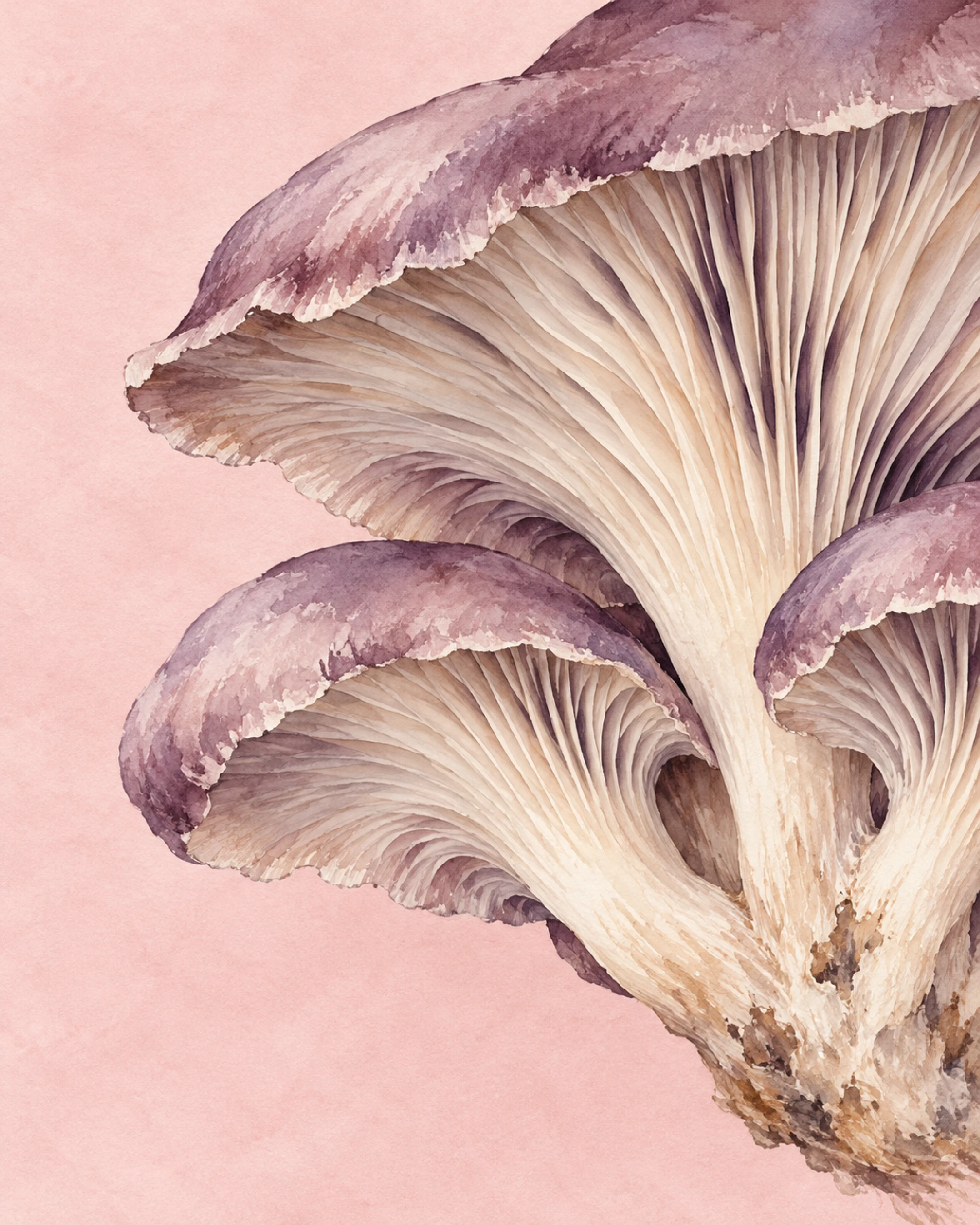
A brand illustration for an independent mushroom grower's packaging sleeve. Intimate gill fans and expansively cropped caps become a generous harvest image through watercolor blooms and broken edges.
Remix this referenceOyster Mushroom Gills · Watercolor Wrap
- Form language
- Compress repeated detail into sweeping grouped rhythms, pairing broad organic masses with a few slender accents. Preserve expressive irregularity rather than tracing every small feature.
- Contour
- Use lost-and-found watercolor boundaries: occasional firm painted edges dissolve into feathered gaps and dry breaks. Do not surround every form with a continuous ink outline of equal weight.
- Mark-making
- Alternate broad wet brush passes with sparse, directional dry-brush flicks. Let stroke width, pigment load, and small edge interruptions vary naturally within a coherent wet-and-dry rhythm.
- Surface rendering
- Allow visible backrun blooms inside transparent washes, pigment pooling beside selected edges, and small untouched reserves. Tonal transitions mingle unevenly, making the watercolor process visibly part of the finished design.
Priority
Make blooms and broken edges feel intentional and alive.
What to avoid & what to check
Avoid uniform digital softness or a repeated texture overlay.
Wet passages and dry interruptions remain visibly different.
Exact prompt for this example
MODULE OWNERSHIP
subject: Subject count, type, stable proportions and landmarks, resting face geometry, hair shape, physical materials, garment construction and permanent marks. No emotion, movement, color assignment or rendering recipe.
expression: Facial soft-tissue displacement and pupil direction, muscle coordination, regional intensity, asymmetry and onset/peak/release. No head/body pose, stable appearance, skin color or rendering.
gesture: Head/neck/body/limb orientation, joint movement, support, contact and pose-caused occlusion using existing anatomy. No eye/pupil movement, emotion, identity, props inventory or camera.
props: Prop count, type, construction, physical material and scale relative to the subject. Holding/contact belongs to gesture, position to composition, color to palette.
scene: Environment elements, terrain, backdrop/floor presence and structural detail. No canvas positions, camera, lighting, assigned colors or render texture.
camera: Projection, focal-length impression, camera elevation/yaw/roll, viewing distance and crop. No actor pose, world placement, lighting or canvas aspect ratio.
composition: Normalized 0-100% canvas positions, scale in frame, depth/overlap, focal hierarchy and margins. No joint pose, camera projection, rendering, subject/prop inventory or emotion.
palette: Color anchors, hue/saturation/value ranges, colors assigned to parts and approximate color coverage. No illumination direction, shading algorithm, physical material or layout.
lighting: Light-source direction/softness/intensity, ambient illumination, physical shadow direction/length and highlight position. Absence of directional illumination is allowed. No shading technique, palette or material changes.
style: Reusable form abstraction, contour weight/taper/edge quality, medium and mark scale/density/direction, surface rendering and tonal transition technique. No fixed subject proportions, anatomy, identity, expression, pose, palette, light-source direction, camera or layout.
output: Image count, aspect ratio, size, file/alpha requirements and global lettering/logo/watermark restrictions. No background scenery, crop, style, identity or pose.

SUBJECT
inventory: One original oyster mushroom cluster comprising three fruiting bodies joined at a shared base. This botanical cluster is the sole subject of the grower's pictorial brand artwork.
geometry: Use broad, shallow shelf caps with irregular rounded lobes, short lateral stems, and gills that converge into the stem junction. Different cap sizes establish recognizable clustered growth rather than three matching disks.
appearance: Preserve fleshy cap tissue, delicate gill membranes, and a fibrous shared base. Include a few naturally uneven cap margins; the cluster is fresh and intact, without decorative carving or permanent graphic marks.

PRIORITY
Make the shared gill-to-stem construction unmistakably oyster mushroom.

AVOID
Avoid generic umbrella mushrooms with long central stalks.

CHECK
The unequal shelf caps belong convincingly to one connected cluster.

PROPS
inventory: No separate props. The packaging sleeve is the intended application of the artwork, not an object depicted within it.
construction: No prop construction, physical material, or subject-relative scale applies because no separate accessory object is depicted.

PRIORITY
Let the botanical subject carry the brand image unaided.

AVOID
Avoid baskets, utensils, labels, or packaging mockup hardware.

CHECK
No accessory competes with the mushroom cluster.

SCENE
inventory: A continuous backing field surrounds the botanical subject. There is no depicted room, landscape, tabletop, or floor.
structure: Keep the backing field uninterrupted, without a horizon, enclosing border, ornamental frame, or architectural divisions. It provides a simple setting for a finished packaging illustration.

PRIORITY
Keep the setting quiet enough for an intimate botanical encounter.

AVOID
Avoid turning the artwork into a farm landscape.

CHECK
The setting introduces no competing environmental story.

CAMERA
projection: Use a natural perspective with a moderately long focal-length impression. Close structures remain legible without exaggerated near-to-far expansion.
viewpoint: An intimate close view sits slightly below the cap shelves, with an oblique yaw that reveals the underside fans and their stem junction. Keep the viewing axis unrolled.
crop: Cut through the largest cap at the top and right edges, suggesting growth beyond the picture. Retain the shared base and enough of both smaller caps to explain the cluster.

PRIORITY
Let the close underside view reveal an unexpected brand motif.

AVOID
Avoid a complete, distant specimen view.

CHECK
The gill fans read clearly despite the expressive crop.

COMPOSITION
placement: Let the cluster inhabit roughly the rightmost 65% of the canvas. Its gill junction is the focal anchor; the broadest cap supplies a generous upper mass.
depth: Overlap the smaller caps beneath the dominant shelf, with a clear sequence from front gill fan to shared base to rear cap. Preserve a few openings between these masses.
spacing: Leave a spacious, uneven opening along the left side. The dense fan rhythms and this quieter interval should feel deliberately asymmetric rather than fitted into a badge.

PRIORITY
Balance expansive botanical detail with a generous quiet interval.

AVOID
Avoid a centered seal or evenly spaced specimen arrangement.

CHECK
The gill junction leads attention before the cap perimeter does.

PALETTE
colors: Use smoky plum, muted lilac, warm ivory, and pale shell pink. Keep saturation restrained, with a small range of richer plum accents.
assignment: Assign lilac and plum to the caps, warm ivory to gills and stems, and shell pink to the backing field. Deeper plum distinguishes the narrow gill recesses.
balance: Let the pale anchors dominate the image, while plum remains a concentrated counterweight. Related hue variations are welcome without adding unrelated accent families.

PRIORITY
Make the plum-and-ivory relationship the memorable brand signature.

AVOID
Avoid a miscellaneous rainbow across individual gills.

CHECK
The few deeper accents strengthen the pale color family.

LIGHTING
sources: A broad, soft source arrives from the upper left, with ample ambient illumination reaching the undersides. Keep the overall contrast gentle.
shadows: Overlapping caps cast short, soft shadows toward the lower right onto neighboring tissue. Gill recesses remain readable; no ground shadow is needed.
highlights: Broad highlights sit on the upper-left cap lips and exposed stem ridges. Avoid tiny sparkling points that imply a polished surface.

PRIORITY
Reveal the underside without sacrificing its sheltered depth.

AVOID
Avoid harsh spotlight contrast across the gills.

CHECK
Soft overlap shadows clarify which cap sits in front.

STYLE GUIDE
form-language: Compress repeated detail into sweeping grouped rhythms, pairing broad organic masses with a few slender accents. Preserve expressive irregularity rather than tracing every small feature.
contour: Use lost-and-found watercolor boundaries: occasional firm painted edges dissolve into feathered gaps and dry breaks. Do not surround every form with a continuous ink outline of equal weight.
mark-making: Alternate broad wet brush passes with sparse, directional dry-brush flicks. Let stroke width, pigment load, and small edge interruptions vary naturally within a coherent wet-and-dry rhythm.
surface-rendering: Allow visible backrun blooms inside transparent washes, pigment pooling beside selected edges, and small untouched reserves. Tonal transitions mingle unevenly, making the watercolor process visibly part of the finished design.

PRIORITY
Make blooms and broken edges feel intentional and alive.

AVOID
Avoid uniform digital softness or a repeated texture overlay.

CHECK
Wet passages and dry interruptions remain visibly different.

OUTPUT
format: Deliver one finished portrait image, 4:5 aspect ratio, 2048 × 2560 pixels, as an opaque PNG.
restrictions: Include no lettering, logos, watermarks, registration marks, or presentation panels. The deliverable is the complete pictorial brand artwork.

PRIORITY
Deliver a finished, directly usable brand illustration.

AVOID
Avoid a contact sheet or explanatory design board.

CHECK
One complete image meets the specified export format.

FINAL INTEGRATION
subject + camera + composition: Let botanical recognition survive the intimate viewpoint while the arrangement gives the detail a confident brand presence.
palette + lighting + style: Keep the color identity consistent as soft illumination and watercolor variation develop the forms.
Model information comes from image provenance. The same prompt may produce a different result.