Text to imageIllustrationStyle guide
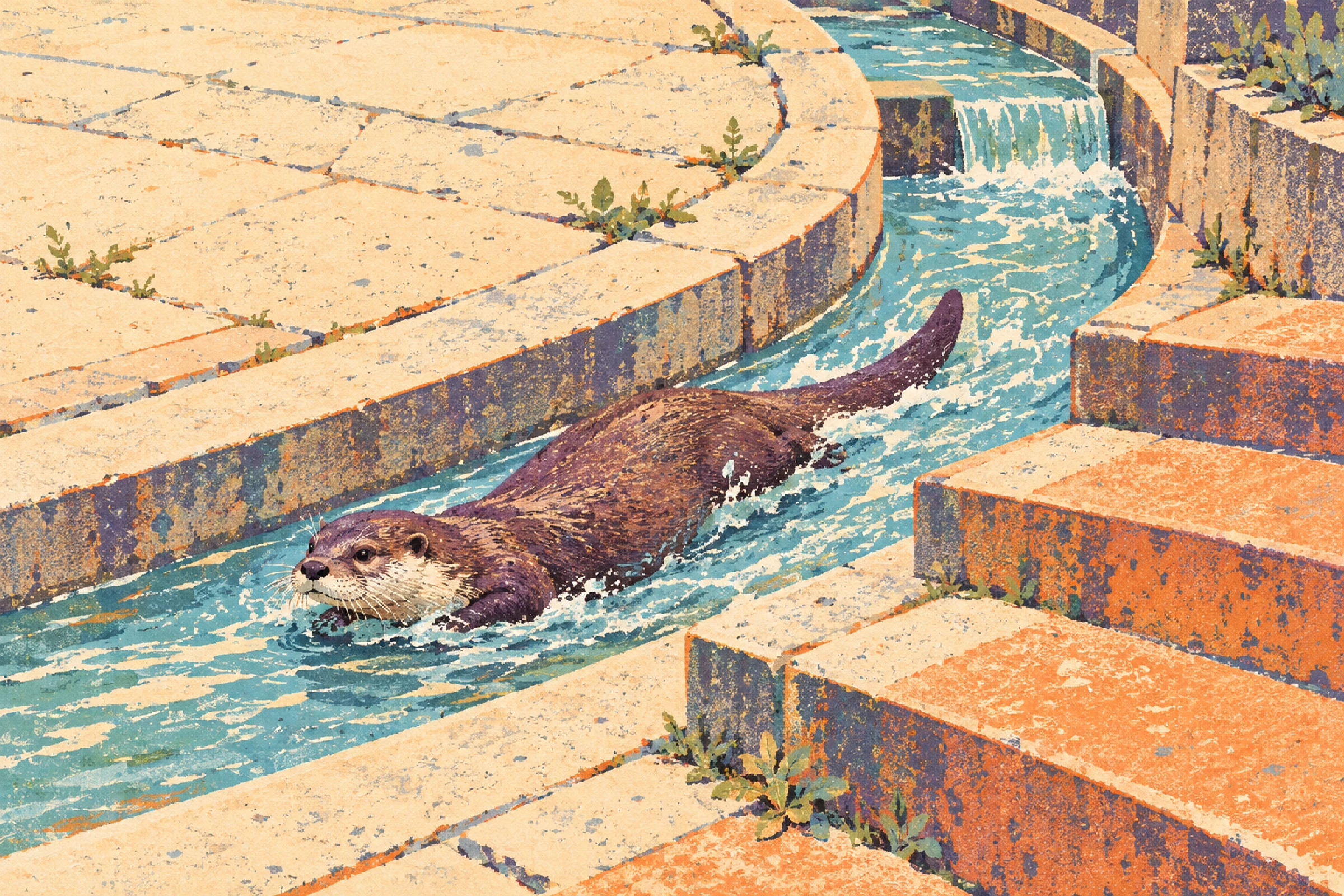
Otter Sliding Down the Rain Channel
An otter slides down a rain channel beside outdoor steps after a shower. Spacious paving and a curling ribbon of water carry grainy risograph impressions and playful registration offsets.
Remix this referenceOtter Sliding Down the Rain Channel
- Form language
- Reduce forms into supple cut-stencil masses and blunt geometric fragments; let minor shapes vary within this shared vocabulary.
- Contour
- Alternate unoutlined silhouettes with short, uneven ink contours; playful registration slips leave doubled edge slivers.
- Mark-making
- Use risograph grain, broken crayon-like strokes and loosely grouped speckles, allowing density and pressure to vary naturally.
- Surface rendering
- Build tone through translucent ink overlaps and irregular screened patches; retain porous coverage and occasional paper breaks.
Priority
Make grain and playful registration offsets integral to the risograph print.
What to avoid & what to check
Exact prompt for this example
MODULE OWNERSHIP
subject: Subject count, type, stable proportions and landmarks, resting face geometry, hair shape, physical materials, garment construction and permanent marks. No emotion, movement, color assignment or rendering recipe.
expression: Facial soft-tissue displacement and pupil direction, muscle coordination, regional intensity, asymmetry and onset/peak/release. No head/body pose, stable appearance, skin color or rendering.
gesture: Head/neck/body/limb orientation, joint movement, support, contact and pose-caused occlusion using existing anatomy. No eye/pupil movement, emotion, identity, props inventory or camera.
props: Prop count, type, construction, physical material and scale relative to the subject. Holding/contact belongs to gesture, position to composition, color to palette.
scene: Environment elements, terrain, backdrop/floor presence and structural detail. No canvas positions, camera, lighting, assigned colors or render texture.
camera: Projection, focal-length impression, camera elevation/yaw/roll, viewing distance and crop. No actor pose, world placement, lighting or canvas aspect ratio.
composition: Normalized 0-100% canvas positions, scale in frame, depth/overlap, focal hierarchy and margins. No joint pose, camera projection, rendering, subject/prop inventory or emotion.
palette: Color anchors, hue/saturation/value ranges, colors assigned to parts and approximate color coverage. No illumination direction, shading algorithm, physical material or layout.
lighting: Light-source direction/softness/intensity, ambient illumination, physical shadow direction/length and highlight position. Absence of directional illumination is allowed. No shading technique, palette or material changes.
style: Reusable form abstraction, contour weight/taper/edge quality, medium and mark scale/density/direction, surface rendering and tonal transition technique. No fixed subject proportions, anatomy, identity, expression, pose, palette, light-source direction, camera or layout.
output: Image count, aspect ratio, size, file/alpha requirements and global lettering/logo/watermark restrictions. No background scenery, crop, style, identity or pose.

SUBJECT
inventory: A is one adult river otter, the only animal or person depicted.
geometry: An elongated body, short legs, small rounded ears and a thick tail tapering continuously from the rump.
resting-face: Small almond-shaped eyes beneath low brow ridges, a broad nasal pad and rounded whisker pads around a short mouth.
appearance: Dense, close-lying fur with a few projecting whiskers; no clothing, accessories or permanent markings.

PRIORITY


AVOID


CHECK


EXPRESSION — ACTOR A
brows: Brow tissue settles without lifting or drawing inward.
lids: Upper lids soften slightly; lower lids remain untensed.
cheeks: Whisker pads rest without bunching or lifting.
nose: The nasal pad stays unwrinkled and nostril rims remain relaxed.
mouth: Lips meet lightly with neither a grin nor a downward pull.
jaw: The jaw settles closed without clenching.
gaze: Both pupils aim downstream with a steady, unfixed gaze.
coordination: Upper and lower facial muscles relax together, with little asymmetry.
timing: Capture the release after initial effort, as facial tension settles.

PRIORITY


AVOID


CHECK


GESTURE
head: A extends its head downstream with the neck low and the muzzle just clear of the water.
torso: A slides belly-first, bending its torso gently with the channel's curve.
limbs: Forefeet tuck beside the chest, hind feet trail loosely, and the tail follows in a relaxed curve.
contact: A's belly stays in contact with the water as it slides.

PRIORITY


AVOID


CHECK


PROPS
inventory: No separate props.
construction: No prop construction applies.

PRIORITY


AVOID


CHECK


SCENE
inventory: An outdoor stairway, a rainwater channel, broad paving, a low retaining wall and sparse weeds in joints.
structure: A shallow concrete flume curves beside the steps and widens into a runoff apron; shallow post-rain water flows through it with a small splash.

PRIORITY


AVOID


CHECK


CAMERA
projection: Moderate wide-angle perspective with gentle depth recession and little edge distortion.
viewpoint: A high oblique view diagonally across the stairway, with a level camera roll.
crop: A wide environmental view includes the entire otter while cropping the continuing stairs and channel at the edges.

PRIORITY


AVOID


CHECK


COMPOSITION
placement: A occupies the lower-left third; the channel sweeps in from the upper right, leaving broad open paving above.
depth: The otter and surrounding water lead the hierarchy; overlapping stair edges form a quieter receding layer.
spacing: Keep A small within the setting, with generous downstream space and unequal intervals between visual accents.

PRIORITY


AVOID


CHECK


PALETTE
colors: Warm ivory, muted turquoise, persimmon orange and deep plum form a restrained palette.
assignment: Ivory carries the paving, turquoise the water, orange selected stair planes, and plum the otter and structural accents.
balance: Pale values dominate; concentrated plum and occasional orange punctuate quieter turquoise passages.

PRIORITY


AVOID


CHECK


LIGHTING
sources: Broad, soft daylight arrives from the upper left, supported by generous ambient light.
shadows: Short, soft shadows fall toward the lower right beneath stair lips and the otter.
highlights: Restrained highlights catch the otter's upper back and the raised edges of small water ripples.

PRIORITY


AVOID


CHECK


STYLE GUIDE
form-language: Reduce forms into supple cut-stencil masses and blunt geometric fragments; let minor shapes vary within this shared vocabulary.
contour: Alternate unoutlined silhouettes with short, uneven ink contours; playful registration slips leave doubled edge slivers.
mark-making: Use risograph grain, broken crayon-like strokes and loosely grouped speckles, allowing density and pressure to vary naturally.
surface-rendering: Build tone through translucent ink overlaps and irregular screened patches; retain porous coverage and occasional paper breaks.

PRIORITY
Make grain and playful registration offsets integral to the risograph print.

AVOID


CHECK


OUTPUT
format: One finished illustration, landscape 3:2, 2400 × 1600 pixels, opaque PNG.
restrictions: No lettering, logos, signatures or watermarks.

PRIORITY


AVOID


CHECK


FINAL INTEGRATION
expression + gesture + camera: Keep facial acting legible at the chosen viewing distance while letting the sliding action remain coherent.
gesture + scene + composition: Let the action, channel structure and open intervals cooperate to carry the viewer through the image.
Model information comes from image provenance. The same prompt may produce a different result.