Text to imageProductStyle guide
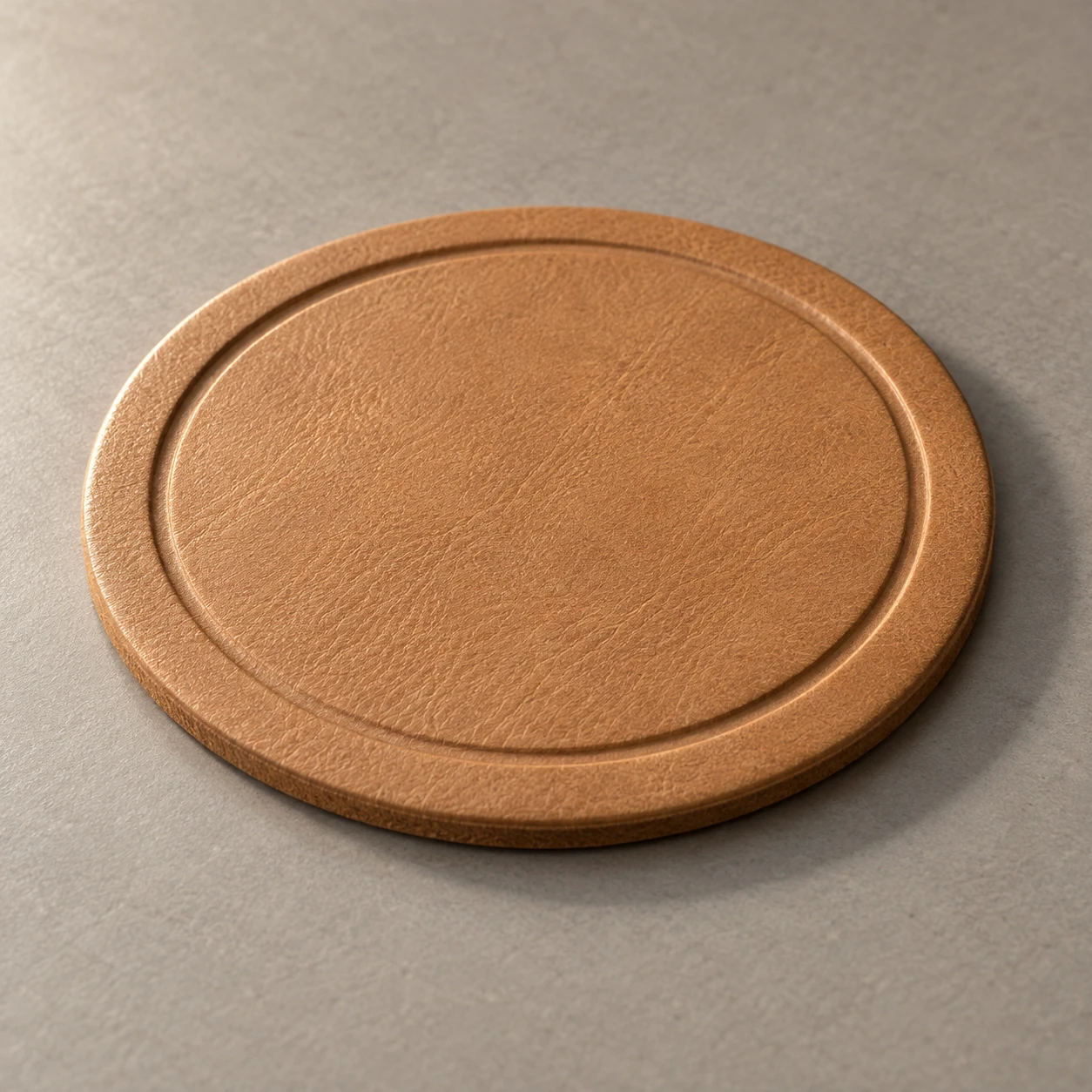
One Leather Coaster · Raking Light on Debossing
Reveal a shallow debossed ring in a leather coaster through low-angle light and contrasting edges inside the groove.
One Leather Coaster · Raking Light on Debossing
- Shape & line
- Build the coaster as a thin, solid leather disk with a clean elliptical outline and a visible front cut edge; trace one continuous recessed ring across its top, compressing the far arc in perspective while keeping both groove edges readable.
- Color & light
- Send a broad, low-angle key light from image upper left across the tan face toward image lower right. Along the near, lower-right arc of the ring, let the upper-left groove lip cast a narrow shadow into the recess and let the opposite inner wall catch a slim highlight; cast the coaster's tabletop shadow toward image lower right.
- Texture & material
- Render the leather with subdued, irregular grain and a soft matte sheen. Flatten and smooth the grain within the pressed groove, preserving the same tan material color so that the recessed relief is explained by light and surface compression rather than a painted stripe.
- Composition
- Keep the elevated view shallow enough to expose the front thickness but high enough to show the complete ring. Hold the top face and groove in clear focus, and use a quiet, evenly toned tabletop so the paired shadow and highlight remain the main visual cue.
Priority
Make the ring read as a shallow depression through directional light.
What to avoid & what to check
Avoid raised piping, a dark painted ring, or glossy plastic leather.
Check that the ring sits below the top face and its shadows agree with the upper-left light.
Exact prompt for this example
SUBJECT
One round tan leather coaster with a single shallow debossed circular groove inset from its outer edge, lying flat on a plain warm-gray surface. The groove is pressed into the leather and remains visibly below the surrounding face.

COMPOSITION
Use an elevated three-quarter close-up with the entire coaster visible as a broad ellipse, centered slightly below the middle of the frame. Leave a modest border of empty tabletop and make the groove large enough to read clearly.

STYLE GUIDE
1. Shape & line
Build the coaster as a thin, solid leather disk with a clean elliptical outline and a visible front cut edge; trace one continuous recessed ring across its top, compressing the far arc in perspective while keeping both groove edges readable.

2. Color & light
Send a broad, low-angle key light from image upper left across the tan face toward image lower right. Along the near, lower-right arc of the ring, let the upper-left groove lip cast a narrow shadow into the recess and let the opposite inner wall catch a slim highlight; cast the coaster's tabletop shadow toward image lower right.

3. Texture & material
Render the leather with subdued, irregular grain and a soft matte sheen. Flatten and smooth the grain within the pressed groove, preserving the same tan material color so that the recessed relief is explained by light and surface compression rather than a painted stripe.

4. Composition
Keep the elevated view shallow enough to expose the front thickness but high enough to show the complete ring. Hold the top face and groove in clear focus, and use a quiet, evenly toned tabletop so the paired shadow and highlight remain the main visual cue.

PRIORITY
Preserve the requested identity, count, action, composition and output settings. Apply the style rules within those constraints; a style reference must not replace the subject or layout. Within the style: Make the ring read as a shallow depression through directional light.

AVOID
Avoid raised piping, a dark painted ring, or glossy plastic leather.

OUTPUT
One photorealistic product-reference image, square 1:1 aspect ratio, with no lettering, logo, captions, or watermark.

SELF-CHECK
Check that the ring sits below the top face and its shadows agree with the upper-left light.
Model information comes from image provenance. The same prompt may produce a different result.