Text to imageArt stylesStyle guide
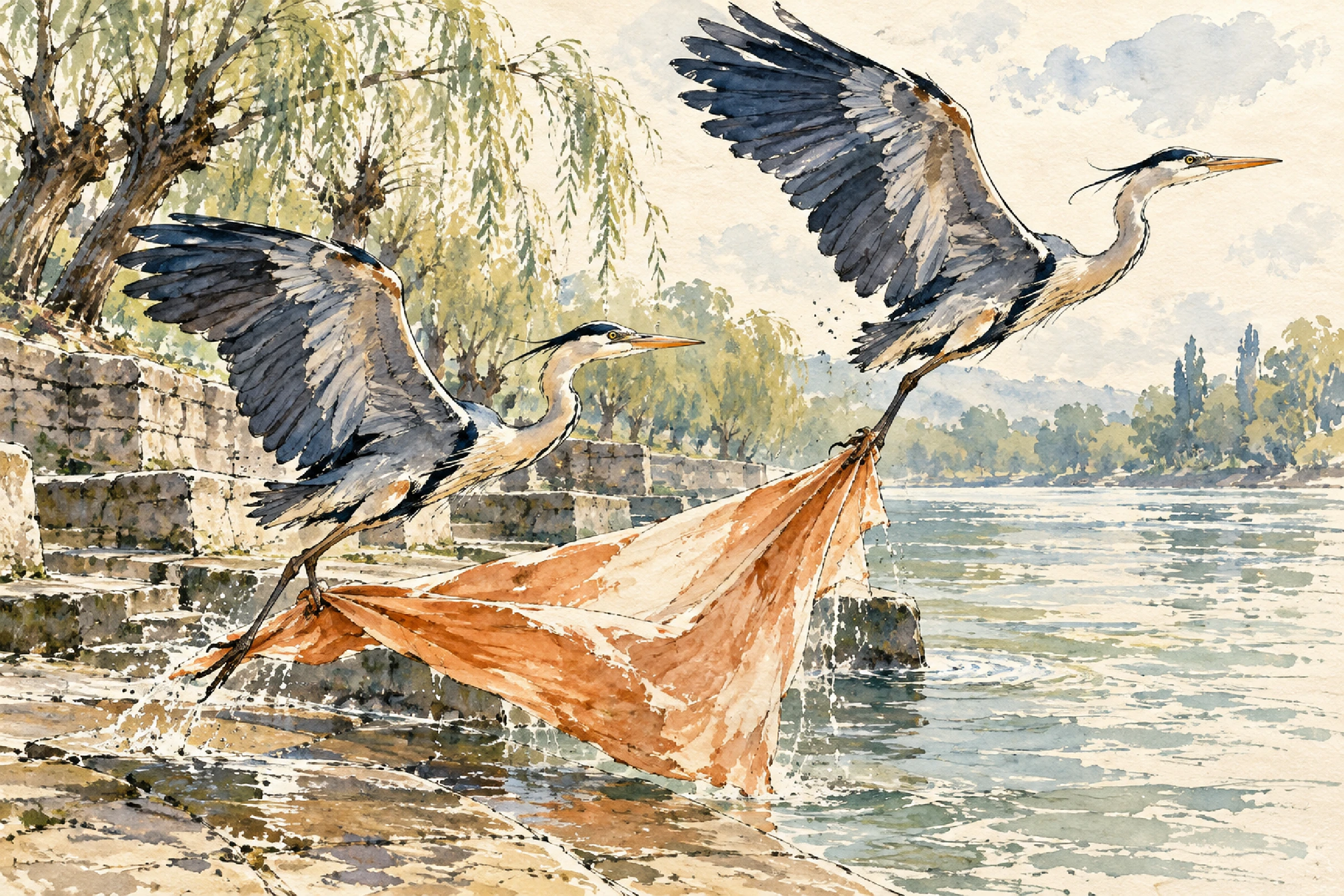
Herons Lifting a Sheet
Two herons rise from a riverside washing ground with a sheet caught on their feet. Spreading ink washes and quick pen lines give the overlapping wings and cloth a lively editorial rhythm.
Remix this referenceHerons Lifting a Sheet
- Form language
- Reduce forms to elastic wedges, ribbons and sweeping arcs; allow selective exaggeration without diagrammatic detail.
- Contour
- Quick pen contours taper, skip and occasionally double back; leave some boundaries entirely to the wash.
- Mark-making
- Editorial ink wash combines decisive wet sweeps with sparse dry nib scratches; vary mark length and pressure naturally.
- Surface rendering
- Transparent washes pool at edges and bloom into damp passages; exposed paper breaks tones into irregular fragments.
Priority
Make fluid ink wash, economical pen lines and untouched paper visibly essential to the rendering.
What to avoid & what to check
Exact prompt for this example
MODULE OWNERSHIP
subject: Subject count, type, stable proportions and landmarks, resting face geometry, hair shape, physical materials, garment construction and permanent marks. No emotion, movement, color assignment or rendering recipe.
expression: Facial soft-tissue displacement and pupil direction, muscle coordination, regional intensity, asymmetry and onset/peak/release. No head/body pose, stable appearance, skin color or rendering.
gesture: Head/neck/body/limb orientation, joint movement, support, contact and pose-caused occlusion using existing anatomy. No eye/pupil movement, emotion, identity, props inventory or camera.
props: Prop count, type, construction, physical material and scale relative to the subject. Holding/contact belongs to gesture, position to composition, color to palette.
scene: Environment elements, terrain, backdrop/floor presence and structural detail. No canvas positions, camera, lighting, assigned colors or render texture.
camera: Projection, focal-length impression, camera elevation/yaw/roll, viewing distance and crop. No actor pose, world placement, lighting or canvas aspect ratio.
composition: Normalized 0-100% canvas positions, scale in frame, depth/overlap, focal hierarchy and margins. No joint pose, camera projection, rendering, subject/prop inventory or emotion.
palette: Color anchors, hue/saturation/value ranges, colors assigned to parts and approximate color coverage. No illumination direction, shading algorithm, physical material or layout.
lighting: Light-source direction/softness/intensity, ambient illumination, physical shadow direction/length and highlight position. Absence of directional illumination is allowed. No shading technique, palette or material changes.
style: Reusable form abstraction, contour weight/taper/edge quality, medium and mark scale/density/direction, surface rendering and tonal transition technique. No fixed subject proportions, anatomy, identity, expression, pose, palette, light-source direction, camera or layout.
output: Image count, aspect ratio, size, file/alpha requirements and global lettering/logo/watermark restrictions. No background scenery, crop, style, identity or pose.

SUBJECT
inventory: Two adult herons, actors A and B; no human figures.
geometry: Both have long slender necks, spear-shaped bills, narrow bodies, broad wings and long legs with long-toed feet.
resting-face: Small lateral eyes and straight bill seams give both birds a spare, recognizable facial structure.
appearance: Layered flight feathers and a short nape crest distinguish each bird; minor feather groupings may vary.

PRIORITY


AVOID


CHECK


EXPRESSION — ACTOR A
brows: No visible brow action is prescribed.
lids: The visible eye stays open, without a squint or raised lower lid.
cheeks: No visible cheek lift or compression is prescribed.
nose: No visible nasal movement is prescribed.
mouth: The bill seam stays closed, without a gape or expressive bend.
jaw: The lower jaw stays closed with no downward release.
gaze: The visible pupil aims forward along the takeoff path.
coordination: The open eye and closed bill remain steady, without humanlike facial acting.
timing: Hold a neutral resting expression through the captured takeoff beat.

PRIORITY


AVOID


CHECK


EXPRESSION — ACTOR B
brows: No visible brow action is prescribed.
lids: The visible eye stays open, without narrowing or eyelid tension.
cheeks: No visible cheek lift or compression is prescribed.
nose: No visible nasal movement is prescribed.
mouth: The bill remains gently closed, without opening to call.
jaw: The lower jaw stays closed without a visible drop.
gaze: The visible pupil aims forward along the shared takeoff path.
coordination: Keep the eye open and bill closed without adding a separate facial reaction.
timing: Hold a neutral resting expression through the captured takeoff beat.

PRIORITY


AVOID


CHECK


GESTURE
head: Both bills point along the takeoff path, with necks drawing into loose flight folds.
torso: Both bodies pitch gently forward through the same sweeping takeoff.
limbs: A lifts its wings while B drives a downstroke; their long legs trail at different stages of extension.
contact: One foot from each bird catches a different part of the sheet hem, lifting the cloth between them.

PRIORITY


AVOID


CHECK


PROPS
inventory: One bed sheet, broad enough to span the two herons.
construction: A lightweight woven linen rectangle with a plain hem and softened, well-used edges.

PRIORITY


AVOID


CHECK


SCENE
inventory: An old riverside washing ground with stone paving, shallow washing steps, river water and pollarded willows.
structure: Worn steps descend into the river; uneven paving and willow branches suggest a working place without clutter.

PRIORITY


AVOID


CHECK


CAMERA
projection: Natural perspective with a mildly wide lens impression.
viewpoint: A slightly elevated side view looks across the washing steps, with no camera roll.
crop: A wide environmental view includes both complete wing spans and the lifted sheet.

PRIORITY


AVOID


CHECK


COMPOSITION
placement: The group sweeps from lower left toward upper right, A ahead of B, with broad open space above the river.
depth: The sheet overlaps B below, while A clears its upper edge; willow branches occupy a distant layer.
spacing: The stretched cloth is the first read, followed by the alternating wings; open gaps preserve each silhouette.

PRIORITY


AVOID


CHECK


PALETTE
colors: Paper ivory, smoky indigo, rusty orange and pale celadon, with near-black accents.
assignment: Indigo belongs to the herons, rusty orange to the sheet, celadon to river and foliage, and ivory to open areas.
balance: Ivory remains dominant; pale cool colors accompany one assertive warm cloth accent.

PRIORITY


AVOID


CHECK


LIGHTING
sources: Broad overcast daylight supplies soft illumination from above with little directional contrast.
shadows: Faint diffuse shadows gather beneath the lifted cloth and fade softly across the paving.
highlights: Restrained broad highlights lie on upper wing surfaces and outward cloth folds.

PRIORITY


AVOID


CHECK


STYLE GUIDE
form-language: Reduce forms to elastic wedges, ribbons and sweeping arcs; allow selective exaggeration without diagrammatic detail.
contour: Quick pen contours taper, skip and occasionally double back; leave some boundaries entirely to the wash.
mark-making: Editorial ink wash combines decisive wet sweeps with sparse dry nib scratches; vary mark length and pressure naturally.
surface-rendering: Transparent washes pool at edges and bloom into damp passages; exposed paper breaks tones into irregular fragments.

PRIORITY
Make fluid ink wash, economical pen lines and untouched paper visibly essential to the rendering.

AVOID


CHECK


OUTPUT
format: One finished illustration, landscape 3:2, 2400 × 1600 pixels, opaque PNG.
restrictions: No lettering, logos or watermarks.

PRIORITY


AVOID


CHECK


FINAL INTEGRATION
gesture + composition + style: Coordinate the action and overlaps so the ink passages retain the narrative's legibility.
Model information comes from image provenance. The same prompt may produce a different result.