Text to imageSpace & architectureStyle guide
Cloth Loops in the Dyehouse
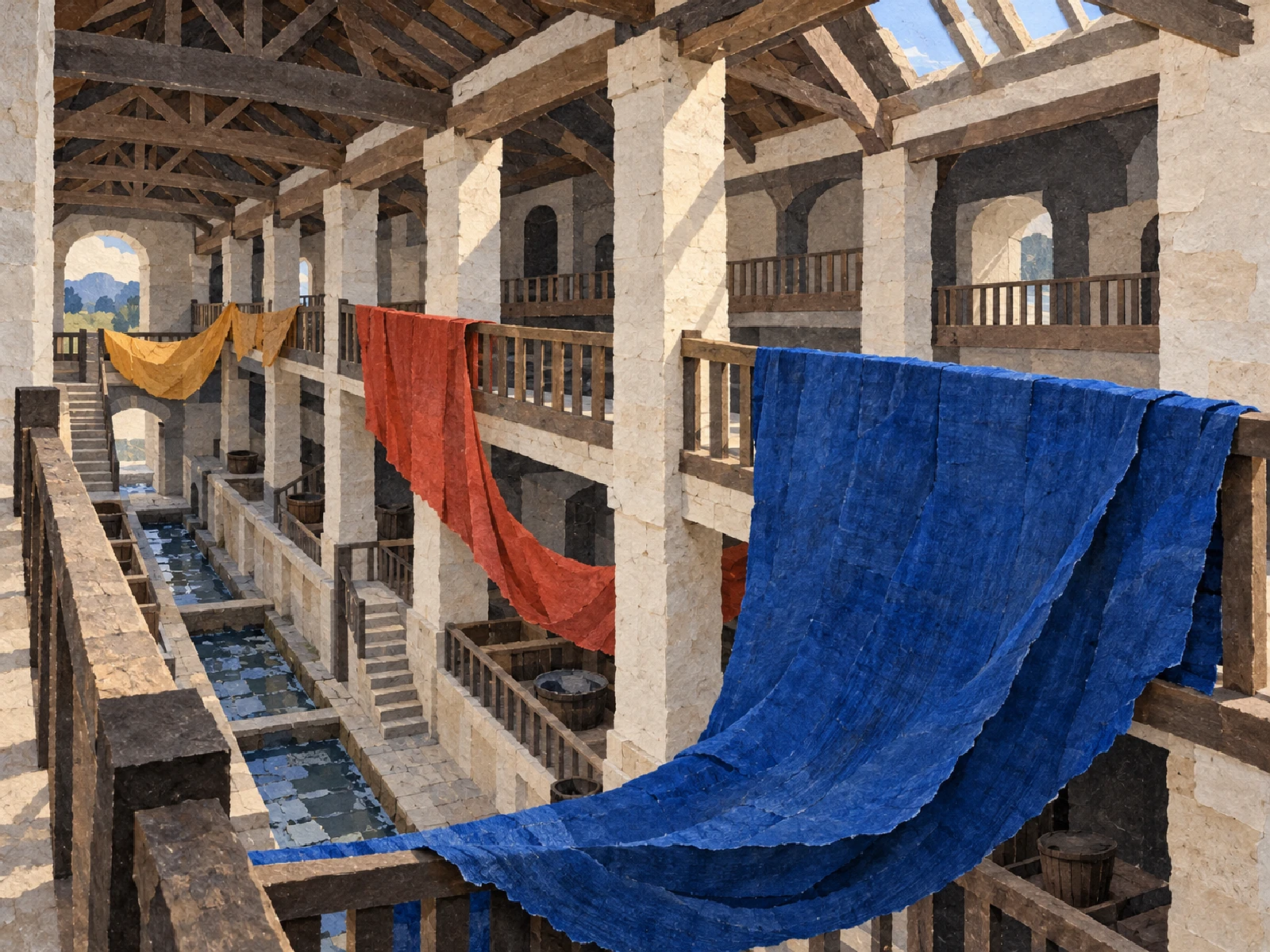
Long cloth lengths cross between drying beams and railings inside a tall dyehouse. Layered colored paper and slightly lifted joins reveal a loosened fabric loop within the deep interior.
Remix this referenceCloth Loops in the Dyehouse
- Form language
- Reduce volumes to folded planes and irregular nested silhouettes; describe openings through clear cutout shapes.
- Contour
- Set crisp scissor edges against occasional torn margins; let hand-cut irregularities replace uniform outlines.
- Mark-making
- Combine broad paper shapes with a few narrow strips; allow small cutting mismatches and tool marks to vary naturally.
- Surface rendering
- Build tactile relief with layered paper and slightly lifted joins; rub pigment into selected planes for uneven tonal transitions.
Priority
Make layered cut-paper collage visibly tactile through overlaps and lifted joins.
What to avoid & what to check
Exact prompt for this example
MODULE OWNERSHIP
subject: Subject count, type, stable proportions and landmarks, resting face geometry, hair shape, physical materials, garment construction and permanent marks. No emotion, movement, color assignment or rendering recipe.
expression: Facial soft-tissue displacement and pupil direction, muscle coordination, regional intensity, asymmetry and onset/peak/release. No head/body pose, stable appearance, skin color or rendering.
gesture: Head/neck/body/limb orientation, joint movement, support, contact and pose-caused occlusion using existing anatomy. No eye/pupil movement, emotion, identity, props inventory or camera.
props: Prop count, type, construction, physical material and scale relative to the subject. Holding/contact belongs to gesture, position to composition, color to palette.
scene: Environment elements, terrain, backdrop/floor presence and structural detail. No canvas positions, camera, lighting, assigned colors or render texture.
camera: Projection, focal-length impression, camera elevation/yaw/roll, viewing distance and crop. No actor pose, world placement, lighting or canvas aspect ratio.
composition: Normalized 0-100% canvas positions, scale in frame, depth/overlap, focal hierarchy and margins. No joint pose, camera projection, rendering, subject/prop inventory or emotion.
palette: Color anchors, hue/saturation/value ranges, colors assigned to parts and approximate color coverage. No illumination direction, shading algorithm, physical material or layout.
lighting: Light-source direction/softness/intensity, ambient illumination, physical shadow direction/length and highlight position. Absence of directional illumination is allowed. No shading technique, palette or material changes.
style: Reusable form abstraction, contour weight/taper/edge quality, medium and mark scale/density/direction, surface rendering and tonal transition technique. No fixed subject proportions, anatomy, identity, expression, pose, palette, light-source direction, camera or layout.
output: Image count, aspect ratio, size, file/alpha requirements and global lettering/logo/watermark restrictions. No background scenery, crop, style, identity or pose.

SUBJECT
inventory: No characters or independent focal subjects; architecture and cloth carry the image.
geometry: No independent subject geometry applies.
resting-face: No faces are present.
appearance: No subject-specific appearance applies.

PRIORITY


AVOID


CHECK


PROPS
inventory: Three long lengths of dyed linen, each broad enough to span several railing bays.
construction: Each length is an uninterrupted woven sheet with soft selvages and no attached fittings.

PRIORITY


AVOID


CHECK


SCENE
inventory: A tall dyehouse with drying beams, staggered galleries, railings, a sunken rinsing channel and an open roof ridge.
structure: Heavy masonry piers support timber roof trusses; short stairs connect the galleries above the tiled channel.

PRIORITY


AVOID


CHECK


CAMERA
projection: Use a moderately wide perspective that preserves the hall's enclosing volume.
viewpoint: View diagonally along the hall from an upper gallery, looking slightly downward without camera roll.
crop: Frame an interior vista with near railings partly cropped and enough roof visible to explain the height.

PRIORITY


AVOID


CHECK


COMPOSITION
placement: Place the largest cloth loop across the lower right; carry the other lengths toward a distant opening at left.
depth: Interleave cloth, railings and piers through several depths, keeping glimpses of the channel between overlaps.
spacing: The loose loop leads attention into the hall; leave an open interval above it between the clustered galleries.

PRIORITY


AVOID


CHECK


PALETTE
colors: Use ultramarine, vermilion, ochre, chalk white and charcoal, with saturated cloth against quieter architecture.
assignment: Make the largest cloth ultramarine, the others vermilion and ochre; use chalk masonry and charcoal recesses.
balance: Broad pale architectural areas support strong blue passages and smaller warm accents.

PRIORITY


AVOID


CHECK


LIGHTING
sources: Soft daylight enters from the high opening at upper right, with moderate ambient fill inside the hall.
shadows: Architectural shadows extend toward the lower left with soft edges; deep recesses remain readable.
highlights: Light catches the upper-right-facing folds and railing tops without hard glare.

PRIORITY


AVOID


CHECK


STYLE GUIDE
form-language: Reduce volumes to folded planes and irregular nested silhouettes; describe openings through clear cutout shapes.
contour: Set crisp scissor edges against occasional torn margins; let hand-cut irregularities replace uniform outlines.
mark-making: Combine broad paper shapes with a few narrow strips; allow small cutting mismatches and tool marks to vary naturally.
surface-rendering: Build tactile relief with layered paper and slightly lifted joins; rub pigment into selected planes for uneven tonal transitions.

PRIORITY
Make layered cut-paper collage visibly tactile through overlaps and lifted joins.

AVOID


CHECK


OUTPUT
format: One landscape image, 4:3 aspect ratio, 1600 × 1200 pixels, opaque PNG.
restrictions: No lettering, logos or watermarks.

PRIORITY


AVOID


CHECK


FINAL INTEGRATION
composition + style: Let physical paper overlaps reinforce spatial overlaps while preserving readable gaps through the interior.
Model information comes from image provenance. The same prompt may produce a different result.