Text to imageCharacterStyle guide
Curious Koala · Tilted Facial Centerline
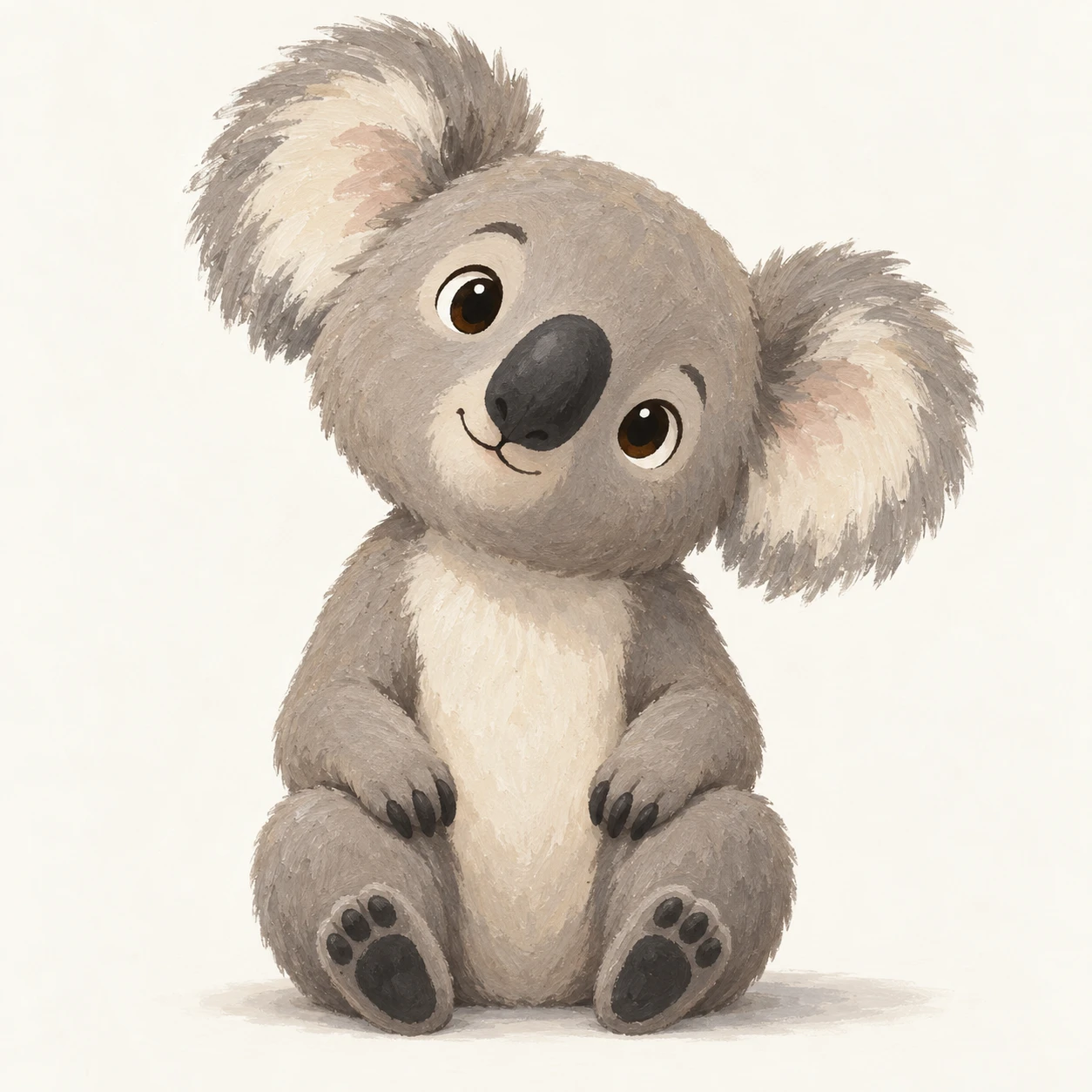
A koala with an upright body and tilted head shows how aligned eyes, nose, and mouth make a head tilt readable.
Curious Koala · Tilted Facial Centerline
- Shape & line
- Build the head as a broad oval with round ears and tilt its facial centerline toward image-right at the top. Place the black nose and small mouth along that same slanted axis; set the eye pair perpendicular to it so the image-right eye sits visibly lower than the image-left eye. Keep the shoulders level to distinguish head tilt from whole-body lean.
- Color & light
- Use warm gray for the body, pale cream inside the ears and on the belly, and charcoal for the nose. Light the character softly from upper image-left, adding a broad muted shadow beneath the image-right cheek and chin while keeping both eyes clearly readable.
- Texture & material
- Paint with opaque gouache and broad, matte color areas. Add short dry-brush tufts around the ears and outer cheeks, following their curved edges; keep the central face smooth so fur marks do not obscure the tilted eye–nose–mouth alignment.
- Composition
- Keep the head large enough that its facial alignment reads at thumbnail size. Separate the ears from the shoulders with clear background gaps, retain an upright torso beneath the tilted head, and place a small soft grounding shadow directly under the seated body.
Priority
Make the shared tilt of the eyes, nose, and mouth the clearest cue to the koala's curiosity.
What to avoid & what to check
Avoid level eyes on a tilted head or a torso that leans with the face.
Check that the image-right eye is lower, the nose and mouth share the tilted axis, and the shoulders remain level.
Exact prompt for this example
SUBJECT
One original, curious koala character sitting upright with both paws resting on its knees. Its head tilts toward image-right while its torso stays vertical; its eyes look toward the viewer and its small mouth forms a gentle, closed smile.

COMPOSITION
Use a frontal, full-body view at the character's eye level. Center the upright torso and leave generous space around both ears, with the tilted head extending slightly toward image-right. Keep both paws and feet visible against a plain pale background.

STYLE GUIDE
1. Shape & line
Build the head as a broad oval with round ears and tilt its facial centerline toward image-right at the top. Place the black nose and small mouth along that same slanted axis; set the eye pair perpendicular to it so the image-right eye sits visibly lower than the image-left eye. Keep the shoulders level to distinguish head tilt from whole-body lean.

2. Color & light
Use warm gray for the body, pale cream inside the ears and on the belly, and charcoal for the nose. Light the character softly from upper image-left, adding a broad muted shadow beneath the image-right cheek and chin while keeping both eyes clearly readable.

3. Texture & material
Paint with opaque gouache and broad, matte color areas. Add short dry-brush tufts around the ears and outer cheeks, following their curved edges; keep the central face smooth so fur marks do not obscure the tilted eye–nose–mouth alignment.

4. Composition
Keep the head large enough that its facial alignment reads at thumbnail size. Separate the ears from the shoulders with clear background gaps, retain an upright torso beneath the tilted head, and place a small soft grounding shadow directly under the seated body.

PRIORITY
Preserve the requested identity, count, action, composition and output settings. Apply the style rules within those constraints; a style reference must not replace the subject or layout. Within the style: Make the shared tilt of the eyes, nose, and mouth the clearest cue to the koala's curiosity.

AVOID
Avoid level eyes on a tilted head or a torso that leans with the face.

OUTPUT
One square character illustration in opaque gouache, with no text, lettering, logos, or watermarks.

SELF-CHECK
Check that the image-right eye is lower, the nose and mouth share the tilted axis, and the shoulders remain level.
Model information comes from image provenance. The same prompt may produce a different result.