Text to imageCharacterStyle guide
Shield-Tailed Creature in the Rain
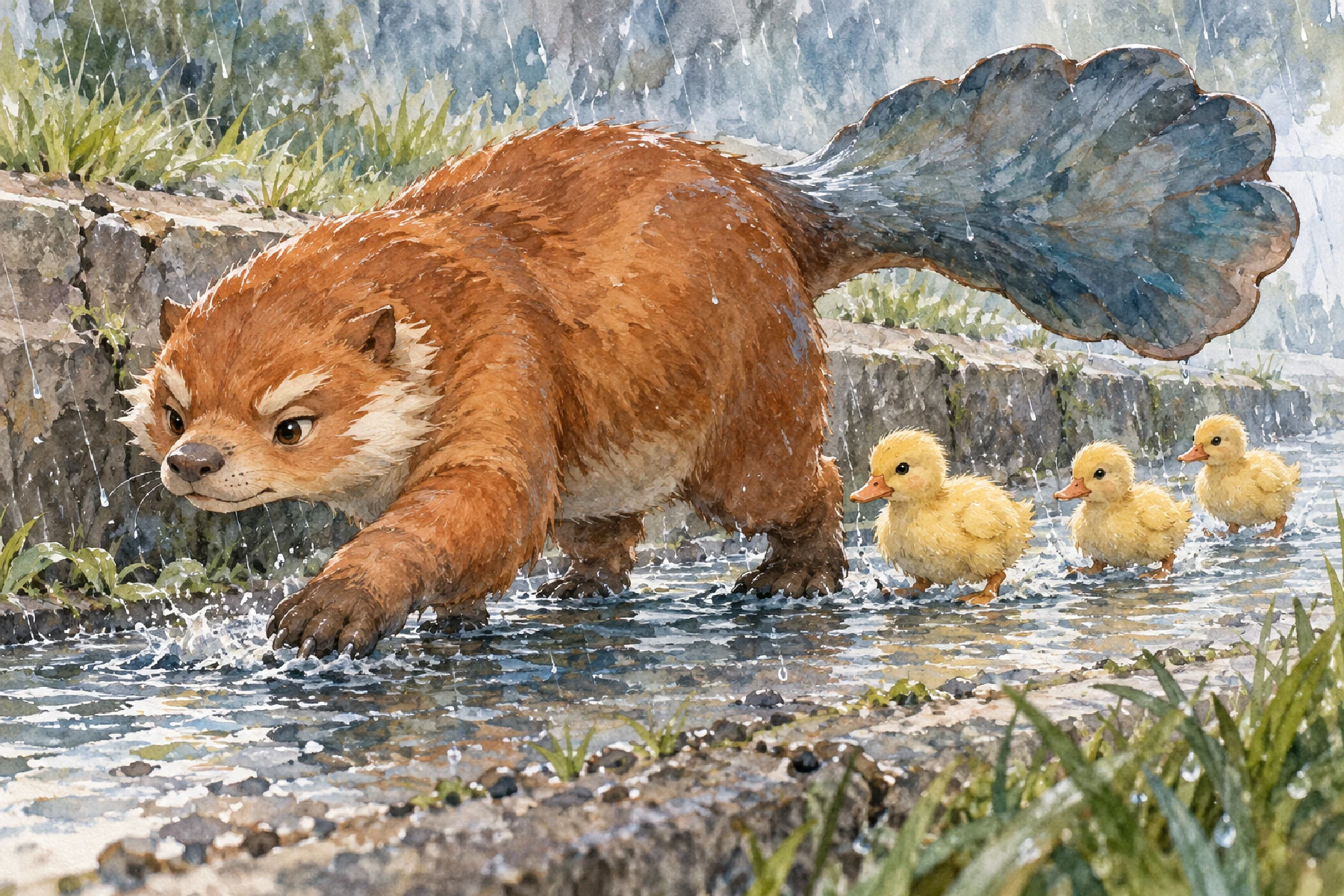
An original creature crosses a rain gutter, sheltering ducklings beneath its broad tail. Blooming watercolor and broken edges animate the little procession.
Remix this referenceShield-Tailed Creature in the Rain
- Form language
- Reduce forms to elastic, interlocking masses; retain small irregularities instead of polishing every silhouette.
- Contour
- Let watercolor edges alternate between sharp wet boundaries, broken dry-brush fragments and passages that dissolve.
- Mark-making
- Use broad loaded strokes with occasional skipping brush tips; vary their length and density naturally.
- Surface rendering
- Build translucent washes with visible blooms and pooled pigment; let paper show through between softly merging tones.
Priority
Make expressive watercolor blooms and broken edges integral to the finished image.
What to avoid & what to check
Exact prompt for this example
MODULE OWNERSHIP
subject: Subject count, type, stable proportions and landmarks, resting face geometry, hair shape, physical materials, garment construction and permanent marks. No emotion, movement, color assignment or rendering recipe.
expression: Facial soft-tissue displacement and pupil direction, muscle coordination, regional intensity, asymmetry and onset/peak/release. No head/body pose, stable appearance, skin color or rendering.
gesture: Head/neck/body/limb orientation, joint movement, support, contact and pose-caused occlusion using existing anatomy. No eye/pupil movement, emotion, identity, props inventory or camera.
props: Prop count, type, construction, physical material and scale relative to the subject. Holding/contact belongs to gesture, position to composition, color to palette.
scene: Environment elements, terrain, backdrop/floor presence and structural detail. No canvas positions, camera, lighting, assigned colors or render texture.
camera: Projection, focal-length impression, camera elevation/yaw/roll, viewing distance and crop. No actor pose, world placement, lighting or canvas aspect ratio.
composition: Normalized 0-100% canvas positions, scale in frame, depth/overlap, focal hierarchy and margins. No joint pose, camera projection, rendering, subject/prop inventory or emotion.
palette: Color anchors, hue/saturation/value ranges, colors assigned to parts and approximate color coverage. No illumination direction, shading algorithm, physical material or layout.
lighting: Light-source direction/softness/intensity, ambient illumination, physical shadow direction/length and highlight position. Absence of directional illumination is allowed. No shading technique, palette or material changes.
style: Reusable form abstraction, contour weight/taper/edge quality, medium and mark scale/density/direction, surface rendering and tonal transition technique. No fixed subject proportions, anatomy, identity, expression, pose, palette, light-source direction, camera or layout.
output: Image count, aspect ratio, size, file/alpha requirements and global lettering/logo/watermark restrictions. No background scenery, crop, style, identity or pose.

SUBJECT
inventory: One original quadruped creature, A, accompanied by three small ducklings.
geometry: A has a pear-shaped trunk, stout legs, a short neck and a broad, scalloped shield-shaped tail.
resting-face: A has widely spaced oval eyes, a blunt muzzle, distinct fur brows and a low, straight resting mouth.
appearance: Short dense fur ends in small cheek tufts; the flexible tail is bare. No clothing or permanent markings.

PRIORITY


AVOID


CHECK


EXPRESSION — ACTOR A
brows: Inner brows draw together with a shallow downward pull.
lids: Upper lids lower slightly; lower lids remain firm.
cheeks: Cheeks gather subtly toward the muzzle.
nose: Nostrils widen slightly without wrinkling the bridge.
mouth: Lips press together, with one corner tucked slightly inward.
jaw: Jaw stays closed with mild tension.
gaze: Pupils aim down and forward toward the next foothold.
coordination: Concentrated eyes and a restrained mouth convey steady resolve.
timing: Hold the expression at its peak, before the tension releases.

PRIORITY


AVOID


CHECK


GESTURE
head: A extends its neck slightly and lowers its muzzle toward the gutter.
torso: Its trunk inclines forward into the crossing, with a gently bowed back.
limbs: One forepaw reaches ahead; the other three paws support it. The tail arches backward over the ducklings.
contact: Supporting paws meet the shallow runoff; the ducklings wade closely behind without touching the tail.

PRIORITY


AVOID


CHECK


PROPS
inventory: No separate props.
construction: No prop construction applies.

PRIORITY


AVOID


CHECK


SCENE
inventory: A shallow roadside rain gutter, a low curb, flattened grass and falling rain.
structure: The gutter widens into a small crossing pool; the curb is chipped and interrupted by grass.

PRIORITY


AVOID


CHECK


CAMERA
projection: Gentle perspective with a normal-lens impression and modest depth compression.
viewpoint: View from the creature's eye height, slightly forward of its side, with no roll.
crop: Use a full-body narrative view that includes the entire tail and all three ducklings.

PRIORITY


AVOID


CHECK


COMPOSITION
placement: A fills the left-middle of the frame; its tail spans the upper right above a descending duckling sequence.
depth: The face leads, followed by the sheltered ducklings; overlapping tail, curb and foreground grass create depth.
spacing: Keep breathing room ahead of the muzzle and a clear gap beneath the tail; let grass graze the lower edge.

PRIORITY


AVOID


CHECK


PALETTE
colors: Use burnt sienna, petrol blue and butter yellow against warm ivory, with muted blue-grey mixtures.
assignment: Sienna fur, petrol-blue tail, butter-yellow ducklings and pale blue-grey rainwater and surroundings.
balance: Pale cool tones occupy the broadest area; the warm creature forms a substantial mass with small yellow accents.

PRIORITY


AVOID


CHECK


LIGHTING
sources: Broad overcast light arrives from the upper left, supported by soft ambient illumination.
shadows: Short diffuse shadows fall down-right; shelter beneath the tail produces a gentle darker pocket.
highlights: Broad dim highlights touch the upper muzzle, tail ridge and upward-facing ripples.

PRIORITY


AVOID


CHECK


STYLE GUIDE
form-language: Reduce forms to elastic, interlocking masses; retain small irregularities instead of polishing every silhouette.
contour: Let watercolor edges alternate between sharp wet boundaries, broken dry-brush fragments and passages that dissolve.
mark-making: Use broad loaded strokes with occasional skipping brush tips; vary their length and density naturally.
surface-rendering: Build translucent washes with visible blooms and pooled pigment; let paper show through between softly merging tones.

PRIORITY
Make expressive watercolor blooms and broken edges integral to the finished image.

AVOID


CHECK


OUTPUT
format: One finished landscape image, 3:2 aspect ratio, 1800 × 1200 pixels, opaque PNG; no lettering, logos or watermarks.
restrictions: Deliver one finished landscape image at 3:2, 1800 × 1200 pixels, as an opaque PNG; no lettering, logos or watermarks.

PRIORITY


AVOID


CHECK


FINAL INTEGRATION
subject + gesture + composition: Keep the distinctive tail construction readable through the movement and overlapping group.
expression + style: Let loose marks surround the facial acting without dissolving its essential cues.
Model information comes from image provenance. The same prompt may produce a different result.