Text to imageSpace & architectureStyle guide
A Kiln Hall with a Rolling Door
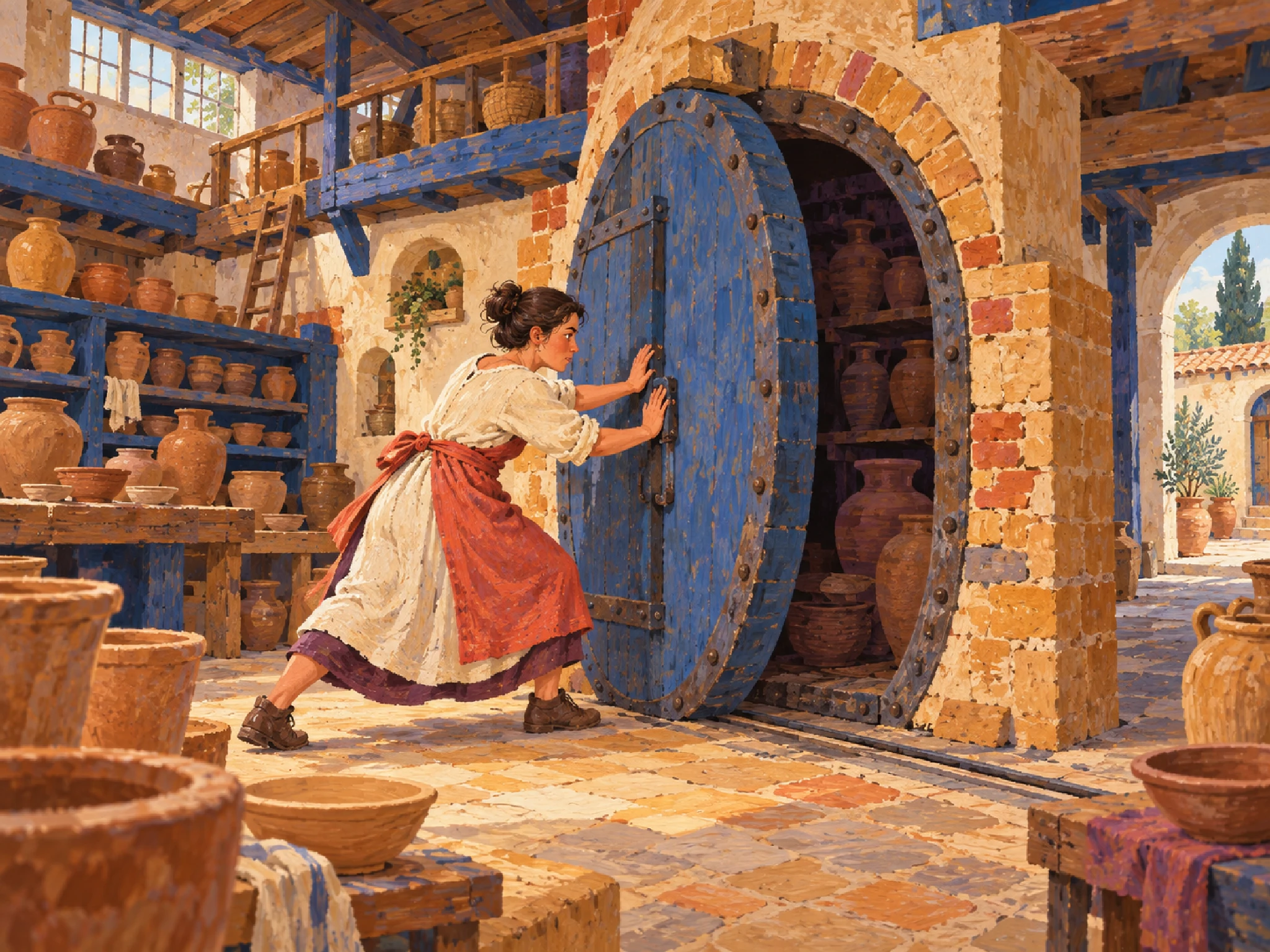
A potter pushes open a great circular kiln door inside a hall layered with shelves, a loft and a courtyard beyond. Uneven outlines and lively decorative brushwork give the space the warmth of a naive folk painting.
Remix this referenceA Kiln Hall with a Rolling Door
- Form language
- Simplify forms into friendly, slightly uneven blocks and circles; use lively decorative repetition without mechanical regularity.
- Contour
- Use blunt, hand-painted outlines that wobble, thicken at turns and occasionally dissolve into adjacent brushwork.
- Mark-making
- Lay down visible bristle strokes with small dashes, scallops and dots; vary their rhythm rather than repeating a stamped pattern.
- Surface rendering
- Build opaque painted patches with dry-brush skips and softly scumbled overlaps; keep tonal steps broad and handmade.
Priority
Preserve the decorative simplification and visibly handmade brushwork of a naive folk painting.
What to avoid & what to check
Exact prompt for this example
MODULE OWNERSHIP
subject: Subject count, type, stable proportions and landmarks, resting face geometry, hair shape, physical materials, garment construction and permanent marks. No emotion, movement, color assignment or rendering recipe.
expression: Facial soft-tissue displacement and pupil direction, muscle coordination, regional intensity, asymmetry and onset/peak/release. No head/body pose, stable appearance, skin color or rendering.
gesture: Head/neck/body/limb orientation, joint movement, support, contact and pose-caused occlusion using existing anatomy. No eye/pupil movement, emotion, identity, props inventory or camera.
props: Prop count, type, construction, physical material and scale relative to the subject. Holding/contact belongs to gesture, position to composition, color to palette.
scene: Environment elements, terrain, backdrop/floor presence and structural detail. No canvas positions, camera, lighting, assigned colors or render texture.
camera: Projection, focal-length impression, camera elevation/yaw/roll, viewing distance and crop. No actor pose, world placement, lighting or canvas aspect ratio.
composition: Normalized 0-100% canvas positions, scale in frame, depth/overlap, focal hierarchy and margins. No joint pose, camera projection, rendering, subject/prop inventory or emotion.
palette: Color anchors, hue/saturation/value ranges, colors assigned to parts and approximate color coverage. No illumination direction, shading algorithm, physical material or layout.
lighting: Light-source direction/softness/intensity, ambient illumination, physical shadow direction/length and highlight position. Absence of directional illumination is allowed. No shading technique, palette or material changes.
style: Reusable form abstraction, contour weight/taper/edge quality, medium and mark scale/density/direction, surface rendering and tonal transition technique. No fixed subject proportions, anatomy, identity, expression, pose, palette, light-source direction, camera or layout.
output: Image count, aspect ratio, size, file/alpha requirements and global lettering/logo/watermark restrictions. No background scenery, crop, style, identity or pose.

SUBJECT
inventory: A is one adult potter with an ordinary human build.
geometry: A has a compact silhouette, broad shoulders and a small rounded hair bun.
resting-face: A has a rounded face, a short straight nose, a softly squared chin and a level resting mouth.
appearance: A wears a woven calf-length work dress, a wraparound apron and plain leather work shoes.

PRIORITY


AVOID


CHECK


EXPRESSION — ACTOR A
brows: The visible brow draws slightly inward and down.
lids: The visible upper lid lowers slightly; the lower lid firms.
cheeks: The visible cheek tightens subtly without lifting into a smile.
nose: The visible nostril widens slightly; the nose bridge stays unwrinkled.
mouth: Lips press together gently, with a slightly firmer visible corner.
jaw: The jaw firms with the teeth together and no exaggerated clench.
gaze: The visible pupil fixes on the exposed edge of the door opening.
coordination: Brow tension and pressed lips coordinate into steady, restrained determination.
timing: Hold the apex steadily, with no visible transition into release.

PRIORITY


AVOID


CHECK


GESTURE
head: A turns partly toward the opening, revealing a readable profile; the neck follows the forward lean.
torso: A leans forward from the hips with a slight twist toward the opening door.
limbs: Both arms extend into the push; one knee bends ahead while the rear leg braces the body.
contact: Both palms press the door rim and both feet remain planted on the floor.

PRIORITY


AVOID


CHECK


PROPS
inventory: Several unfinished clay vessels, ranging from small bowls to knee-high jars.
construction: The vessels have thick rounded lips, broad bases and slight irregularities from hand building.

PRIORITY


AVOID


CHECK


SCENE
inventory: A kiln hall with a built-in firing chamber, rolling circular door, timber loft, wall shelves and an arch to a small courtyard.
structure: The taller-than-person brick door has an iron rim and floor track; thick masonry supports an open-beamed roof with a clerestory.

PRIORITY


AVOID


CHECK


CAMERA
projection: Use a broad natural perspective with a mild wide-angle impression.
viewpoint: Look diagonally across the hall from slightly above standing eye level, with no camera roll.
crop: Include A's full body, the complete door and enough adjoining architecture to establish an inhabited interior.

PRIORITY


AVOID


CHECK


COMPOSITION
placement: Place the door near 60% across and A just to its left; the courtyard opening sits deeper on the right.
depth: The push against the door is the focal event; cropped foreground shelving, the kiln and the distant arch create successive layers.
spacing: Keep a clear pocket around A's arms while vessels gather in irregular shelf groups and the loft crosses the upper frame.

PRIORITY


AVOID


CHECK


PALETTE
colors: Anchor the image in warm cream, ochre, coral red and deep cobalt, with muted plum accents.
assignment: Use cream for plaster, ochre for masonry and vessels, coral for A's apron, cobalt for doors and plum for deep recesses.
balance: Warm pale colors occupy most surfaces; cobalt provides a substantial counterweight and coral remains a small vivid accent.

PRIORITY


AVOID


CHECK


LIGHTING
sources: Soft daylight enters from the high left clerestory, with gentle ambient light throughout the hall.
shadows: Short, soft shadows fall rightward beneath shelves, vessels and the door rim.
highlights: Broad highlights touch upward-facing rims and A's upper shoulders; the kiln interior stays dim.

PRIORITY


AVOID


CHECK


STYLE GUIDE
form-language: Simplify forms into friendly, slightly uneven blocks and circles; use lively decorative repetition without mechanical regularity.
contour: Use blunt, hand-painted outlines that wobble, thicken at turns and occasionally dissolve into adjacent brushwork.
mark-making: Lay down visible bristle strokes with small dashes, scallops and dots; vary their rhythm rather than repeating a stamped pattern.
surface-rendering: Build opaque painted patches with dry-brush skips and softly scumbled overlaps; keep tonal steps broad and handmade.

PRIORITY
Preserve the decorative simplification and visibly handmade brushwork of a naive folk painting.

AVOID


CHECK


OUTPUT
format: One finished image, 4:3 aspect ratio, 2048 × 1536 pixels, opaque PNG.
restrictions: No lettering, logos or watermarks.

PRIORITY


AVOID


CHECK
Model information comes from image provenance. The same prompt may produce a different result.