Text to imageArt stylesStyle guide
A Hand in Falling Grain
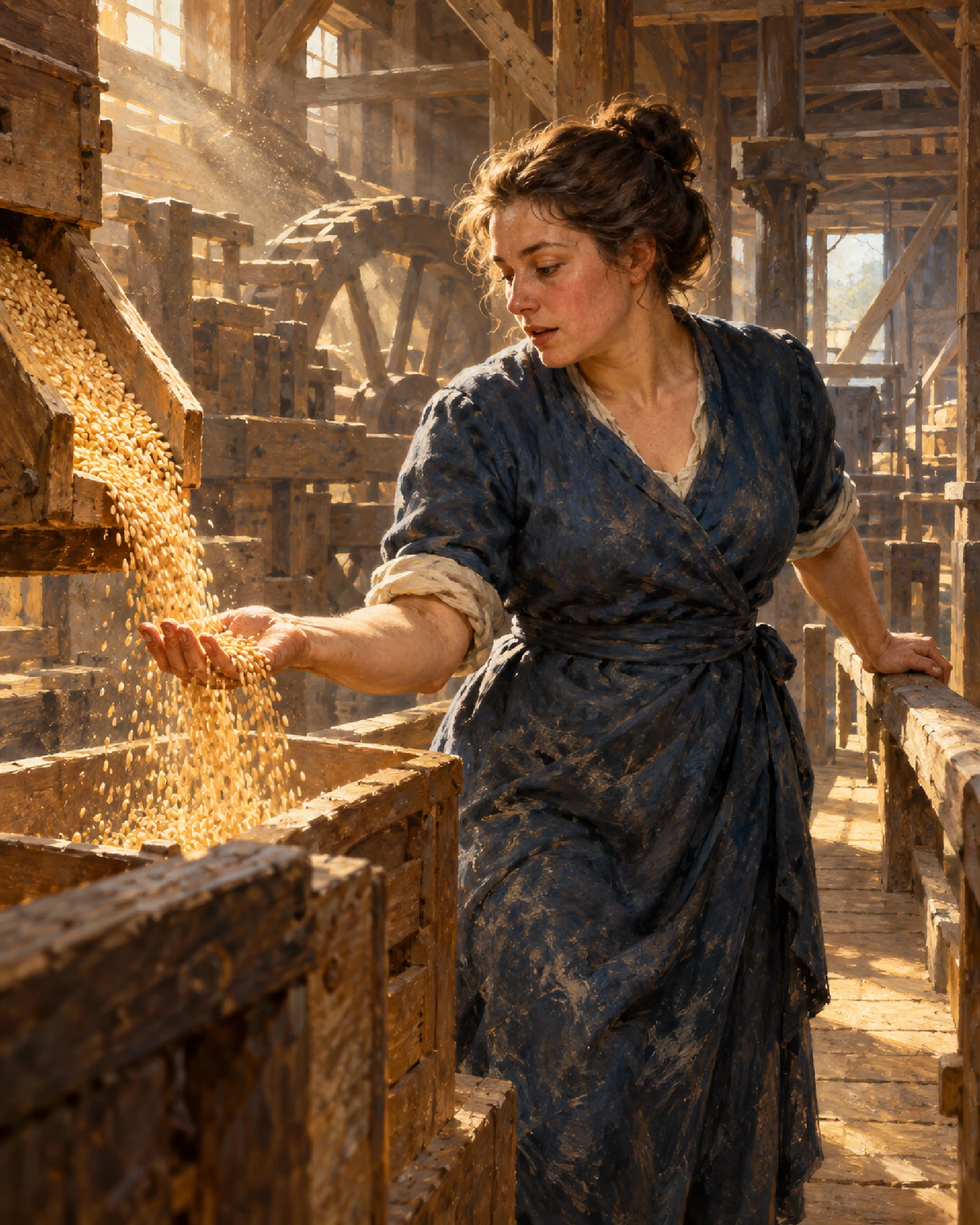
A woman opens her hand through falling grain inside an old mill. Thin oil-paint veils and flowing tonal transitions give the dusty interior and sweeping gesture a luminous presence.
Remix this referenceA Hand in Falling Grain
- Form language
- Gather forms into broad, gently irregular masses, simplifying small details while preserving convincing volume.
- Contour
- Use painted edges without enclosing outlines; alternate dissolved boundaries with a few crisp, tapering accents.
- Mark-making
- Lay broad oil-brush sweeps beneath sparse dragged strokes and broken flecks; let mark size and pressure vary naturally.
- Surface rendering
- Build luminous continuous tones through thin translucent paint veils, softly merged transitions and selective opaque scumbles.
Priority
Keep the translucent depth and continuous tonal modeling visibly painterly.
What to avoid & what to check
Exact prompt for this example
MODULE OWNERSHIP
subject: Subject count, type, stable proportions and landmarks, resting face geometry, hair shape, physical materials, garment construction and permanent marks. No emotion, movement, color assignment or rendering recipe.
expression: Facial soft-tissue displacement and pupil direction, muscle coordination, regional intensity, asymmetry and onset/peak/release. No head/body pose, stable appearance, skin color or rendering.
gesture: Head/neck/body/limb orientation, joint movement, support, contact and pose-caused occlusion using existing anatomy. No eye/pupil movement, emotion, identity, props inventory or camera.
props: Prop count, type, construction, physical material and scale relative to the subject. Holding/contact belongs to gesture, position to composition, color to palette.
scene: Environment elements, terrain, backdrop/floor presence and structural detail. No canvas positions, camera, lighting, assigned colors or render texture.
camera: Projection, focal-length impression, camera elevation/yaw/roll, viewing distance and crop. No actor pose, world placement, lighting or canvas aspect ratio.
composition: Normalized 0-100% canvas positions, scale in frame, depth/overlap, focal hierarchy and margins. No joint pose, camera projection, rendering, subject/prop inventory or emotion.
palette: Color anchors, hue/saturation/value ranges, colors assigned to parts and approximate color coverage. No illumination direction, shading algorithm, physical material or layout.
lighting: Light-source direction/softness/intensity, ambient illumination, physical shadow direction/length and highlight position. Absence of directional illumination is allowed. No shading technique, palette or material changes.
style: Reusable form abstraction, contour weight/taper/edge quality, medium and mark scale/density/direction, surface rendering and tonal transition technique. No fixed subject proportions, anatomy, identity, expression, pose, palette, light-source direction, camera or layout.
output: Image count, aspect ratio, size, file/alpha requirements and global lettering/logo/watermark restrictions. No background scenery, crop, style, identity or pose.

SUBJECT
inventory: A is one adult woman.
geometry: She has a sturdy build, broad palms, a long nose bridge and a rounded chin.
resting-face: Her resting face has straight brows, hooded upper lids and a broad, softly defined mouth.
appearance: Her hair forms a compact coiled bun; a heavy cotton work smock has rolled cuffs and a wrap front.

PRIORITY


AVOID


CHECK


EXPRESSION — ACTOR A
brows: The nearer brow lifts slightly while the other remains relaxed.
lids: Upper lids rise gently; lower lids remain loose.
cheeks: Cheeks remain relaxed without a smile lift.
nose: Nostrils remain unflared and the nose bridge stays unwrinkled.
mouth: Lips part narrowly, with neither corner pulled upward.
jaw: The jaw releases just enough to support the parted lips.
gaze: Pupils track the descending grain.
coordination: A slight brow asymmetry and quiet lower face convey absorbed curiosity.
timing: Hold the apex of a small discovery, before any smile develops.

PRIORITY


AVOID


CHECK


GESTURE
head: A inclines her head toward her working hand, with her neck comfortably extended.
torso: Her torso leans into the task with a gentle twist through the waist.
limbs: One arm sweeps outward with palm open; the other bends back to brace her weight.
contact: Grain runs across the open palm and between the fingers; her other hand grips the fixed rail.

PRIORITY


AVOID


CHECK


PROPS
inventory: No separate props.
construction: No prop construction applies.

PRIORITY


AVOID


CHECK


SCENE
inventory: An old timber mill contains a grain chute, fixed walkway rail, exposed wheelwork, a plank floor and airborne dust.
structure: Grain descends from the open chute; connected bays, heavy beams and a high wall opening deepen the interior.

PRIORITY


AVOID


CHECK


CAMERA
projection: Use natural perspective with a moderately wide lens impression.
viewpoint: View from chest height at an oblique angle across the milling bay, with a level horizon.
crop: Frame A from mid-thigh upward, retaining both hands and generous surrounding interior.

PRIORITY


AVOID


CHECK


COMPOSITION
placement: A occupies the right third; her hand sits just left of center as the primary focus.
depth: A cropped foreground beam overlaps the rail; A and the grain separate from receding machinery and open bays.
spacing: Keep breathing room around the working hand and an open interval between her face and the descending grain.

PRIORITY


AVOID


CHECK


PALETTE
colors: Use honey amber, deep petrol blue, warm ivory and restrained rose-brown.
assignment: Assign amber to grain and timber, petrol blue to the smock, rose-brown to skin and ivory to pale accents.
balance: Let muted amber and dark blue dominate, with small high-value ivory passages and subdued skin hues.

PRIORITY


AVOID


CHECK


LIGHTING
sources: Broad sunlight enters from the high left opening, supported by weak ambient light throughout the mill.
shadows: Soft-edged shadows extend toward the lower right, becoming deeper beneath beams and machinery.
highlights: Light catches the upper palm, passing grain and left-facing cheek.

PRIORITY


AVOID


CHECK


STYLE GUIDE
form-language: Gather forms into broad, gently irregular masses, simplifying small details while preserving convincing volume.
contour: Use painted edges without enclosing outlines; alternate dissolved boundaries with a few crisp, tapering accents.
mark-making: Lay broad oil-brush sweeps beneath sparse dragged strokes and broken flecks; let mark size and pressure vary naturally.
surface-rendering: Build luminous continuous tones through thin translucent paint veils, softly merged transitions and selective opaque scumbles.

PRIORITY
Keep the translucent depth and continuous tonal modeling visibly painterly.

AVOID


CHECK


OUTPUT
format: Deliver one 4:5 image at 1600 × 2000 pixels as an opaque PNG.
restrictions: Include no lettering, logos, signatures or watermarks.

PRIORITY


AVOID


CHECK


FINAL INTEGRATION
gesture + composition: Keep the hand-to-grain contact readable through the overlapping depth.
lighting + style: Let painted transitions carry the illumination while retaining the medium's irregular touch.
Model information comes from image provenance. The same prompt may produce a different result.