Text to imageCharacterStyle guide
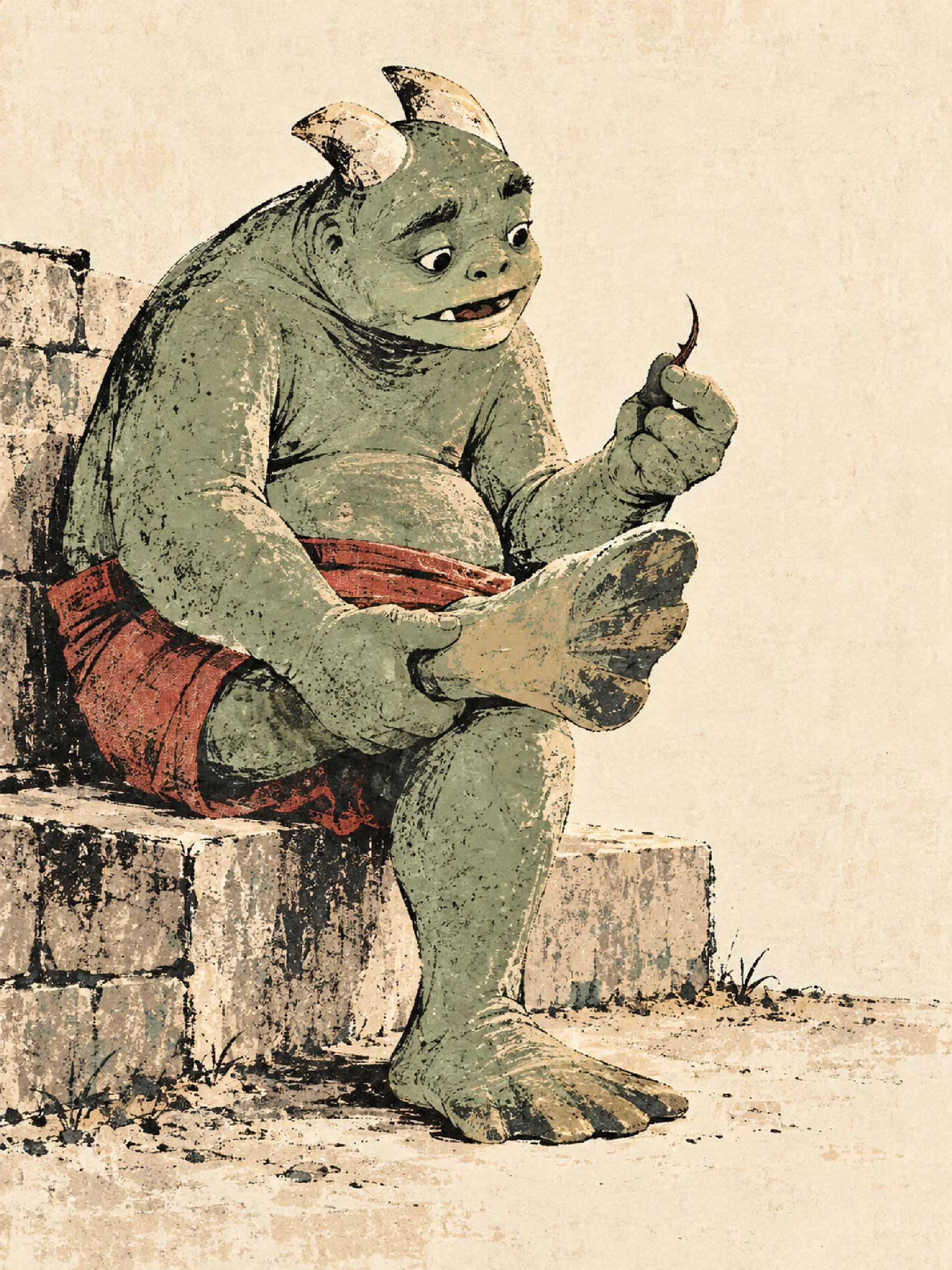
Paddle-Horned Creature Pulling a Thorn
A paddle-horned creature has just pulled a thorn from its heel on a stone step, rendered with rough ink, shifted print shapes, and generous negative space.
Remix this referencePaddle-Horned Creature Pulling a Thorn
- Form language
- Compress forms into asymmetric lobes and blunt wedges, allowing cutout-like joins and abrupt simplification between adjoining masses.
- Contour
- Brush-ink contours swell, split, and occasionally disappear into printed shapes; retain drag marks at changes of direction.
- Mark-making
- Combine sparse scratchy ink strokes with broad roller impressions; allow irregular pressure and slight print registration shifts.
- Surface rendering
- Build tones through translucent overprints, broken ink deposits, and occasional rubbed passages rather than uniformly filled shapes.
Priority
Make the ink-and-print experimental poster treatment evident through the interaction of strokes and imperfect impressions.
What to avoid & what to check
Exact prompt for this example
MODULE OWNERSHIP
subject: Subject count, type, stable proportions and landmarks, resting face geometry, hair shape, physical materials, garment construction and permanent marks. No emotion, movement, color assignment or rendering recipe.
expression: Facial soft-tissue displacement and pupil direction, muscle coordination, regional intensity, asymmetry and onset/peak/release. No head/body pose, stable appearance, skin color or rendering.
gesture: Head/neck/body/limb orientation, joint movement, support, contact and pose-caused occlusion using existing anatomy. No eye/pupil movement, emotion, identity, props inventory or camera.
props: Prop count, type, construction, physical material and scale relative to the subject. Holding/contact belongs to gesture, position to composition, color to palette.
scene: Environment elements, terrain, backdrop/floor presence and structural detail. No canvas positions, camera, lighting, assigned colors or render texture.
camera: Projection, focal-length impression, camera elevation/yaw/roll, viewing distance and crop. No actor pose, world placement, lighting or canvas aspect ratio.
composition: Normalized 0-100% canvas positions, scale in frame, depth/overlap, focal hierarchy and margins. No joint pose, camera projection, rendering, subject/prop inventory or emotion.
palette: Color anchors, hue/saturation/value ranges, colors assigned to parts and approximate color coverage. No illumination direction, shading algorithm, physical material or layout.
lighting: Light-source direction/softness/intensity, ambient illumination, physical shadow direction/length and highlight position. Absence of directional illumination is allowed. No shading technique, palette or material changes.
style: Reusable form abstraction, contour weight/taper/edge quality, medium and mark scale/density/direction, surface rendering and tonal transition technique. No fixed subject proportions, anatomy, identity, expression, pose, palette, light-source direction, camera or layout.
output: Image count, aspect ratio, size, file/alpha requirements and global lettering/logo/watermark restrictions. No background scenery, crop, style, identity or pose.

SUBJECT
inventory: One original amphibious humanoid creature, actor A.
geometry: A pear-shaped torso, broad mitten-like hands, paddle feet, and two short flattened horns make a recognizable silhouette.
resting-face: Small round eyes beneath low brow ridges, a blunt nose, and a wide mouth with a slight underbite.
appearance: Supple pebbled skin, smooth horn surfaces, and simple woven shorts with a broad waistband; no hair.

PRIORITY


AVOID


CHECK


EXPRESSION — ACTOR A
brows: The inner brow ridges ease downward from a slight pinch.
lids: Upper lids settle halfway as lower lids lose their tension.
cheeks: The cheeks soften without rising into a grin.
nose: Nostrils relax after a brief flare.
mouth: Lips part in a loose exhale, with one corner barely lifted.
jaw: The jaw drops slightly as its clench releases.
gaze: Pupils aim toward the extracted thorn.
coordination: Release the mouth and jaw first, leaving a trace of tension around the inner brows.
timing: Show the breath immediately after the thorn comes free.

PRIORITY


AVOID


CHECK


GESTURE
head: The head bows toward the raised foot, with the neck comfortably shortened.
torso: Seated on the step, the torso folds forward over the lap with a gently rounded back.
limbs: One foot stays planted; the other leg crosses the lap. The left hand cups the heel as the right draws away.
contact: The right fingertips pinch the freed thorn; the step supports the seated weight and the left palm supports the heel.

PRIORITY


AVOID


CHECK


PROPS
inventory: One curved thorn, approximately the length of the creature's thumb.
construction: A woody thorn with a thick broken base tapering to a fine point.

PRIORITY


AVOID


CHECK


SCENE
inventory: A low stone step, a short adjoining wall, and a narrow strip of bare ground against an otherwise empty backdrop.
structure: The step is a single worn slab; the wall terminates in an exposed broken end with simple masonry joints.

PRIORITY


AVOID


CHECK


CAMERA
projection: A shallow perspective with little depth convergence and a normal-lens impression.
viewpoint: View from slightly above the seated figure, at a three-quarter angle and without roll.
crop: A full-figure view including the horn tips, planted foot, and the end of the step.

PRIORITY


AVOID


CHECK


COMPOSITION
placement: The creature fills the left 65% of the canvas; the face sits above the raised foot and the thorn projects toward the open right.
depth: The raised foot overlaps the lap, with the extracting hand ahead of both; the face-to-hand relationship leads the hierarchy.
spacing: Leave the upper-right quarter broadly empty and a clear gap around the thorn; the wall exits through the left edge.

PRIORITY


AVOID


CHECK


PALETTE
colors: Soot black, dusty vermilion, dull sage, and warm ivory form a restricted print palette.
assignment: Sage skin, ivory horns and backdrop, vermilion shorts, and black thorn and structural accents.
balance: Ivory remains the largest color field; sage forms the main midvalue mass and vermilion supplies one compact accent.

PRIORITY


AVOID


CHECK


LIGHTING
sources: Broad soft light comes from the upper right, with ample ambient fill.
shadows: A short soft cast shadow falls leftward; contact shadows remain beneath the body and planted foot.
highlights: Broad highlights touch the right horn, upper cheek, and exposed top of the raised foot.

PRIORITY


AVOID


CHECK


STYLE GUIDE
form-language: Compress forms into asymmetric lobes and blunt wedges, allowing cutout-like joins and abrupt simplification between adjoining masses.
contour: Brush-ink contours swell, split, and occasionally disappear into printed shapes; retain drag marks at changes of direction.
mark-making: Combine sparse scratchy ink strokes with broad roller impressions; allow irregular pressure and slight print registration shifts.
surface-rendering: Build tones through translucent overprints, broken ink deposits, and occasional rubbed passages rather than uniformly filled shapes.

PRIORITY
Make the ink-and-print experimental poster treatment evident through the interaction of strokes and imperfect impressions.

AVOID


CHECK


OUTPUT
format: One finished image, 3:4 aspect ratio, 1800 × 2400 pixels, opaque PNG; no lettering, logos, or watermarks.
restrictions: One finished image, 3:4 aspect ratio, 1800 × 2400 pixels, opaque PNG; no lettering, logos, or watermarks.

PRIORITY


AVOID


CHECK


FINAL INTEGRATION
style + expression: Preserve the facial release through selective ink marks, allowing surrounding impressions to vary more freely.
gesture + composition: Let the pose create distinct openings that make the small action readable across the spacious arrangement.
Model information comes from image provenance. The same prompt may produce a different result.