Text to imageArt stylesStyle guide
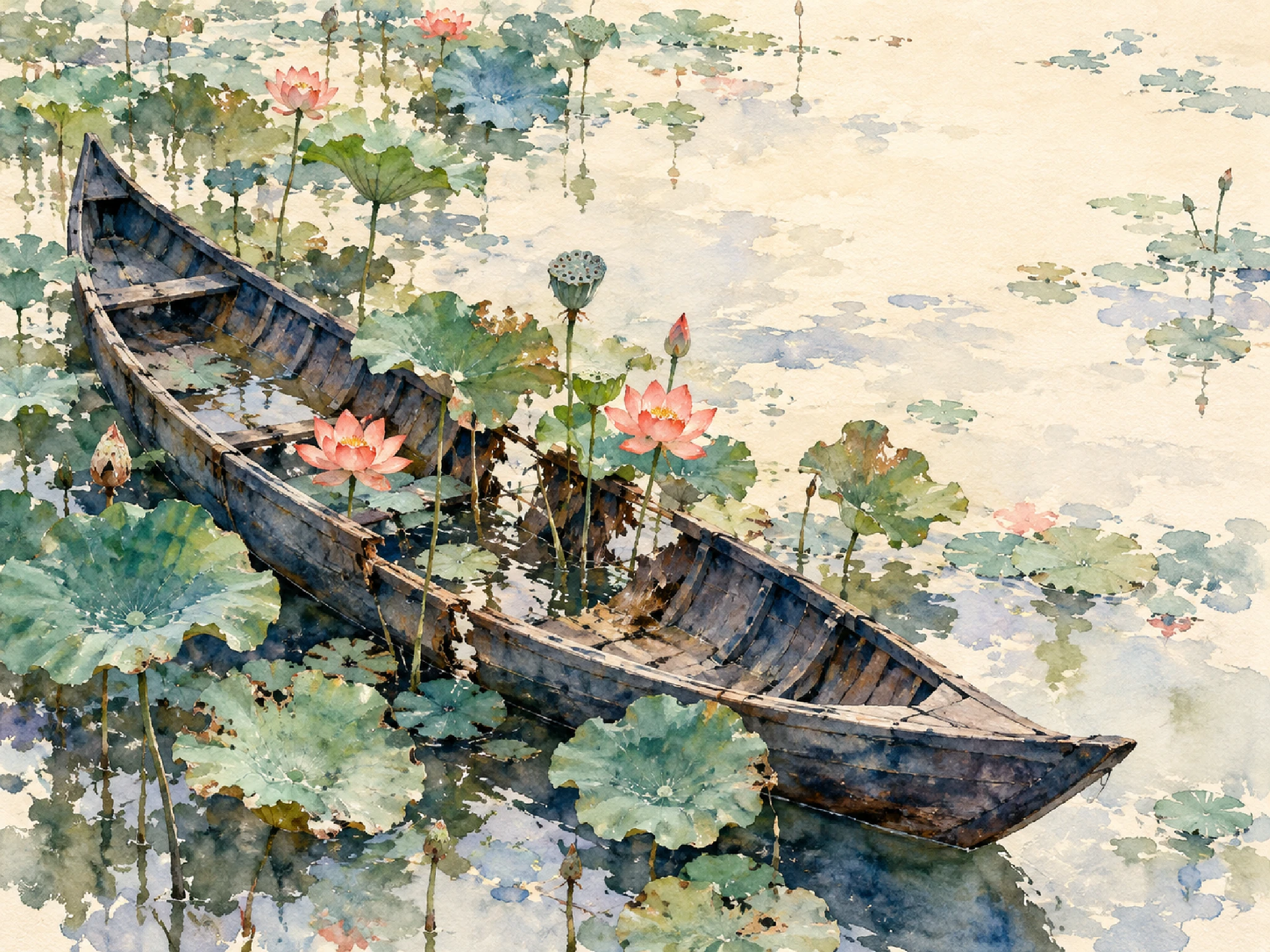
Lotus Through a Split Canoe
Lotus leaves and flowers grow through a split wooden canoe. Blooming watercolor and broken edges dissolve into a spacious expanse of pond.
Remix this referenceLotus Through a Split Canoe
- Form language
- Simplify forms into elongated crescents and broad cupped shapes; retain irregular openings rather than describing every small component.
- Contour
- Alternate crisp brush-defined edges with lost edges and dry, broken rims; use no continuous enclosing outline.
- Mark-making
- Use generous wet brush passages, occasional dragged-bristle streaks and a few concentrated touches; let mark size and spacing vary naturally.
- Surface rendering
- Let transparent watercolor pools bloom into damp washes, with pigment gathering at drying edges and untouched paper breaking through.
Priority
Make watercolor blooms and broken edges visibly shape the image.
What to avoid & what to check
Exact prompt for this example
MODULE OWNERSHIP
subject: Subject count, type, stable proportions and landmarks, resting face geometry, hair shape, physical materials, garment construction and permanent marks. No emotion, movement, color assignment or rendering recipe.
expression: Facial soft-tissue displacement and pupil direction, muscle coordination, regional intensity, asymmetry and onset/peak/release. No head/body pose, stable appearance, skin color or rendering.
gesture: Head/neck/body/limb orientation, joint movement, support, contact and pose-caused occlusion using existing anatomy. No eye/pupil movement, emotion, identity, props inventory or camera.
props: Prop count, type, construction, physical material and scale relative to the subject. Holding/contact belongs to gesture, position to composition, color to palette.
scene: Environment elements, terrain, backdrop/floor presence and structural detail. No canvas positions, camera, lighting, assigned colors or render texture.
camera: Projection, focal-length impression, camera elevation/yaw/roll, viewing distance and crop. No actor pose, world placement, lighting or canvas aspect ratio.
composition: Normalized 0-100% canvas positions, scale in frame, depth/overlap, focal hierarchy and margins. No joint pose, camera projection, rendering, subject/prop inventory or emotion.
palette: Color anchors, hue/saturation/value ranges, colors assigned to parts and approximate color coverage. No illumination direction, shading algorithm, physical material or layout.
lighting: Light-source direction/softness/intensity, ambient illumination, physical shadow direction/length and highlight position. Absence of directional illumination is allowed. No shading technique, palette or material changes.
style: Reusable form abstraction, contour weight/taper/edge quality, medium and mark scale/density/direction, surface rendering and tonal transition technique. No fixed subject proportions, anatomy, identity, expression, pose, palette, light-source direction, camera or layout.
output: Image count, aspect ratio, size, file/alpha requirements and global lettering/logo/watermark restrictions. No background scenery, crop, style, identity or pose.

SUBJECT
inventory: One abandoned wooden canoe, its fractured hull serving as the principal subject.
geometry: A slender open hull with pointed ends, a curved gunwale and a broad irregular break across its middle.
resting-face: No face or facial landmarks apply.
appearance: Timber planks, exposed ribs and splintered fracture surfaces; small signs of weathering may vary naturally.

PRIORITY


AVOID


CHECK


PROPS
inventory: No separate props.
construction: No prop construction applies.

PRIORITY


AVOID


CHECK


SCENE
inventory: A shallow pond with lotus leaves, a few flowers and seed heads; no buildings.
structure: Lotus stems rise from the pond bed, with open water between the plants.

PRIORITY


AVOID


CHECK


CAMERA
projection: Gentle perspective with a normal-lens impression and little near-to-far exaggeration.
viewpoint: Look obliquely downward from above the near gunwale, with no camera roll.
crop: Include the complete canoe and tallest lotus growth with surrounding water; keep the shore and horizon outside the frame.

PRIORITY


AVOID


CHECK


COMPOSITION
placement: Arc the canoe across the lower-left 60% of the canvas; let the flowers punctuate its broken middle.
depth: Let lotus stems pass through the hull fracture and leaves overlap its rim; make the opening the first focus and the pointed bow the second.
spacing: Keep roughly the upper-right third spacious, with only sparse water traces interrupting the negative space.

PRIORITY


AVOID


CHECK


PALETTE
colors: Warm ivory, smoky indigo, muted jade and a small coral accent; favor pale and middle values.
assignment: Ivory belongs to open water, indigo to the canoe, jade to lotus foliage and coral to the flowers.
balance: Let pale ivory dominate; reserve the deepest indigo for small hull recesses and keep coral scarce.

PRIORITY


AVOID


CHECK


LIGHTING
sources: Broad overcast daylight from the upper left, with generous ambient illumination.
shadows: Soft, short shadows fall toward the lower right beneath the rim and overlapping leaves.
highlights: Subtle highlights touch upper-left rim edges and the highest folds of leaves.

PRIORITY


AVOID


CHECK


STYLE GUIDE
form-language: Simplify forms into elongated crescents and broad cupped shapes; retain irregular openings rather than describing every small component.
contour: Alternate crisp brush-defined edges with lost edges and dry, broken rims; use no continuous enclosing outline.
mark-making: Use generous wet brush passages, occasional dragged-bristle streaks and a few concentrated touches; let mark size and spacing vary naturally.
surface-rendering: Let transparent watercolor pools bloom into damp washes, with pigment gathering at drying edges and untouched paper breaking through.

PRIORITY
Make watercolor blooms and broken edges visibly shape the image.

AVOID


CHECK


OUTPUT
format: One finished image, landscape 4:3, 2048 × 1536 pixels, opaque PNG.
restrictions: No lettering, logos, signatures or watermarks.

PRIORITY


AVOID


CHECK
Model information comes from image provenance. The same prompt may produce a different result.