Text to imageIllustrationStyle guide
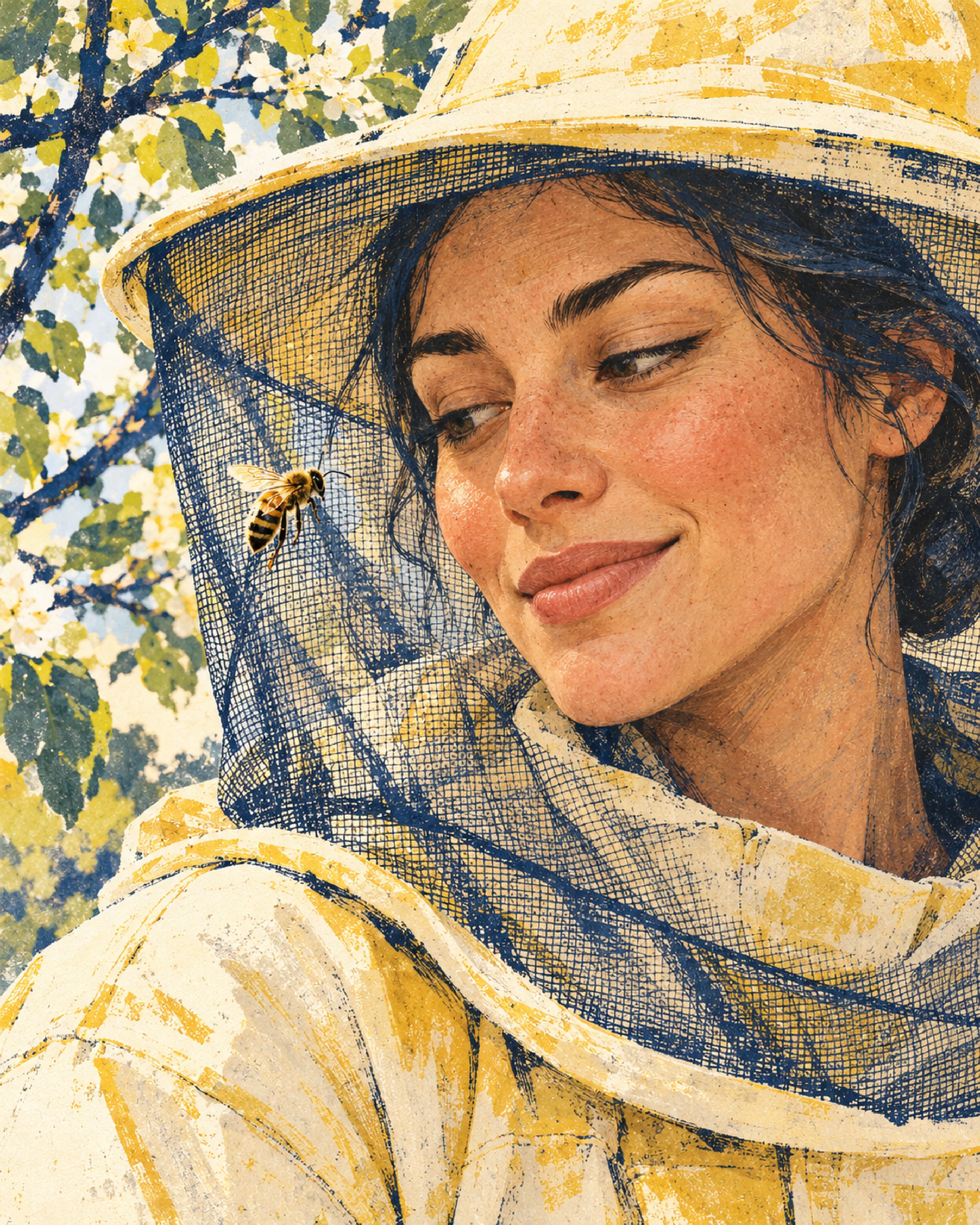
A Bee on the Veil
A beekeeper suppresses a smile at a bee resting on her veil, just beyond her nose. Fine mesh and a supple face meet through rough brushwork and displaced print layers in an intimate poster illustration.
Remix this referenceA Bee on the Veil
- Form language
- Reduce forms to broad cut-paper-like masses, allowing small irregularities to interrupt otherwise decisive silhouettes.
- Contour
- Brush-ink contours swell, taper and occasionally break; let printed edges slip slightly beyond selected drawn boundaries.
- Mark-making
- Combine sweeping dry-brush streaks with fine mesh-like line passages; vary pressure and spacing naturally rather than repeating a perfect pattern.
- Surface rendering
- Build tones through translucent screenprint overlaps and uneven ink deposits, leaving paper breaks inside dense passages and softly rubbed transitions.
Priority
Make the dialogue between gestural brush ink and imperfect print layers visibly define the illustration.
What to avoid & what to check
Exact prompt for this example
MODULE OWNERSHIP
subject: Subject count, type, stable proportions and landmarks, resting face geometry, hair shape, physical materials, garment construction and permanent marks. No emotion, movement, color assignment or rendering recipe.
expression: Facial soft-tissue displacement and pupil direction, muscle coordination, regional intensity, asymmetry and onset/peak/release. No head/body pose, stable appearance, skin color or rendering.
gesture: Head/neck/body/limb orientation, joint movement, support, contact and pose-caused occlusion using existing anatomy. No eye/pupil movement, emotion, identity, props inventory or camera.
props: Prop count, type, construction, physical material and scale relative to the subject. Holding/contact belongs to gesture, position to composition, color to palette.
scene: Environment elements, terrain, backdrop/floor presence and structural detail. No canvas positions, camera, lighting, assigned colors or render texture.
camera: Projection, focal-length impression, camera elevation/yaw/roll, viewing distance and crop. No actor pose, world placement, lighting or canvas aspect ratio.
composition: Normalized 0-100% canvas positions, scale in frame, depth/overlap, focal hierarchy and margins. No joint pose, camera projection, rendering, subject/prop inventory or emotion.
palette: Color anchors, hue/saturation/value ranges, colors assigned to parts and approximate color coverage. No illumination direction, shading algorithm, physical material or layout.
lighting: Light-source direction/softness/intensity, ambient illumination, physical shadow direction/length and highlight position. Absence of directional illumination is allowed. No shading technique, palette or material changes.
style: Reusable form abstraction, contour weight/taper/edge quality, medium and mark scale/density/direction, surface rendering and tonal transition technique. No fixed subject proportions, anatomy, identity, expression, pose, palette, light-source direction, camera or layout.
output: Image count, aspect ratio, size, file/alpha requirements and global lettering/logo/watermark restrictions. No background scenery, crop, style, identity or pose.

SUBJECT
inventory: One adult woman beekeeper, actor A, and one honeybee; the bee needs no independent acting controls.
geometry: A has a long face and broad cheekbones; the bee has a compact segmented body and paired translucent wings.
resting-face: A has straight brows, hooded upper lids, a straight nose and a broad mouth with a fuller lower lip.
appearance: Her hair forms a low coil beneath a cotton hat; woven mesh hangs from its brim above a canvas work jacket.

PRIORITY


AVOID


CHECK


EXPRESSION — ACTOR A
brows: The nearer brow lifts slightly; the other remains almost at rest.
lids: Lower lids rise gently without narrowing the eyes to slits.
cheeks: One cheek gathers slightly more than the other.
nose: The nose stays relaxed, with no wrinkle or nostril flare.
mouth: Closed lips form a small uneven smile, with the nearer corner rising first.
jaw: The jaw remains loose beneath the closed mouth.
gaze: Both pupils turn slightly inward and down toward the bee beyond her nose.
coordination: The small cheek lift supports the uneven smile; the upper face stays restrained.
timing: Catch the onset, just as one lip corner begins to escape her composure.

PRIORITY


AVOID


CHECK


GESTURE
head: A dips her chin and inclines her head slightly toward the bee.
torso: Her shoulders curl gently forward beneath the hanging veil.
limbs: No arm arrangement is prescribed.
contact: The bee's feet rest on the outer mesh; the veil hangs clear of A's nose and lips.

PRIORITY


AVOID


CHECK


PROPS
inventory: No separate props.
construction: No prop construction applies.

PRIORITY


AVOID


CHECK


SCENE
inventory: An orchard suggested by branching twigs and broad leaf clusters.
structure: Foliage forms an open canopy with gaps between branches; neither ground nor buildings are visible.

PRIORITY


AVOID


CHECK


CAMERA
projection: Use a short-telephoto perspective with gentle depth compression.
viewpoint: View at eye level from a shallow three-quarter angle, with no camera roll.
crop: An intimate head-and-shoulders crop cuts through the hat and lower jacket, excludes the arms and retains all facial features.

PRIORITY


AVOID


CHECK


COMPOSITION
placement: The face fills the right two-thirds; the bee sits just left of the nose, linking the eyes to the open left field.
depth: The veil overlaps the face as a shallow foreground layer; orchard fragments remain behind the portrait.
spacing: The bee-and-eye exchange leads; leave breathing room beside the bee and let the hat push beyond the frame.

PRIORITY


AVOID


CHECK


PALETTE
colors: Use deep indigo, pollen yellow, muted coral and warm paper ivory.
assignment: Indigo carries hair, mesh and branches; yellow carries hat, jacket and bee; coral warms the face against ivory.
balance: Ivory and yellow dominate, indigo provides substantial dark passages, and coral remains a smaller accent.

PRIORITY


AVOID


CHECK


LIGHTING
sources: Broad, soft daylight enters from upper left with generous ambient fill.
shadows: Short, soft shadows fall toward lower right beneath the brim, nose and chin.
highlights: Gentle highlights touch the left brow ridge, cheek and the bee's upper wings.

PRIORITY


AVOID


CHECK


STYLE GUIDE
form-language: Reduce forms to broad cut-paper-like masses, allowing small irregularities to interrupt otherwise decisive silhouettes.
contour: Brush-ink contours swell, taper and occasionally break; let printed edges slip slightly beyond selected drawn boundaries.
mark-making: Combine sweeping dry-brush streaks with fine mesh-like line passages; vary pressure and spacing naturally rather than repeating a perfect pattern.
surface-rendering: Build tones through translucent screenprint overlaps and uneven ink deposits, leaving paper breaks inside dense passages and softly rubbed transitions.

PRIORITY
Make the dialogue between gestural brush ink and imperfect print layers visibly define the illustration.

AVOID


CHECK


OUTPUT
format: One finished image, portrait 4:5, 2400 × 3000 pixels, opaque PNG.
restrictions: No lettering, logos or watermarks.

PRIORITY


AVOID


CHECK


FINAL INTEGRATION
subject + expression + style: Let the mesh and print marks cooperate with facial articulation so the expression remains readable through both.
Model information comes from image provenance. The same prompt may produce a different result.