Text to imageArt stylesStyle guide
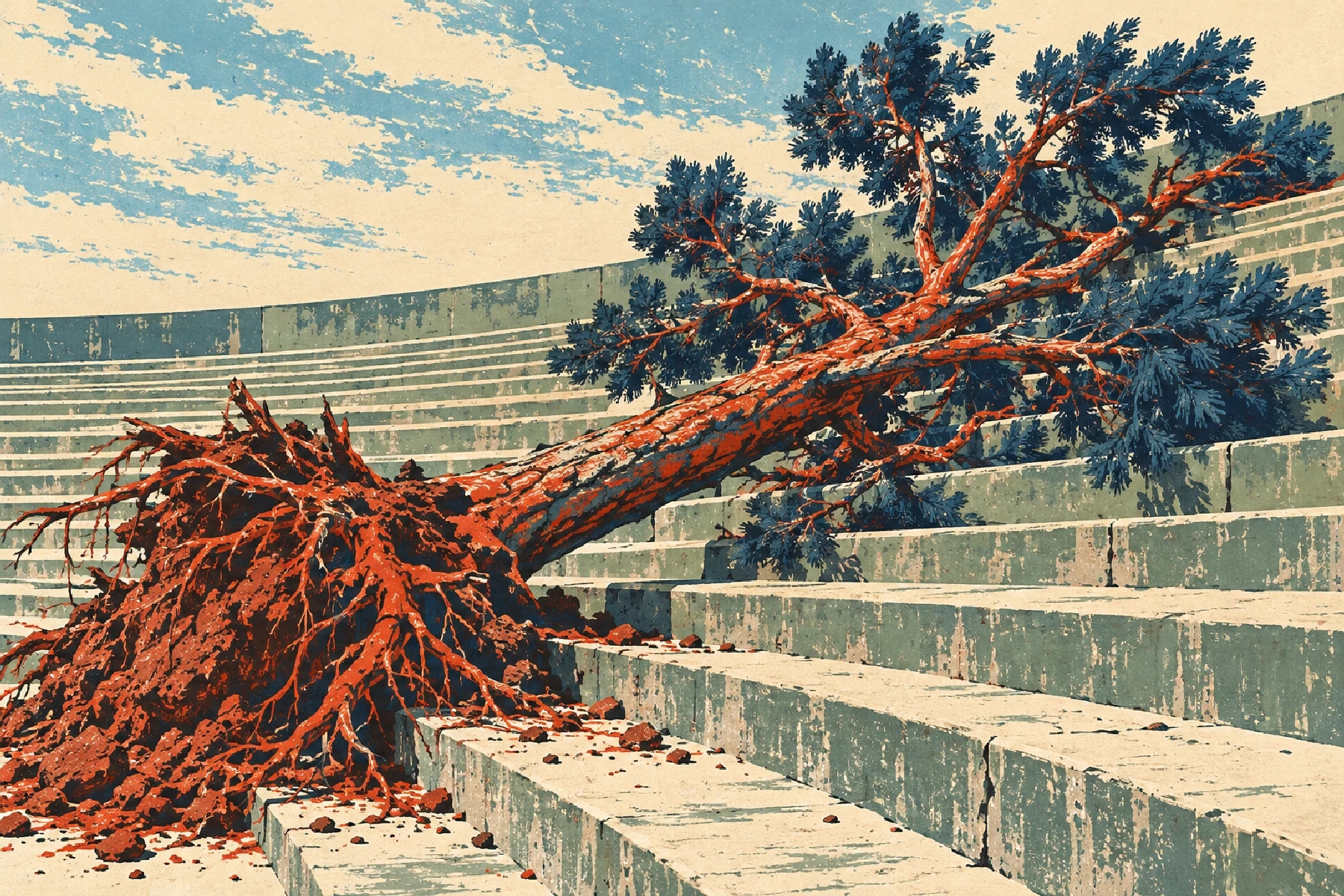
A Pine Across the Stadium Steps
A fallen pine interrupts the repeated steps of an empty outdoor stadium. Decisive shape rhythms and rough ink edges give the asymmetric screen print its force.
Remix this referenceA Pine Across the Stadium Steps
- Form language
- Compress complex forms into interlocking wedges, hooked bands and blunt clusters; vary the width and interval of repeated shapes.
- Contour
- Let adjoining printed masses define most edges; occasional thick, broken contours end bluntly instead of enclosing every form.
- Mark-making
- Use dragged squeegee streaks and sparse rough cut-ins, with naturally varied length and pressure.
- Surface rendering
- Build tone through opaque ink layers and selective overprints; allow uneven ink bite and small registration slips at a few joins.
Priority
Make decisive screen-printed shape rhythms the defining treatment.
What to avoid & what to check
Exact prompt for this example
MODULE OWNERSHIP
subject: Subject count, type, stable proportions and landmarks, resting face geometry, hair shape, physical materials, garment construction and permanent marks. No emotion, movement, color assignment or rendering recipe.
expression: Facial soft-tissue displacement and pupil direction, muscle coordination, regional intensity, asymmetry and onset/peak/release. No head/body pose, stable appearance, skin color or rendering.
gesture: Head/neck/body/limb orientation, joint movement, support, contact and pose-caused occlusion using existing anatomy. No eye/pupil movement, emotion, identity, props inventory or camera.
props: Prop count, type, construction, physical material and scale relative to the subject. Holding/contact belongs to gesture, position to composition, color to palette.
scene: Environment elements, terrain, backdrop/floor presence and structural detail. No canvas positions, camera, lighting, assigned colors or render texture.
camera: Projection, focal-length impression, camera elevation/yaw/roll, viewing distance and crop. No actor pose, world placement, lighting or canvas aspect ratio.
composition: Normalized 0-100% canvas positions, scale in frame, depth/overlap, focal hierarchy and margins. No joint pose, camera projection, rendering, subject/prop inventory or emotion.
palette: Color anchors, hue/saturation/value ranges, colors assigned to parts and approximate color coverage. No illumination direction, shading algorithm, physical material or layout.
lighting: Light-source direction/softness/intensity, ambient illumination, physical shadow direction/length and highlight position. Absence of directional illumination is allowed. No shading technique, palette or material changes.
style: Reusable form abstraction, contour weight/taper/edge quality, medium and mark scale/density/direction, surface rendering and tonal transition technique. No fixed subject proportions, anatomy, identity, expression, pose, palette, light-source direction, camera or layout.
output: Image count, aspect ratio, size, file/alpha requirements and global lettering/logo/watermark restrictions. No background scenery, crop, style, identity or pose.

SUBJECT
inventory: One uprooted mature pine tree; no people or animals.
geometry: A long crooked trunk divides into irregular boughs, clustered needles and a broad exposed root fan.
resting-face: No face or facial landmarks apply.
appearance: Plated bark, woody roots with attached soil clods and dense needle bundles; minor branching may vary naturally.

PRIORITY


AVOID


CHECK


GESTURE
head: No head or neck control targets apply.
torso: The tree lies on its side across the terrace steps.
limbs: No articulated limb control targets apply.
contact: The trunk and lower boughs rest against concrete treads at several levels.

PRIORITY


AVOID


CHECK


PROPS
inventory: No separate props.
construction: No prop construction applies.

PRIORITY


AVOID


CHECK


SCENE
inventory: An outdoor stadium with concrete spectator terraces, a low perimeter wall and open sky.
structure: Broad concrete treads alternate with narrow risers; the perimeter wall follows the stadium curve.

PRIORITY


AVOID


CHECK


CAMERA
projection: Restrained perspective with a normal-lens impression keeps terrace intervals legible.
viewpoint: Look obliquely along the terraces from slightly above seat height, with a level horizon.
crop: A wide environmental view includes the root fan and most of the crown; outer needle tips may leave the frame.

PRIORITY


AVOID


CHECK


COMPOSITION
placement: The root fan anchors the lower left; the trunk crosses toward the right, with open sky in the upper left.
depth: The tree overlaps several terrace levels; its interruption leads attention before the receding steps.
spacing: Alternate broad empty terrace bands with compressed branch clusters; keep the root silhouette clear of the frame.

PRIORITY


AVOID


CHECK


PALETTE
colors: Use vermilion, midnight blue, muted sage and warm ivory as a compact set of expressive anchors.
assignment: Assign vermilion to trunk and roots, midnight blue to needles, sage to terraces and ivory to sky.
balance: Ivory and sage dominate; vermilion supplies a concentrated accent and blue supplies the darkest values.

PRIORITY


AVOID


CHECK


LIGHTING
sources: Broad daylight enters from the upper left with moderate softness and ample ambient light.
shadows: The trunk casts short, connected shadows down and right across the terrace levels.
highlights: Broad light accents catch upper bark ridges and exposed terrace lips.

PRIORITY


AVOID


CHECK


STYLE GUIDE
form-language: Compress complex forms into interlocking wedges, hooked bands and blunt clusters; vary the width and interval of repeated shapes.
contour: Let adjoining printed masses define most edges; occasional thick, broken contours end bluntly instead of enclosing every form.
mark-making: Use dragged squeegee streaks and sparse rough cut-ins, with naturally varied length and pressure.
surface-rendering: Build tone through opaque ink layers and selective overprints; allow uneven ink bite and small registration slips at a few joins.

PRIORITY
Make decisive screen-printed shape rhythms the defining treatment.

AVOID


CHECK


OUTPUT
format: One finished image, landscape 3:2, 1800 × 1200 pixels, opaque PNG.
restrictions: No lettering, logos or watermarks.

PRIORITY


AVOID


CHECK
Model information comes from image provenance. The same prompt may produce a different result.