Text to imageAnimationStyle guide
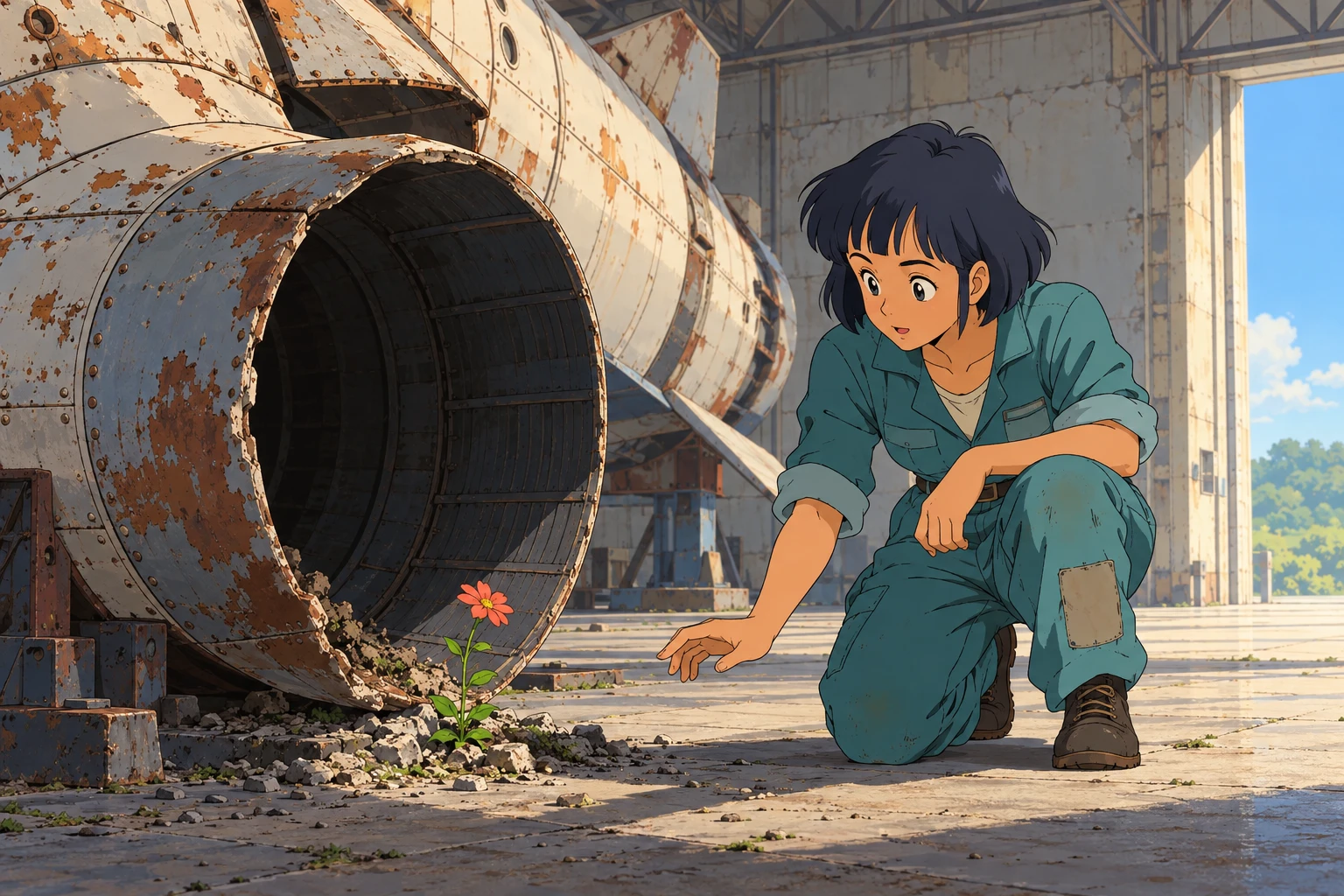
Mechanic Finding a Flower in a Rocket
A mechanic pauses before a tiny flower growing inside a rocket exhaust. Spacious cel-animation staging gives the small discovery room beside the enormous hull.
Remix this referenceMechanic Finding a Flower in a Rocket
- Form language
- Combine rounded masses with wedge-like facets; simplify small detail into a few legible shapes, allowing incidental irregularity.
- Contour
- Use continuous ink exterior contours and finer interior separators, with slight hand-drawn weight changes at turns.
- Mark-making
- Use short tapered crease marks and sparse interior strokes; let opaque brushwork vary naturally in width and spacing.
- Surface rendering
- Cel-painted shapes use hard-edged base fills and one secondary tonal plane with restrained cel-surface texture; brush-painted passages use broad opaque tonal transitions.
Priority
Rendering medium: 2D Japanese television-anime cel illustration; formal rendering reference: Toei Animation · 1980s · Dragon Ball (1986)
What to avoid & what to check
Exact prompt for this example
MODULE OWNERSHIP
subject: Subject count, type, stable proportions and landmarks, resting face geometry, hair shape, physical materials, garment construction and permanent marks. No emotion, movement, color assignment or rendering recipe.
expression: Facial soft-tissue displacement and pupil direction, muscle coordination, regional intensity, asymmetry and onset/peak/release. No head/body pose, stable appearance, skin color or rendering.
gesture: Head/neck/body/limb orientation, joint movement, support, contact and pose-caused occlusion using existing anatomy. No eye/pupil movement, emotion, identity, props inventory or camera.
props: Prop count, type, construction, physical material and scale relative to the subject. Holding/contact belongs to gesture, position to composition, color to palette.
scene: Environment elements, terrain, backdrop/floor presence and structural detail. No canvas positions, camera, lighting, assigned colors or render texture.
camera: Projection, focal-length impression, camera elevation/yaw/roll, viewing distance and crop. No actor pose, world placement, lighting or canvas aspect ratio.
composition: Normalized 0-100% canvas positions, scale in frame, depth/overlap, focal hierarchy and margins. No joint pose, camera projection, rendering, subject/prop inventory or emotion.
palette: Color anchors, hue/saturation/value ranges, colors assigned to parts and approximate color coverage. No illumination direction, shading algorithm, physical material or layout.
lighting: Light-source direction/softness/intensity, ambient illumination, physical shadow direction/length and highlight position. Absence of directional illumination is allowed. No shading technique, palette or material changes.
style: Reusable form abstraction, contour weight/taper/edge quality, medium and mark scale/density/direction, surface rendering and tonal transition technique. No fixed subject proportions, anatomy, identity, expression, pose, palette, light-source direction, camera or layout.
output: Image count, aspect ratio, size, file/alpha requirements and global lettering/logo/watermark restrictions. No background scenery, crop, style, identity or pose.

SUBJECT
inventory: A: one adult woman mechanic. One small flowering plant is a secondary living subject without facial controls.
geometry: A has a sturdy build, broad hands and a rounded chin; the plant has a slender stem and an irregular petal ring.
resting-face: A has widely spaced oval eyes, straight resting brows, a broad nose tip and a short upper lip.
appearance: A has a blunt bob with an uneven fringe and wears a canvas coverall with rolled sleeves and a sewn knee patch.

PRIORITY


AVOID


CHECK


EXPRESSION — ACTOR A
brows: Both brows lift slightly, with the nearer brow rising first.
lids: Upper lids lift; lower lids remain relaxed.
cheeks: Cheeks remain soft, with a faint lift beside the nearer mouth corner.
nose: Nostrils stay relaxed without a wrinkle across the bridge.
mouth: Lips part narrowly; one corner begins a small upward curl.
jaw: The jaw releases slightly without a broad mouth opening.
gaze: Both pupils settle on the flower's center.
coordination: The brow lift leads the subtle mouth change, keeping the response quietly inquisitive.
timing: Capture the onset of recognition, before the small smile fully forms.

PRIORITY


AVOID


CHECK


GESTURE
head: A extends her neck slightly and inclines her head toward the exhaust opening.
torso: She kneels on one knee, her torso leaning forward from a settled pelvis.
limbs: One forearm rests across the raised thigh; the other hand pauses open beside the flower.
contact: The lowered knee and opposite foot support her weight; her hovering fingertips do not touch the petals.

PRIORITY


AVOID


CHECK


PROPS
inventory: One retired rocket, roughly twice A's standing height; no separate tools.
construction: The rocket has a riveted metal shell and a broad bell exhaust with a chipped rim and earth caught in its inner lip.

PRIORITY


AVOID


CHECK


SCENE
inventory: A disused maintenance hangar with a concrete floor, a tall plaster wall and exposed roof beams.
structure: A high open doorway interrupts the otherwise broad wall; sparse floor cracks suggest long neglect.

PRIORITY


AVOID


CHECK


CAMERA
projection: Perspective with a natural moderate-wide focal-length impression and restrained foreshortening.
viewpoint: View from A's current eye height, obliquely across the exhaust, with a level camera.
crop: A medium-wide view includes her complete figure while the rocket's nose extends beyond the frame.

PRIORITY


AVOID


CHECK


COMPOSITION
placement: The rocket dominates the left half; A occupies the lower right, with the flower in the narrow interval between them.
depth: The exhaust rim overlaps the stem's base; A's face and the flower remain clearly separated against the distant wall.
spacing: Make the face–flower exchange the focal point; leave broad breathing room above A and clear space around her hand.

PRIORITY


AVOID


CHECK


PALETTE
colors: Use dusty turquoise, warm ivory, muted rust and a small clear coral accent, grounded by deep blue-gray.
assignment: Give the coverall turquoise, the hull ivory with rust patches, the flower coral, hair blue-gray and skin warm ochre.
balance: Let pale wall and hull colors predominate; reserve the clearest saturation for the tiny blossom.

PRIORITY


AVOID


CHECK


LIGHTING
sources: Broad daylight enters from the upper right through the open doorway, softened by generous ambient bounce.
shadows: Soft floor shadows extend leftward; the exhaust interior remains darker while retaining the flower's silhouette.
highlights: Place modest highlights on the upper-right exhaust rim, cheek and exposed knuckles.

PRIORITY


AVOID


CHECK


STYLE GUIDE
form-language: Combine rounded masses with wedge-like facets; simplify small detail into a few legible shapes, allowing incidental irregularity.
contour: Use continuous ink exterior contours and finer interior separators, with slight hand-drawn weight changes at turns.
mark-making: Use short tapered crease marks and sparse interior strokes; let opaque brushwork vary naturally in width and spacing.
surface-rendering: Cel-painted shapes use hard-edged base fills and one secondary tonal plane with restrained cel-surface texture; brush-painted passages use broad opaque tonal transitions.

PRIORITY
Rendering medium: 2D Japanese television-anime cel illustration; formal rendering reference: Toei Animation · 1980s · Dragon Ball (1986)

AVOID


CHECK


OUTPUT
format: One finished image, 3:2 landscape, 1536 × 1024 pixels, opaque PNG.
restrictions: No lettering, logos, signatures or watermarks.

PRIORITY


AVOID


CHECK


FINAL INTEGRATION
expression + gesture + composition: Let the facial response, paused hand and surrounding space cooperate to make the discovery feel newly noticed.
style + lighting + palette: Translate the chosen illumination and color relationships through the cel treatment while preserving their separate roles.
Art direction
토에이 애니메이션 / Toei Animation · 1980s · 드래곤볼(1986) / Dragon Ball (1986) ↗- Combine rounded masses and wedge-like facets into readable form abstractions
- Continuous ink exterior contours with finer interior separators
- Short tapered crease marks and sparse marks inside filled areas
- Hard-edged base and single secondary tonal planes with restrained cel-surface texture
Model information comes from image provenance. The same prompt may produce a different result.