Text to imageCalligraphyStyle guide
Sweeping Teal Lettering
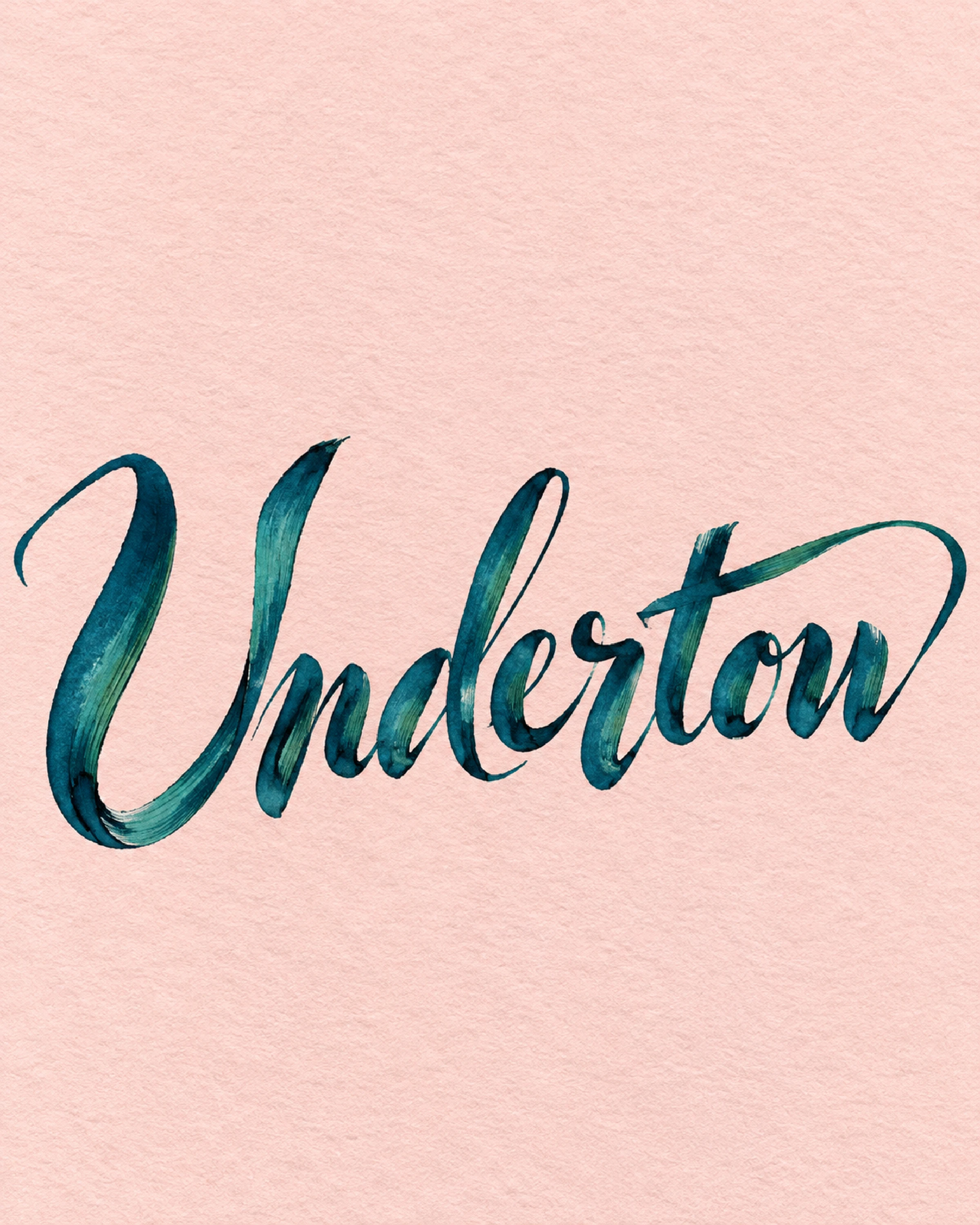
An expansive initial and closely linked lowercase letters create flowing tension in broad-nib calligraphy on shell-pink paper.
Remix this referenceSweeping Teal Lettering
- Form language
- Build flowing ribbon bands that broaden through curves and narrow at connections, keeping each letter readily recognizable.
- Contour
- Pair crisp nib-cut terminals with rounded outer bends; allow slight handmade irregularity along otherwise assured edges.
- Mark-making
- Use long broad-nib pulls and decisive lifts, with occasional fine nib tracks inside wide strokes; vary marks naturally within this language.
- Surface rendering
- Render gouache ink with dense body, softly uneven opacity and small pigment pools at turns; let restrained paper tooth show through.
Priority
Broad-nib lettering with confident ribbon strokes.
What to avoid & what to check
Exact prompt for this example
MODULE OWNERSHIP
subject: Subject count, type, stable proportions and landmarks, resting face geometry, hair shape, physical materials, garment construction and permanent marks. No emotion, movement, color assignment or rendering recipe.
expression: Facial soft-tissue displacement and pupil direction, muscle coordination, regional intensity, asymmetry and onset/peak/release. No head/body pose, stable appearance, skin color or rendering.
gesture: Head/neck/body/limb orientation, joint movement, support, contact and pose-caused occlusion using existing anatomy. No eye/pupil movement, emotion, identity, props inventory or camera.
props: Prop count, type, construction, physical material and scale relative to the subject. Holding/contact belongs to gesture, position to composition, color to palette.
scene: Environment elements, terrain, backdrop/floor presence and structural detail. No canvas positions, camera, lighting, assigned colors or render texture.
camera: Projection, focal-length impression, camera elevation/yaw/roll, viewing distance and crop. No actor pose, world placement, lighting or canvas aspect ratio.
composition: Normalized 0-100% canvas positions, scale in frame, depth/overlap, focal hierarchy and margins. No joint pose, camera projection, rendering, subject/prop inventory or emotion.
palette: Color anchors, hue/saturation/value ranges, colors assigned to parts and approximate color coverage. No illumination direction, shading algorithm, physical material or layout.
lighting: Light-source direction/softness/intensity, ambient illumination, physical shadow direction/length and highlight position. Absence of directional illumination is allowed. No shading technique, palette or material changes.
style: Reusable form abstraction, contour weight/taper/edge quality, medium and mark scale/density/direction, surface rendering and tonal transition technique. No fixed subject proportions, anatomy, identity, expression, pose, palette, light-source direction, camera or layout.
output: Image count, aspect ratio, size, file/alpha requirements and global lettering/logo/watermark restrictions. No background scenery, crop, style, identity or pose.

SUBJECT
inventory: One original calligraphic word; no figures or animals.
geometry: Write "Undertow" with an open capital U, distinct lowercase joins and clearly open counters.
resting-face: No face is present.
appearance: The lettering consists of a pigment film on paper, without dimensional extrusion.

PRIORITY


AVOID


CHECK


PROPS
inventory: No separate props.
construction: No prop construction applies.

PRIORITY


AVOID


CHECK


SCENE
inventory: A continuous paper backdrop is the only environmental element.
structure: The paper forms an uninterrupted plane without a horizon, frame or visible sheet edge.

PRIORITY


AVOID


CHECK


CAMERA
projection: Orthographic reproduction with no perspective convergence.
viewpoint: Look squarely at the paper surface with no yaw or roll.
crop: Use an intimate close crop; allow peripheral flourishes to leave the frame while retaining every letter.

PRIORITY


AVOID


CHECK


COMPOSITION
placement: Place the word across the lower-middle field on a gently rising baseline, with the initial opening toward the left edge.
depth: Keep one graphic plane; the expansive initial leads into the compact lowercase sequence as the focal progression.
spacing: Leave generous breathing room above; preserve clear gaps between letters despite the tightly woven rhythm.

PRIORITY


AVOID


CHECK


PALETTE
colors: Use deep petrol teal, muted verdigris and pale shell pink.
assignment: Assign petrol teal to the lettering, verdigris to occasional lighter passages, and shell pink to the paper.
balance: Let the pale ground dominate the open field, with dark lettering carrying the strongest value contrast.

PRIORITY


AVOID


CHECK


LIGHTING
sources: Use soft, even ambient illumination without a visible directional source.
shadows: No cast shadows are visible.
highlights: No localized highlights interrupt the lettering.

PRIORITY


AVOID


CHECK


STYLE GUIDE
form-language: Build flowing ribbon bands that broaden through curves and narrow at connections, keeping each letter readily recognizable.
contour: Pair crisp nib-cut terminals with rounded outer bends; allow slight handmade irregularity along otherwise assured edges.
mark-making: Use long broad-nib pulls and decisive lifts, with occasional fine nib tracks inside wide strokes; vary marks naturally within this language.
surface-rendering: Render gouache ink with dense body, softly uneven opacity and small pigment pools at turns; let restrained paper tooth show through.

PRIORITY
Broad-nib lettering with confident ribbon strokes.

AVOID


CHECK


OUTPUT
format: Deliver one portrait image, 4:5, 2400 × 3000 pixels, as an opaque PNG. Allow primary lettering through the final integration note; forbid additional text, logos and watermarks.
restrictions: Deliver one portrait image, 4:5, 2400 × 3000 pixels, as an opaque PNG. Allow primary lettering through the final integration note; forbid additional text, logos and watermarks.

PRIORITY


AVOID


CHECK


FINAL INTEGRATION
subject + output: The primary lettering permitted by output is exactly "Undertow", as defined in subject.geometry.
Model information comes from image provenance. The same prompt may produce a different result.