Text to imageAnimationStyle guide
A Film Loop in the Projection Booth
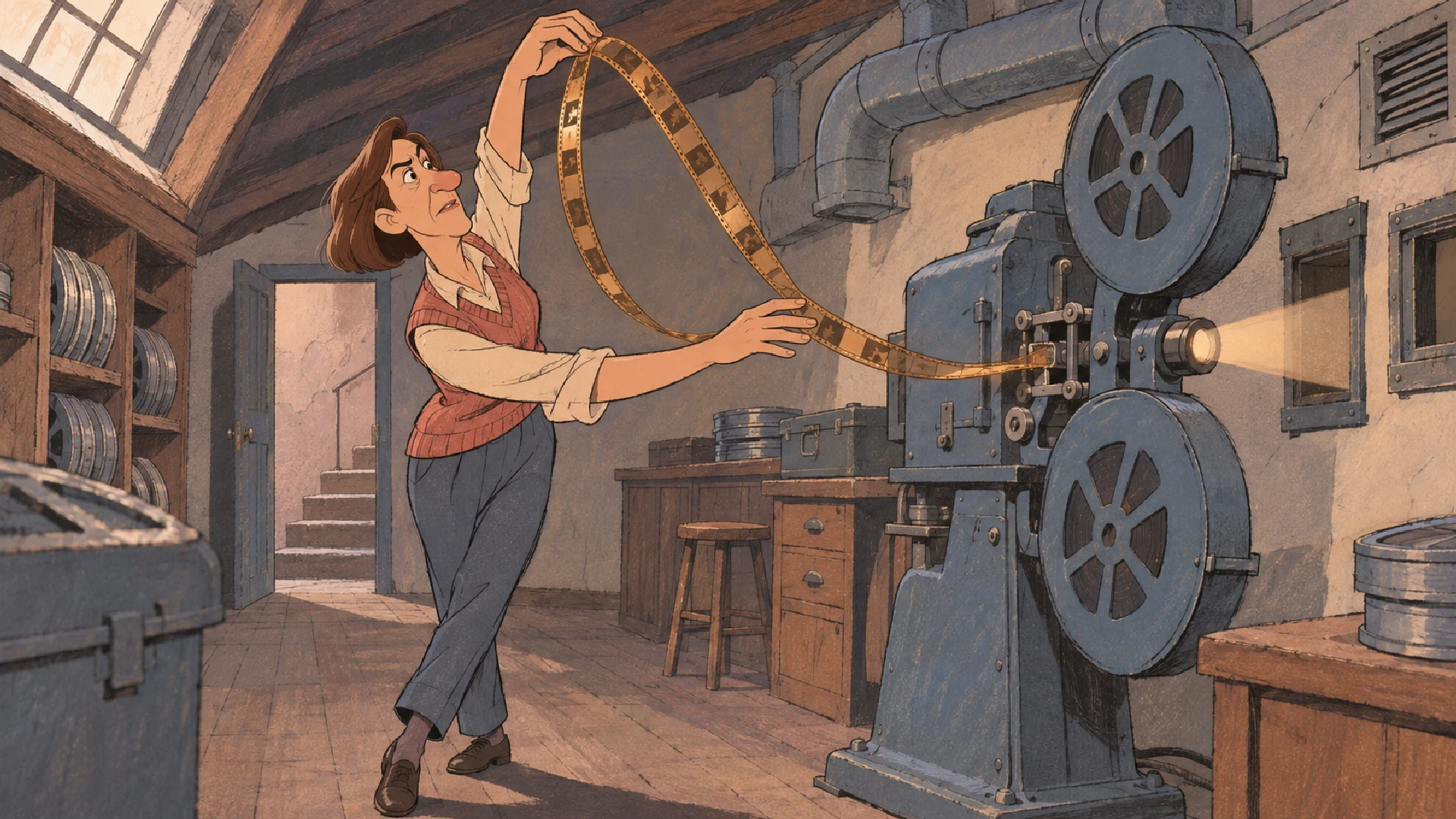
In a cramped projection booth, a projectionist lifts a loose film loop overhead. Layered equipment and a sweeping ribbon of film frame a moment of startled concentration in xerographic cel animation.
Remix this referenceA Film Loop in the Projection Booth
- Form language
- Build legible masses with selective angular simplification; vary secondary shapes naturally within a coherent drawn vocabulary.
- Contour
- Use sketch-like graphite contours with slight weight tremors, tapered exits and occasional open edges instead of uniform ink polish.
- Mark-making
- Retain a few short doubled outlines and broken pencil traces; use looser directional brush marks in painted passages.
- Surface rendering
- Combine flat cel fills and a few discrete tonal steps with lightly scumbled paint; allow slight line-to-fill misregistration.
Priority
Rendering medium: hand-drawn 2D xerographic cel-animation illustration; formal rendering reference: Walt Disney Studios · 1960s · One Hundred and One Dalmatians (1961)
What to avoid & what to check
Exact prompt for this example
MODULE OWNERSHIP
subject: Subject count, type, stable proportions and landmarks, resting face geometry, hair shape, physical materials, garment construction and permanent marks. No emotion, movement, color assignment or rendering recipe.
expression: Facial soft-tissue displacement and pupil direction, muscle coordination, regional intensity, asymmetry and onset/peak/release. No head/body pose, stable appearance, skin color or rendering.
gesture: Head/neck/body/limb orientation, joint movement, support, contact and pose-caused occlusion using existing anatomy. No eye/pupil movement, emotion, identity, props inventory or camera.
props: Prop count, type, construction, physical material and scale relative to the subject. Holding/contact belongs to gesture, position to composition, color to palette.
scene: Environment elements, terrain, backdrop/floor presence and structural detail. No canvas positions, camera, lighting, assigned colors or render texture.
camera: Projection, focal-length impression, camera elevation/yaw/roll, viewing distance and crop. No actor pose, world placement, lighting or canvas aspect ratio.
composition: Normalized 0-100% canvas positions, scale in frame, depth/overlap, focal hierarchy and margins. No joint pose, camera projection, rendering, subject/prop inventory or emotion.
palette: Color anchors, hue/saturation/value ranges, colors assigned to parts and approximate color coverage. No illumination direction, shading algorithm, physical material or layout.
lighting: Light-source direction/softness/intensity, ambient illumination, physical shadow direction/length and highlight position. Absence of directional illumination is allowed. No shading technique, palette or material changes.
style: Reusable form abstraction, contour weight/taper/edge quality, medium and mark scale/density/direction, surface rendering and tonal transition technique. No fixed subject proportions, anatomy, identity, expression, pose, palette, light-source direction, camera or layout.
output: Image count, aspect ratio, size, file/alpha requirements and global lettering/logo/watermark restrictions. No background scenery, crop, style, identity or pose.

SUBJECT
inventory: One original human projectionist, actor A, a middle-aged woman.
geometry: A has a lanky build, a long pear-shaped face, a prominent rounded nose and broad hands.
resting-face: Her resting features have straight brows, hooded eyes and a wide mouth with a fuller lower lip.
appearance: A blunt bob tucks behind one ear; she wears a woven work shirt, sleeveless knitted vest and high-waisted trousers.

PRIORITY


AVOID


CHECK


EXPRESSION — ACTOR A
brows: The brows draw inward, with one inner corner slightly higher.
lids: Upper lids lift while the lower lids tighten slightly.
cheeks: Cheeks remain mostly relaxed, with slight tension beside the mouth.
nose: Nostrils open subtly without wrinkling the bridge.
mouth: Lips part narrowly; one corner pulls sideways in concentration.
jaw: The jaw releases just enough to separate the lips.
gaze: Pupils track the film segment nearest one hand.
coordination: Alert eyes lead a restrained mouth response; keep the asymmetry subtle.
timing: Capture concentration beginning to replace the first instant of surprise.

PRIORITY


AVOID


CHECK


GESTURE
head: A cranes her neck upward and turns her head toward the raised hand.
torso: Her torso stretches upward with a sideways bend over a planted supporting leg.
limbs: One arm reaches overhead; the other extends forward, while the free foot takes a crossing step.
contact: Raised fingertips lift one edge of the film; the lower hand guides another section without closing into a fist.

PRIORITY


AVOID


CHECK


PROPS
inventory: One floor-standing film projector and one continuous strip of motion-picture film.
construction: The projector has a cast-metal body and two large reel housings; flexible translucent film has visible perforated edges.

PRIORITY


AVOID


CHECK


SCENE
inventory: An old cinema projection booth with a narrow working aisle, reel-storage recesses, ventilation ducts and projection ports.
structure: Sloping roof beams compress the room; an open service doorway reveals a short stair and a second plaster wall beyond.

PRIORITY


AVOID


CHECK


CAMERA
projection: Moderate wide-angle perspective with clear spatial recession and restrained edge distortion.
viewpoint: View diagonally down the aisle from waist height, with a level camera.
crop: Show A's full figure and the film without edge cropping; let nearby equipment extend beyond the frame.

PRIORITY


AVOID


CHECK


COMPOSITION
placement: Place A near 35% across; the film occupies the upper middle, counterbalanced by the projector on the right.
depth: A foreground housing overlaps the aisle; A and the film lead into the projector, then the receding doorway.
spacing: A fills roughly two-thirds of the image height; prioritize face and hand, with open space inside the film loop.

PRIORITY


AVOID


CHECK


PALETTE
colors: Use smoky blue, tobacco brown, dusty coral and warm cream, with restrained saturation.
assignment: Blue belongs to equipment and trousers, brown to wood and hair, coral to the vest, cream to plaster and shirt; skin is warm ochre.
balance: Blue and cream dominate; coral is a compact accent, film is amber and contours are deep charcoal.

PRIORITY


AVOID


CHECK


LIGHTING
sources: Soft daylight enters from high left; a weaker projector lamp adds a narrow forward beam.
shadows: Broad shadows fall down and right; ambient bounce keeps the deeper booth readable.
highlights: Small highlights touch upper knuckles, the nose ridge and the film edges facing the daylight.

PRIORITY


AVOID


CHECK


STYLE GUIDE
form-language: Build legible masses with selective angular simplification; vary secondary shapes naturally within a coherent drawn vocabulary.
contour: Use sketch-like graphite contours with slight weight tremors, tapered exits and occasional open edges instead of uniform ink polish.
mark-making: Retain a few short doubled outlines and broken pencil traces; use looser directional brush marks in painted passages.
surface-rendering: Combine flat cel fills and a few discrete tonal steps with lightly scumbled paint; allow slight line-to-fill misregistration.

PRIORITY
Rendering medium: hand-drawn 2D xerographic cel-animation illustration; formal rendering reference: Walt Disney Studios · 1960s · One Hundred and One Dalmatians (1961)

AVOID


CHECK


OUTPUT
format: One finished image, landscape 16:9, 1920 × 1080 pixels, opaque PNG.
restrictions: No lettering, logos, captions or watermarks.

PRIORITY


AVOID


CHECK
Art direction
디즈니 / Walt Disney Studios · 1960s · 101마리 달마시안(1961) / One Hundred and One Dalmatians (1961) ↗- Use legible form masses with selective angular simplification
- Sketch-like contours with small weight irregularities instead of polished ink uniformity
- Retain selective short doubled contour traces and broken pencil-like marks
- Flat fills with few tonal levels and slight line-to-fill edge misregistration
Model information comes from image provenance. The same prompt may produce a different result.