Text to imageLandscapeStyle guide
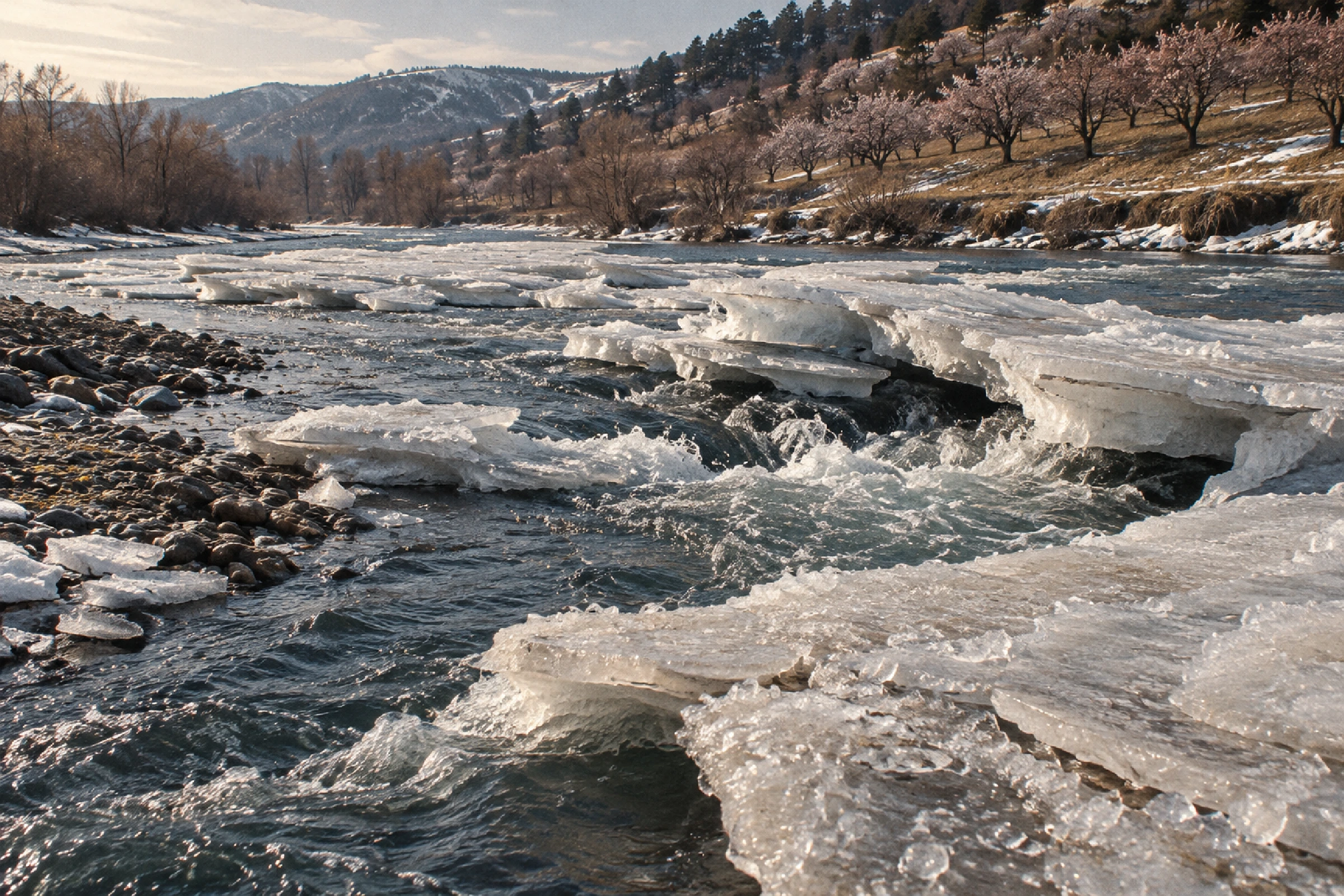
Ice Breakup at an Orchard Bend
An analog landscape photograph catches overlapping river ice breaking apart below an orchard just beginning to bloom.
Remix this referenceIce Breakup at an Orchard Bend
- Form language
- Preserve irregular masses through continuous photographic detail; allow fine forms to merge into broader shapes through optical softness.
- Contour
- Resolve edges optically, varying crisp boundaries with softly dissolved transitions; use no drawn outlines.
- Mark-making
- Use fine, uneven analog film grain and slight local motion softness; let grain vary naturally with tone.
- Surface rendering
- Use a film-print tonal shoulder, gentle highlight bloom and rich midtone separation while retaining fine surface detail.
Priority
The analog photographic treatment should remain visibly present across the finished image.
What to avoid & what to check
Exact prompt for this example
MODULE OWNERSHIP
subject: Subject count, type, stable proportions and landmarks, resting face geometry, hair shape, physical materials, garment construction and permanent marks. No emotion, movement, color assignment or rendering recipe.
expression: Facial soft-tissue displacement and pupil direction, muscle coordination, regional intensity, asymmetry and onset/peak/release. No head/body pose, stable appearance, skin color or rendering.
gesture: Head/neck/body/limb orientation, joint movement, support, contact and pose-caused occlusion using existing anatomy. No eye/pupil movement, emotion, identity, props inventory or camera.
props: Prop count, type, construction, physical material and scale relative to the subject. Holding/contact belongs to gesture, position to composition, color to palette.
scene: Environment elements, terrain, backdrop/floor presence and structural detail. No canvas positions, camera, lighting, assigned colors or render texture.
camera: Projection, focal-length impression, camera elevation/yaw/roll, viewing distance and crop. No actor pose, world placement, lighting or canvas aspect ratio.
composition: Normalized 0-100% canvas positions, scale in frame, depth/overlap, focal hierarchy and margins. No joint pose, camera projection, rendering, subject/prop inventory or emotion.
palette: Color anchors, hue/saturation/value ranges, colors assigned to parts and approximate color coverage. No illumination direction, shading algorithm, physical material or layout.
lighting: Light-source direction/softness/intensity, ambient illumination, physical shadow direction/length and highlight position. Absence of directional illumination is allowed. No shading technique, palette or material changes.
style: Reusable form abstraction, contour weight/taper/edge quality, medium and mark scale/density/direction, surface rendering and tonal transition technique. No fixed subject proportions, anatomy, identity, expression, pose, palette, light-source direction, camera or layout.
output: Image count, aspect ratio, size, file/alpha requirements and global lettering/logo/watermark restrictions. No background scenery, crop, style, identity or pose.

SUBJECT
inventory: No people, animals or standalone character subjects.
geometry: No character proportions or identity landmarks apply.
resting-face: No visible faces.
appearance: No character appearance, garments or permanent marks apply.

PRIORITY


AVOID


CHECK


PROPS
inventory: No separate props.
construction: No prop construction applies.

PRIORITY


AVOID


CHECK


SCENE
inventory: A thawing river bend, fractured ice with rough surfaces, wet gravel banks and a hillside orchard with sparse early blossoms.
structure: Ice plates buckle into overlapping shelves around an exposed turbulent channel; orchard rows follow the slope.

PRIORITY


AVOID


CHECK


CAMERA
projection: Rectilinear photographic perspective with a normal-lens impression and moderate depth of field.
viewpoint: Look obliquely downstream from just above the near bank, keeping the camera level.
crop: A broad landscape crop includes the river bend and orchard slope, with only a narrow strip of sky.

PRIORITY


AVOID


CHECK


COMPOSITION
placement: The main ice rupture sits right of center; the river sweeps from the lower left toward the upper right.
depth: Large foreground ice edges overlap the channel, which leads behind a bank into the smaller orchard forms.
spacing: Give the rupture first emphasis, the orchard second; preserve an open stretch of water between dense clusters.

PRIORITY


AVOID


CHECK


PALETTE
colors: Slate blue, warm ivory, straw ochre and restrained dusty coral, mostly at low saturation.
assignment: Use slate blue for water, ivory for ice, ochre for banks and orchard ground, and dusty coral for blossoms.
balance: Cool river tones dominate; broad pale ice shapes interrupt them, with sparse warm land and blossom accents.

PRIORITY


AVOID


CHECK


LIGHTING
sources: Soft sunlight through thin cloud comes from the upper left rear, with ample diffuse skylight.
shadows: Ice shelves cast soft, short shadows toward the lower right; open water retains readable detail.
highlights: Broken highlights catch raised ice rims and the small crests of the exposed current.

PRIORITY


AVOID


CHECK


STYLE GUIDE
form-language: Preserve irregular masses through continuous photographic detail; allow fine forms to merge into broader shapes through optical softness.
contour: Resolve edges optically, varying crisp boundaries with softly dissolved transitions; use no drawn outlines.
mark-making: Use fine, uneven analog film grain and slight local motion softness; let grain vary naturally with tone.
surface-rendering: Use a film-print tonal shoulder, gentle highlight bloom and rich midtone separation while retaining fine surface detail.

PRIORITY
The analog photographic treatment should remain visibly present across the finished image.

AVOID


CHECK


OUTPUT
format: One finished image, 3:2 aspect ratio, 2400 × 1600 pixels, opaque PNG.
restrictions: No lettering, logos or watermarks.

PRIORITY


AVOID


CHECK


FINAL INTEGRATION
scene + composition + camera + style: Let environmental structure, overlapping depth and photographic edge variation cooperate to make the thaw feel immediate.
Model information comes from image provenance. The same prompt may produce a different result.