Text to imageCharacterStyle guide
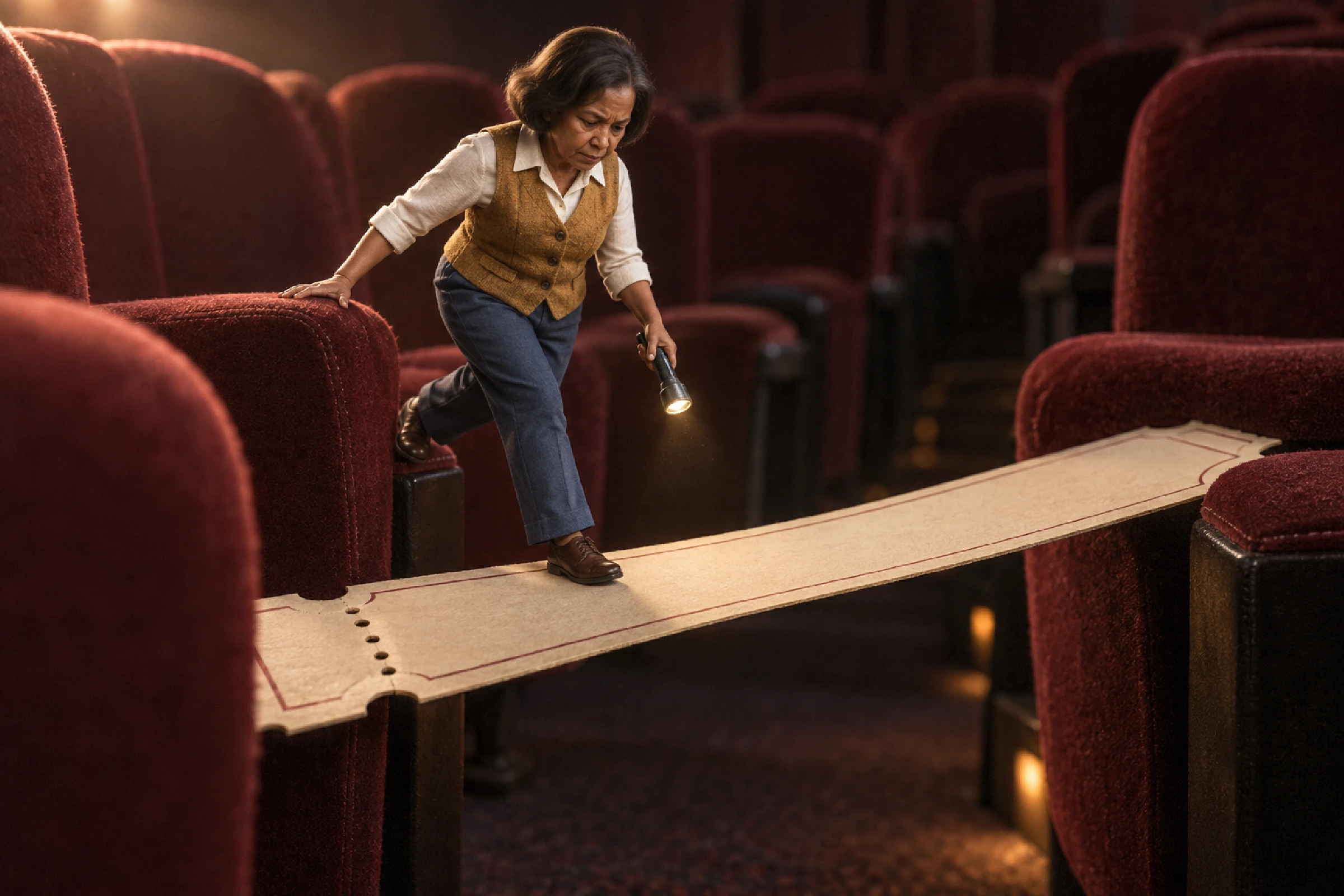
Usher Crossing a Ticket Bridge
A miniature cinema usher carefully crosses an oversized ticket between enormous seat armrests. Readable concentration and analog photographic depth turn a familiar auditorium into unexpected terrain.
Remix this referenceUsher Crossing a Ticket Bridge
- Form language
- Use photographic volume and tangible everyday irregularity; preserve subtle surface dents and fabric compression without stylized exaggeration.
- Contour
- Edges emerge from tonal contrast without drawn outlines; fine boundaries retain a slight emulsion softness.
- Mark-making
- Fine irregular film grain is most visible in middle values, with natural fluctuations rather than a uniform digital noise overlay.
- Surface rendering
- Continuous photographic tones taper gently into highlights and dense shadows; slight halation lends the brightest edges an analog bloom.
Priority
Make the analog photographic treatment visible through grain, tonal rolloff and restrained halation.
What to avoid & what to check
Exact prompt for this example
MODULE OWNERSHIP
subject: Subject count, type, stable proportions and landmarks, resting face geometry, hair shape, physical materials, garment construction and permanent marks. No emotion, movement, color assignment or rendering recipe.
expression: Facial soft-tissue displacement and pupil direction, muscle coordination, regional intensity, asymmetry and onset/peak/release. No head/body pose, stable appearance, skin color or rendering.
gesture: Head/neck/body/limb orientation, joint movement, support, contact and pose-caused occlusion using existing anatomy. No eye/pupil movement, emotion, identity, props inventory or camera.
props: Prop count, type, construction, physical material and scale relative to the subject. Holding/contact belongs to gesture, position to composition, color to palette.
scene: Environment elements, terrain, backdrop/floor presence and structural detail. No canvas positions, camera, lighting, assigned colors or render texture.
camera: Projection, focal-length impression, camera elevation/yaw/roll, viewing distance and crop. No actor pose, world placement, lighting or canvas aspect ratio.
composition: Normalized 0-100% canvas positions, scale in frame, depth/overlap, focal hierarchy and margins. No joint pose, camera projection, rendering, subject/prop inventory or emotion.
palette: Color anchors, hue/saturation/value ranges, colors assigned to parts and approximate color coverage. No illumination direction, shading algorithm, physical material or layout.
lighting: Light-source direction/softness/intensity, ambient illumination, physical shadow direction/length and highlight position. Absence of directional illumination is allowed. No shading technique, palette or material changes.
style: Reusable form abstraction, contour weight/taper/edge quality, medium and mark scale/density/direction, surface rendering and tonal transition technique. No fixed subject proportions, anatomy, identity, expression, pose, palette, light-source direction, camera or layout.
output: Image count, aspect ratio, size, file/alpha requirements and global lettering/logo/watermark restrictions. No background scenery, crop, style, identity or pose.

SUBJECT
inventory: A is one original older adult woman, a miniature cinema usher; no other characters.
geometry: Adult proportions, a compact build, broad cheekbones, a rounded chin and a straight nose with a blunt tip.
resting-face: At rest, level brows sit above softly hooded eyes; the lips have a shallow upper bow and fuller lower lip.
appearance: A tucked short bob, cotton shirt, woven waistcoat with a button front, straight trousers and leather shoes.

PRIORITY


AVOID


CHECK


EXPRESSION — ACTOR A
brows: Inner brows draw slightly down and together, with a little more tension on the left.
lids: Upper lids lower slightly; lower lids stay lightly engaged without a hard squint.
cheeks: Cheeks remain mostly relaxed, with subtle tension beside the mouth.
nose: Nose wings remain relaxed, without wrinkling or flaring.
mouth: Lips meet in a gently compressed line; neither corner lifts.
jaw: The jaw is lightly set, without visible clenching.
gaze: Pupils aim down and to her right toward the ticket ahead.
coordination: Brow and lid tension carry the concentration; the restrained mouth keeps it quiet.
timing: Hold the apex of quiet determination, with the facial tension fully established.

PRIORITY


AVOID


CHECK


GESTURE
head: A inclines her head slightly forward, keeping her neck comfortably extended.
torso: Her torso leans forward over the supporting leg, with a small counterturn through the shoulders.
limbs: One foot is planted on the ticket and the trailing foot stays on the armrest; her free elbow opens outward.
contact: Her left fingertips steady her against the armrest; her right hand grips the flashlight with its beam end down.

PRIORITY


AVOID


CHECK


PROPS
inventory: One oversized cinema ticket several actor-heights long and one flashlight sized for A's hand.
construction: The ticket is thick card with a perforated stub and gentle central sag; the flashlight has a metal barrel and glass lens.

PRIORITY


AVOID


CHECK


SCENE
inventory: An empty cinema auditorium with upholstered seats, padded armrests and a narrow aisle.
structure: Repeated seat backs establish the auditorium; their broad upholstery seams provide recognizable scale cues.

PRIORITY


AVOID


CHECK


CAMERA
projection: Natural photographic perspective with a normal-lens impression and a moderately shallow focus field.
viewpoint: Place the camera near miniature eye height, slightly above it, looking obliquely across the seats with no roll.
crop: Show A's full figure and the complete ticket crossing; crop the enormous seat bodies at the frame edges.

PRIORITY


AVOID


CHECK


COMPOSITION
placement: The ticket runs diagonally from lower-left toward middle-right; A occupies the upper-middle, slightly left of center.
depth: A foreground armrest overlaps the ticket's near end; repeated seat backs recede behind the figure.
spacing: A is the focal point at roughly two-fifths of frame height; retain an open seat gap beneath the ticket and breathing room ahead.

PRIORITY


AVOID


CHECK


PALETTE
colors: Burgundy, amber, cream and muted blue, with warm medium-brown complexion tones.
assignment: Burgundy upholstery, amber waistcoat, cream shirt and ticket, muted blue trousers; hair and shoes are dark brown.
balance: Burgundy dominates the broad areas; cream provides a clear interval, with amber and blue used in smaller amounts.

PRIORITY


AVOID


CHECK


LIGHTING
sources: Broad soft light enters from upper-left; weak aisle illumination rises from lower-right in dim ambient light.
shadows: Soft, short shadows fall rightward across the ticket; the seat gaps remain deeply shadowed.
highlights: Gentle highlights touch the left cheek, shirt collar and upper ticket edge; the flashlight produces only a faint local glow.

PRIORITY


AVOID


CHECK


STYLE GUIDE
form-language: Use photographic volume and tangible everyday irregularity; preserve subtle surface dents and fabric compression without stylized exaggeration.
contour: Edges emerge from tonal contrast without drawn outlines; fine boundaries retain a slight emulsion softness.
mark-making: Fine irregular film grain is most visible in middle values, with natural fluctuations rather than a uniform digital noise overlay.
surface-rendering: Continuous photographic tones taper gently into highlights and dense shadows; slight halation lends the brightest edges an analog bloom.

PRIORITY
Make the analog photographic treatment visible through grain, tonal rolloff and restrained halation.

AVOID


CHECK


OUTPUT
format: One finished image, landscape 3:2, 2400 × 1600 pixels, opaque PNG.
restrictions: No lettering, logos or watermarks; the ticket carries no printed text.

PRIORITY


AVOID


CHECK


FINAL INTEGRATION
subject + props + scene + camera: The familiar auditorium and ordinary human construction make the scale reversal immediately legible.
expression + gesture: Quiet facial concentration and careful physical support should feel like one continuous performance.
Model information comes from image provenance. The same prompt may produce a different result.