Text to imageArt stylesStyle guide
Opening the Organ Bellows
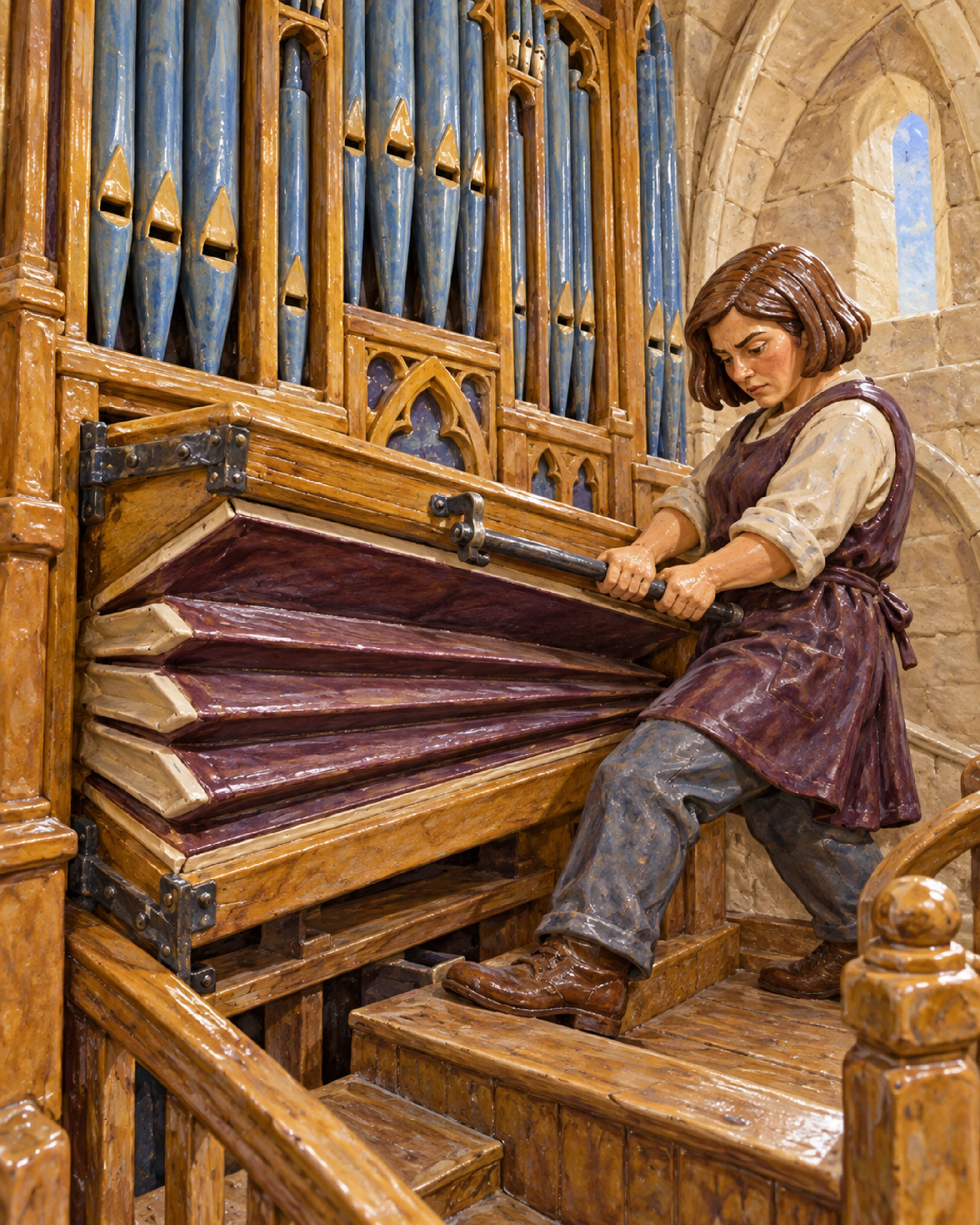
A caretaker leans back to open enormous bellows in a cramped organ loft. Layered pipes and unfolding pleats become modeled ceramic relief with pooled glaze.
Remix this referenceOpening the Organ Bellows
- Form language
- Translate forms into hand-modeled ceramic relief: rounded slabs, pressed recesses and softened ridges retain slight handmade irregularity.
- Contour
- Let raised clay rims define contours, swelling at broad turns and thinning into shallow incisions rather than uniform drawn outlines.
- Mark-making
- Use sparse thumb compressions and loose tool drags that follow surface curvature; vary their depth and spacing naturally.
- Surface rendering
- Translucent glaze pools in hollows and thins over crests; softly fused tonal transitions alternate with small uneven glaze boundaries.
Priority
The finished image must visibly read as modeled ceramic relief with glazed surfaces.
What to avoid & what to check
Exact prompt for this example
MODULE OWNERSHIP
subject: Subject count, type, stable proportions and landmarks, resting face geometry, hair shape, physical materials, garment construction and permanent marks. No emotion, movement, color assignment or rendering recipe.
expression: Facial soft-tissue displacement and pupil direction, muscle coordination, regional intensity, asymmetry and onset/peak/release. No head/body pose, stable appearance, skin color or rendering.
gesture: Head/neck/body/limb orientation, joint movement, support, contact and pose-caused occlusion using existing anatomy. No eye/pupil movement, emotion, identity, props inventory or camera.
props: Prop count, type, construction, physical material and scale relative to the subject. Holding/contact belongs to gesture, position to composition, color to palette.
scene: Environment elements, terrain, backdrop/floor presence and structural detail. No canvas positions, camera, lighting, assigned colors or render texture.
camera: Projection, focal-length impression, camera elevation/yaw/roll, viewing distance and crop. No actor pose, world placement, lighting or canvas aspect ratio.
composition: Normalized 0-100% canvas positions, scale in frame, depth/overlap, focal hierarchy and margins. No joint pose, camera projection, rendering, subject/prop inventory or emotion.
palette: Color anchors, hue/saturation/value ranges, colors assigned to parts and approximate color coverage. No illumination direction, shading algorithm, physical material or layout.
lighting: Light-source direction/softness/intensity, ambient illumination, physical shadow direction/length and highlight position. Absence of directional illumination is allowed. No shading technique, palette or material changes.
style: Reusable form abstraction, contour weight/taper/edge quality, medium and mark scale/density/direction, surface rendering and tonal transition technique. No fixed subject proportions, anatomy, identity, expression, pose, palette, light-source direction, camera or layout.
output: Image count, aspect ratio, size, file/alpha requirements and global lettering/logo/watermark restrictions. No background scenery, crop, style, identity or pose.

SUBJECT
inventory: A is one adult organ caretaker; no other figures.
geometry: Sturdy human proportions and broad hands give the figure a recognizable construction.
resting-face: An oval face has a broad nasal bridge, rounded chin and a straight resting mouth.
appearance: A blunt bob, cotton work smock over trousers and leather ankle boots; garment details may vary naturally.

PRIORITY


AVOID


CHECK


EXPRESSION — ACTOR A
brows: Inner brows draw slightly inward and down.
lids: Upper lids lower slightly; lower lids firm without a squint.
cheeks: Cheeks remain mostly relaxed, with slight tension beside the mouth.
nose: Nostrils widen subtly without wrinkling the nose.
mouth: Lips press together gently; one corner tightens a little more.
jaw: The jaw stays closed with mild muscular tension.
gaze: Pupils direct downward toward the pull bar.
coordination: Firm brows and lips cooperate while the cheeks stay comparatively quiet.
timing: Hold the apex of restrained determination before the facial tension releases.

PRIORITY


AVOID


CHECK


GESTURE
head: The head inclines toward the pull bar, with the neck following the backward lean.
torso: The torso leans away from the organ as the caretaker draws the upper bellows board upward.
limbs: Both elbows bend into the pull; one knee bends on a step while the rear leg braces on the landing.
contact: Both hands grip the attached bar; both boots bear weight on their supporting surfaces.

PRIORITY


AVOID


CHECK


PROPS
inventory: One monumental pipe organ with exposed wedge bellows and an attached pull bar; its pipes tower above A.
construction: A timber wind chest supports metal pipe ranks; leather pleats join hinged bellows boards fitted with an iron pull bar.

PRIORITY


AVOID


CHECK


SCENE
inventory: An enclosed organ loft with a timber landing, narrow stairs, stone ribs and a small unglazed opening.
structure: The stairs wrap around the loft supports; curved masonry encloses a cramped chamber with a continuous floor.

PRIORITY


AVOID


CHECK


CAMERA
projection: Moderate wide-angle perspective gives the chamber depth without conspicuous lens distortion.
viewpoint: Look slightly downward from A's front-side quarter so the face remains readable; keep camera roll level.
crop: Include the full caretaker and opened bellows; let the tallest pipes and nearest stair rail continue beyond the crop.

PRIORITY


AVOID


CHECK


COMPOSITION
placement: A occupies the lower right; the opened bellows span the middle, with pipe ranks filling the left and upper field.
depth: A cropped foreground rail overlaps the landing; A and the bellows sit before receding pipes and masonry.
spacing: The hands and opening pleats form the focal junction; a quiet wall pocket separates it from the dense pipe tiers.

PRIORITY


AVOID


CHECK


PALETTE
colors: Use smoky plum, mustard ochre, mist blue and warm ivory, with deep aubergine as the darkest anchor.
assignment: Plum bellows, ochre woodwork, mist-blue pipes, ivory masonry and an aubergine smock distinguish the main parts.
balance: Muted ivory and blue dominate; warmer ochre passages support the richer plum accent.

PRIORITY


AVOID


CHECK


LIGHTING
sources: Broad, soft daylight enters from high right, with gentle ambient illumination throughout the loft.
shadows: Short shadows fall toward the lower left, deepening beneath the bellows lip and between pipe ranks.
highlights: Broad highlights rest on upper-right-facing ridges, with smaller glints along the raised pleats.

PRIORITY


AVOID


CHECK


STYLE GUIDE
form-language: Translate forms into hand-modeled ceramic relief: rounded slabs, pressed recesses and softened ridges retain slight handmade irregularity.
contour: Let raised clay rims define contours, swelling at broad turns and thinning into shallow incisions rather than uniform drawn outlines.
mark-making: Use sparse thumb compressions and loose tool drags that follow surface curvature; vary their depth and spacing naturally.
surface-rendering: Translucent glaze pools in hollows and thins over crests; softly fused tonal transitions alternate with small uneven glaze boundaries.

PRIORITY
The finished image must visibly read as modeled ceramic relief with glazed surfaces.

AVOID


CHECK


OUTPUT
format: One finished image, portrait 4:5, 2048 × 2560 pixels, opaque PNG.
restrictions: No lettering, logos or watermarks.

PRIORITY


AVOID


CHECK


FINAL INTEGRATION
gesture + props: Keep the pulling action consistent with the bellows hinge and attached bar.
expression + camera: Keep the facial acting readable within the immersive chamber view.
lighting + style: Coordinate illumination and relief modeling so glazed depth remains readable.
Model information comes from image provenance. The same prompt may produce a different result.