Text to imageArt stylesStyle guide
Broken Oar at the Waterline
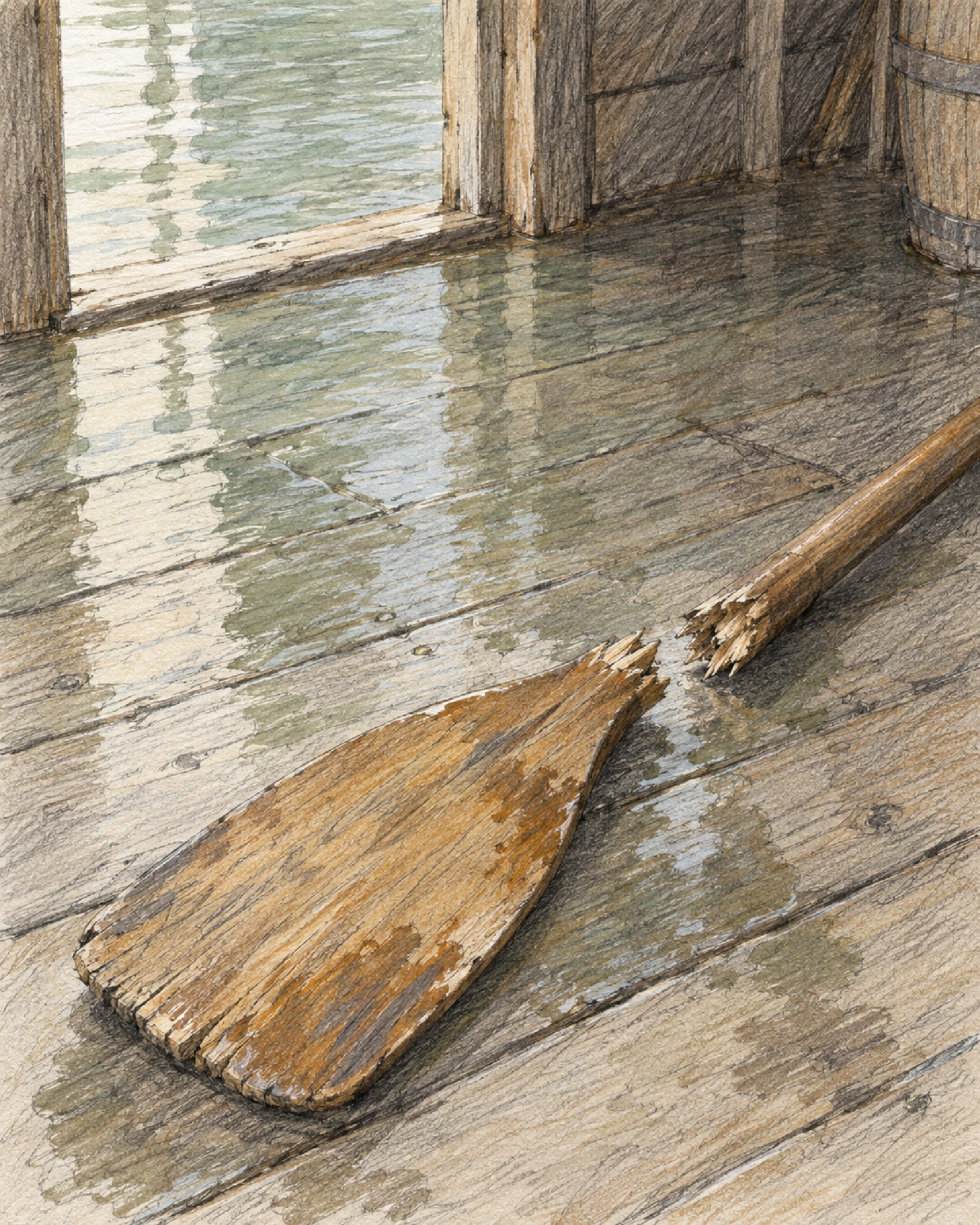
A broken oar in a flooded boathouse, drawn with rough graphite and colored pencil. Drawing gathers around the fractured wood, while generous negative space gives the moment its quiet.
Remix this referenceBroken Oar at the Waterline
- Form language
- Reduce forms to broad masses and a few searching structural lines; let minor shapes remain uneven within a coherent sketchbook language.
- Contour
- Use pressure-changing graphite contours with occasional doubled searches, broken stretches and blunt, unfinished terminals.
- Mark-making
- Combine brisk graphite hatching with loose colored-pencil strokes; vary stroke length and direction naturally, retaining visible paper tooth.
- Surface rendering
- Build tone through porous pencil layers and scattered side-of-lead rubs; let transitions dissolve into sparse marks and exposed paper.
Priority
Keep rough graphite and colored-pencil marks visibly distinct.
What to avoid & what to check
Exact prompt for this example
MODULE OWNERSHIP
subject: Subject count, type, stable proportions and landmarks, resting face geometry, hair shape, physical materials, garment construction and permanent marks. No emotion, movement, color assignment or rendering recipe.
expression: Facial soft-tissue displacement and pupil direction, muscle coordination, regional intensity, asymmetry and onset/peak/release. No head/body pose, stable appearance, skin color or rendering.
gesture: Head/neck/body/limb orientation, joint movement, support, contact and pose-caused occlusion using existing anatomy. No eye/pupil movement, emotion, identity, props inventory or camera.
props: Prop count, type, construction, physical material and scale relative to the subject. Holding/contact belongs to gesture, position to composition, color to palette.
scene: Environment elements, terrain, backdrop/floor presence and structural detail. No canvas positions, camera, lighting, assigned colors or render texture.
camera: Projection, focal-length impression, camera elevation/yaw/roll, viewing distance and crop. No actor pose, world placement, lighting or canvas aspect ratio.
composition: Normalized 0-100% canvas positions, scale in frame, depth/overlap, focal hierarchy and margins. No joint pose, camera projection, rendering, subject/prop inventory or emotion.
palette: Color anchors, hue/saturation/value ranges, colors assigned to parts and approximate color coverage. No illumination direction, shading algorithm, physical material or layout.
lighting: Light-source direction/softness/intensity, ambient illumination, physical shadow direction/length and highlight position. Absence of directional illumination is allowed. No shading technique, palette or material changes.
style: Reusable form abstraction, contour weight/taper/edge quality, medium and mark scale/density/direction, surface rendering and tonal transition technique. No fixed subject proportions, anatomy, identity, expression, pose, palette, light-source direction, camera or layout.
output: Image count, aspect ratio, size, file/alpha requirements and global lettering/logo/watermark restrictions. No background scenery, crop, style, identity or pose.

SUBJECT
inventory: One original wooden rowing oar, broken into two separate pieces; no people or animals.
geometry: A broad tapering blade joins a slender round shaft; the two broken ends retain recognizable splintered profiles.
resting-face: No facial geometry applies.
appearance: Unpainted solid wood with worn blade edges, exposed end grain and damp patches; individual chips may vary.

PRIORITY


AVOID


CHECK


PROPS
inventory: No separate props.
construction: No prop construction applies.

PRIORITY


AVOID


CHECK


SCENE
inventory: A timber boathouse with shallow floodwater, floorboards, a wooden threshold and an open doorway.
structure: Floorboard joints remain visible beneath the water; the doorway has a plain frame and an uninterrupted sill.

PRIORITY


AVOID


CHECK


CAMERA
projection: Natural perspective with a normal-lens impression and modest foreshortening.
viewpoint: An elevated oblique view looks down across the floor from inside the boathouse.
crop: A medium-close view includes both oar pieces and ample floor; only a fragment of the doorway enters the crop.

PRIORITY


AVOID


CHECK


COMPOSITION
placement: Gather the broken pieces in the lower-right half, with their separated ends forming the primary focal point.
depth: The blade is the broad foreground mass; floorboard lines and the doorway provide a quieter receding layer.
spacing: Leave the upper-left broadly spacious and the gap between fragments open; allow unequal margins around the cluster.

PRIORITY


AVOID


CHECK


PALETTE
colors: Warm ivory, graphite gray, rusty amber and muted celadon; keep most colors low in saturation.
assignment: Ivory anchors the ground, amber belongs to the oar, gray to the floor and celadon to the water.
balance: Ivory dominates; amber forms the concentrated color mass, with celadon appearing in restrained passages.

PRIORITY


AVOID


CHECK


LIGHTING
sources: Broad, soft daylight enters from the left through the doorway, with gentle ambient illumination.
shadows: Faint, soft shadows extend to the right of the wood and remain short near the floor.
highlights: Small highlights catch left-facing wet edges; the water carries a broad, subdued reflection of the doorway.

PRIORITY


AVOID


CHECK


STYLE GUIDE
form-language: Reduce forms to broad masses and a few searching structural lines; let minor shapes remain uneven within a coherent sketchbook language.
contour: Use pressure-changing graphite contours with occasional doubled searches, broken stretches and blunt, unfinished terminals.
mark-making: Combine brisk graphite hatching with loose colored-pencil strokes; vary stroke length and direction naturally, retaining visible paper tooth.
surface-rendering: Build tone through porous pencil layers and scattered side-of-lead rubs; let transitions dissolve into sparse marks and exposed paper.

PRIORITY
Keep rough graphite and colored-pencil marks visibly distinct.

AVOID


CHECK


OUTPUT
format: One finished image, portrait 4:5, 1600 × 2000 pixels, opaque PNG.
restrictions: No lettering, logos or watermarks.

PRIORITY


AVOID


CHECK


FINAL INTEGRATION
subject + style: Structural recognition and freely varied drawing marks should reinforce each other without fixing every incidental chip.
Model information comes from image provenance. The same prompt may produce a different result.