Text to imageProductStyle guide
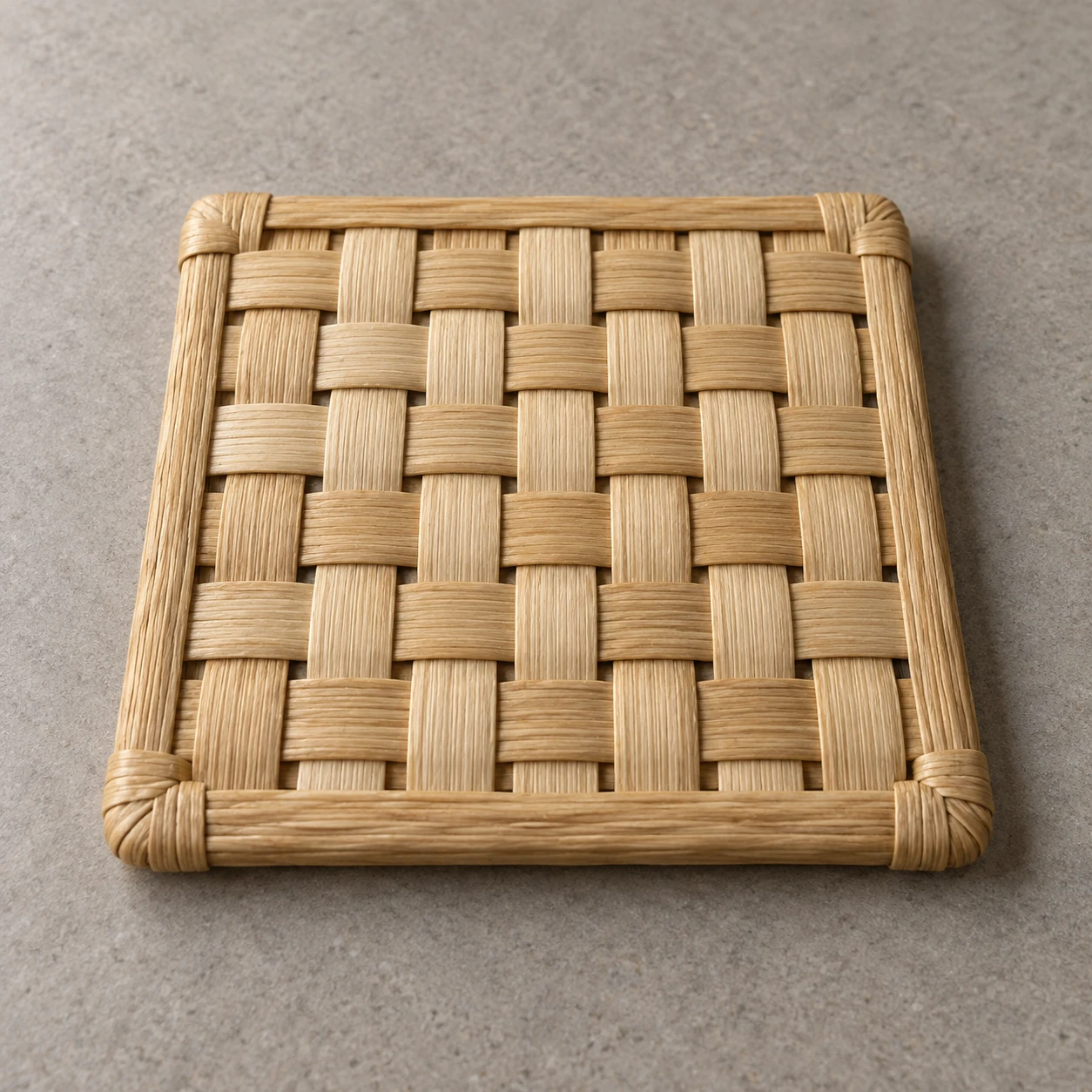
Reed Coaster · Over–Under Weave
A product image using overlap and short shadows to show flat reed strips alternating over and under.
Reed Coaster · Over–Under Weave
- Shape & line
- Build the square from two perpendicular families of flat strips. At each crossing, keep the upper strip's two edges continuous and interrupt the lower strip's edges beneath it; reverse this relationship at the next crossing along either direction to establish a consistent checkerboard weave.
- Color & light
- Use pale straw and honey tones under a broad light from image-upper-left. Place a short, soft shadow on the exposed lower strip immediately toward image-lower-right of each raised crossing, with a darker contact line tucked beneath the upper strip; keep the lit reed surfaces softly luminous.
- Texture & material
- Give each reed strip subtle lengthwise fibers and a dry, low-sheen surface. Let the strips rise gently over crossings and settle into the gaps between them, so fibers follow each strip's own direction and the weave reads as flexible material with shallow physical depth.
- Composition
- Keep the full bound border visible and use the overhead oblique view to expose several adjacent crossings near the center. Compress the weave spacing gradually toward image-top with perspective, while leaving the image-bottom crossings large enough to inspect the alternating overlaps.
Priority
Prioritize a consistent alternating overlap pattern and visible shallow depth at the crossings.
What to avoid & what to check
Avoid printed checkerboard markings, fused intersections, and deep basket-like bulges.
Check that each strip visibly switches from above to beneath at consecutive crossings.
Exact prompt for this example
SUBJECT
One square coaster woven from broad, flat natural reed strips in two perpendicular sets, with a narrow bound border holding the weave together. At successive crossings, each strip alternates between passing above and beneath the other set.

COMPOSITION
Show the entire coaster centered on a warm gray tabletop, viewed obliquely from above. Its front edge sits toward image-bottom and its rear edge toward image-top; keep the square outline and individual crossings clearly readable with generous surrounding space.

STYLE GUIDE
1. Shape & line
Build the square from two perpendicular families of flat strips. At each crossing, keep the upper strip's two edges continuous and interrupt the lower strip's edges beneath it; reverse this relationship at the next crossing along either direction to establish a consistent checkerboard weave.

2. Color & light
Use pale straw and honey tones under a broad light from image-upper-left. Place a short, soft shadow on the exposed lower strip immediately toward image-lower-right of each raised crossing, with a darker contact line tucked beneath the upper strip; keep the lit reed surfaces softly luminous.

3. Texture & material
Give each reed strip subtle lengthwise fibers and a dry, low-sheen surface. Let the strips rise gently over crossings and settle into the gaps between them, so fibers follow each strip's own direction and the weave reads as flexible material with shallow physical depth.

4. Composition
Keep the full bound border visible and use the overhead oblique view to expose several adjacent crossings near the center. Compress the weave spacing gradually toward image-top with perspective, while leaving the image-bottom crossings large enough to inspect the alternating overlaps.

PRIORITY
Preserve the requested identity, count, action, composition and output settings. Apply the style rules within those constraints; a style reference must not replace the subject or layout. Within the style: Prioritize a consistent alternating overlap pattern and visible shallow depth at the crossings.

AVOID
Avoid printed checkerboard markings, fused intersections, and deep basket-like bulges.

OUTPUT
One realistic studio product image in a 1:1 aspect ratio, without text, logos, labels, or a watermark.

SELF-CHECK
Check that each strip visibly switches from above to beneath at consecutive crossings.
Model information comes from image provenance. The same prompt may produce a different result.