Text to imageAnimationStyle guide
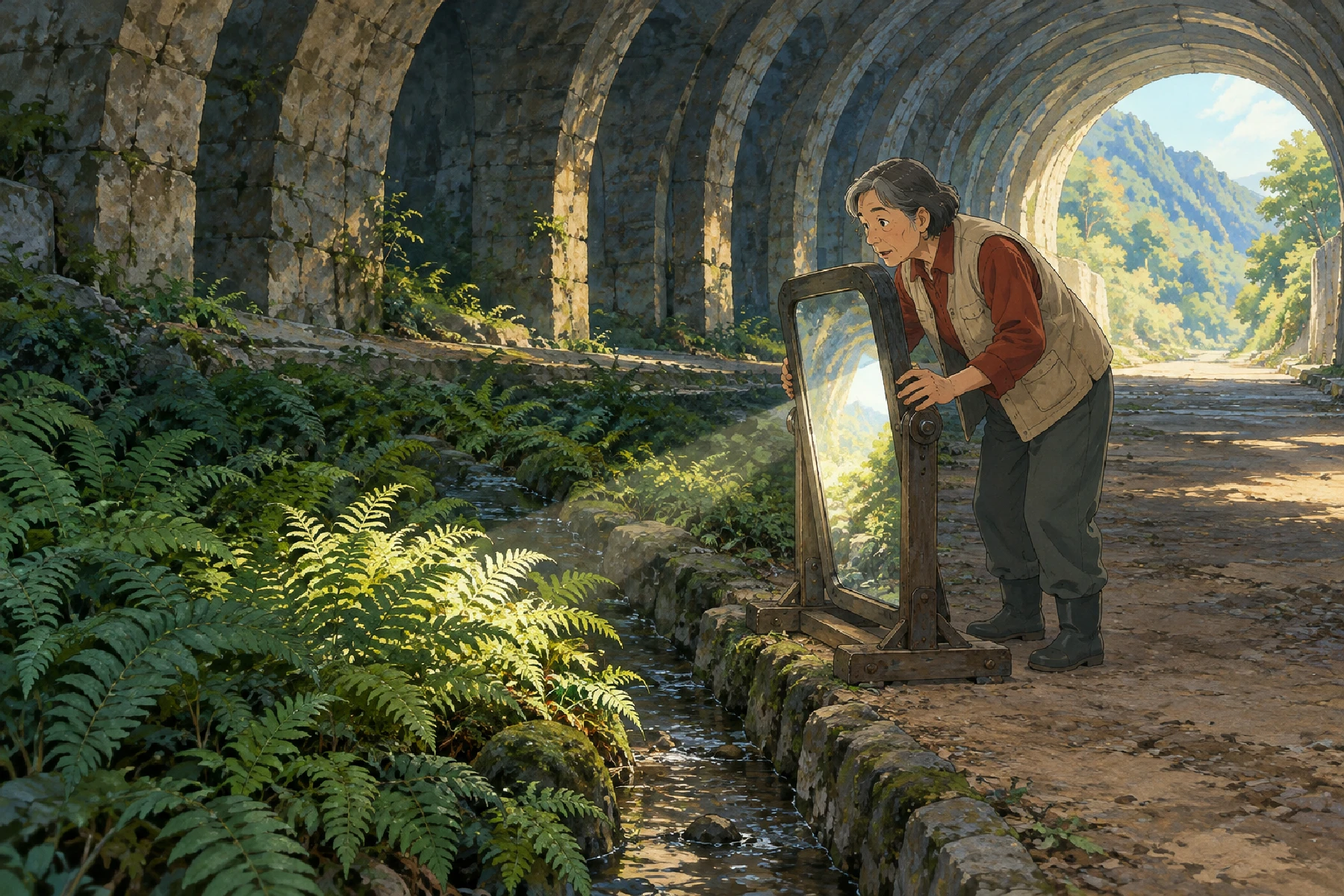
Tilting a Mirror in the Tunnel Garden
Inside an old mountain tunnel, a woman tilts a mirror to send sunlight among the ferns. Receding arches and abundant vegetation unfold through uneven painted planes and softly mingled pigment.
Remix this referenceTilting a Mirror in the Tunnel Garden
- Form language
- Establish broad interlocking planes first; describe smaller surface changes with selective painted patches and simplified clusters.
- Contour
- Let firm and softened painted boundaries alternate; use occasional tapered accents instead of continuous heavy outlines.
- Mark-making
- Overlap broad brush traces along each plane, adding sparse broken dry-brush strokes; let incidental marks vary naturally.
- Surface rendering
- Use shallow paper-and-pigment texture, uneven opaque passages and softly blended tonal transitions with occasional visible underpainting.
Priority
Rendering medium: 2D hand-painted animated-film background illustration; formal rendering reference: Studio Ghibli · 2020s · The Boy and the Heron (2023), background art
What to avoid & what to check
Exact prompt for this example
MODULE OWNERSHIP
subject: Subject count, type, stable proportions and landmarks, resting face geometry, hair shape, physical materials, garment construction and permanent marks. No emotion, movement, color assignment or rendering recipe.
expression: Facial soft-tissue displacement and pupil direction, muscle coordination, regional intensity, asymmetry and onset/peak/release. No head/body pose, stable appearance, skin color or rendering.
gesture: Head/neck/body/limb orientation, joint movement, support, contact and pose-caused occlusion using existing anatomy. No eye/pupil movement, emotion, identity, props inventory or camera.
props: Prop count, type, construction, physical material and scale relative to the subject. Holding/contact belongs to gesture, position to composition, color to palette.
scene: Environment elements, terrain, backdrop/floor presence and structural detail. No canvas positions, camera, lighting, assigned colors or render texture.
camera: Projection, focal-length impression, camera elevation/yaw/roll, viewing distance and crop. No actor pose, world placement, lighting or canvas aspect ratio.
composition: Normalized 0-100% canvas positions, scale in frame, depth/overlap, focal hierarchy and margins. No joint pose, camera projection, rendering, subject/prop inventory or emotion.
palette: Color anchors, hue/saturation/value ranges, colors assigned to parts and approximate color coverage. No illumination direction, shading algorithm, physical material or layout.
lighting: Light-source direction/softness/intensity, ambient illumination, physical shadow direction/length and highlight position. Absence of directional illumination is allowed. No shading technique, palette or material changes.
style: Reusable form abstraction, contour weight/taper/edge quality, medium and mark scale/density/direction, surface rendering and tonal transition technique. No fixed subject proportions, anatomy, identity, expression, pose, palette, light-source direction, camera or layout.
output: Image count, aspect ratio, size, file/alpha requirements and global lettering/logo/watermark restrictions. No background scenery, crop, style, identity or pose.

SUBJECT
inventory: One older adult woman, actor A, with an original everyday appearance.
geometry: A sturdy, compact build with broad cheekbones, a blunt jaw and substantial hands.
resting-face: A broad nose, shallow upper-lid folds and a wide mouth with a thin upper lip.
appearance: Short hair tucked behind the ears; a canvas vest over a roomy shirt, straight trousers and rubber boots.

PRIORITY


AVOID


CHECK


EXPRESSION — ACTOR A
brows: Both brows lift slightly, with the nearer brow a little higher.
lids: Upper lids open modestly while lower lids remain loose.
cheeks: Cheeks remain relaxed without a smile-driven lift.
nose: Nostrils remain relaxed without flare or wrinkling.
mouth: Lips part narrowly, with both corners nearly level.
jaw: The jaw releases just enough to separate the lips.
gaze: Pupils settle on the fern.
coordination: Gentle upper-face alertness accompanies a nearly resting lower face.
timing: Hold the quiet apex of curiosity.

PRIORITY


AVOID


CHECK


GESTURE
head: Her neck extends slightly and her head inclines toward the fern bed.
torso: She leans forward from the hips with a small turn through the shoulders.
limbs: Feet stagger for support; softly bent knees and unequal elbow bends sustain the adjustment.
contact: Both hands grip opposite sides of the mirror frame, tipping it on its pivot.

PRIORITY


AVOID


CHECK


PROPS
inventory: One freestanding pivot mirror, approximately the height of the woman's torso.
construction: Silvered glass in a weathered wooden frame, mounted on metal side pivots and a broad wooden base.

PRIORITY


AVOID


CHECK


SCENE
inventory: An old mountain road tunnel converted into a fern garden, with a hillside visible outside its mouth.
structure: Repeated masonry arches span an earthen floor; fern beds follow a shallow drainage rill between cracked curbs.

PRIORITY


AVOID


CHECK


CAMERA
projection: Natural perspective with a moderately wide, roughly 35 mm lens impression.
viewpoint: Standing eye level, looking obliquely along the tunnel with a level horizon.
crop: An environmental full-figure view with ample surrounding architecture.

PRIORITY


AVOID


CHECK


COMPOSITION
placement: The tunnel mouth occupies the upper right; the woman and mirror occupy the right middle third, opposite the lower-left fern bed.
depth: Cropped foreground fronds overlap the floor; successive arches carry the eye beyond the woman into the tunnel.
spacing: Hands and mirror establish the first focus, followed by the fern; leave an open interval between these anchors.

PRIORITY


AVOID


CHECK


PALETTE
colors: Deep petrol, muted fern green, chalky ochre and a small rust-red accent.
assignment: Petrol anchors the tunnel; greens distinguish foliage, ochre marks masonry and vest, and rust red belongs to the shirt.
balance: Broad subdued cools dominate, with restrained warm passages and pale neutral mirror tones.

PRIORITY


AVOID


CHECK


LIGHTING
sources: Sunlight enters through the tunnel mouth from above right; the mirror redirects a softened patch toward the fern bed.
shadows: Long entrance shadows extend inward to the left, easing into diffuse interior shade.
highlights: A narrow glint touches the mirror rim; reflected light catches fern tips and nearby fingertips.

PRIORITY


AVOID


CHECK


STYLE GUIDE
form-language: Establish broad interlocking planes first; describe smaller surface changes with selective painted patches and simplified clusters.
contour: Let firm and softened painted boundaries alternate; use occasional tapered accents instead of continuous heavy outlines.
mark-making: Overlap broad brush traces along each plane, adding sparse broken dry-brush strokes; let incidental marks vary naturally.
surface-rendering: Use shallow paper-and-pigment texture, uneven opaque passages and softly blended tonal transitions with occasional visible underpainting.

PRIORITY
Rendering medium: 2D hand-painted animated-film background illustration; formal rendering reference: Studio Ghibli · 2020s · The Boy and the Heron (2023), background art

AVOID


CHECK


OUTPUT
format: One finished image, landscape 3:2, 1800 × 1200 pixels, opaque PNG.
restrictions: No lettering, logos or watermarks.

PRIORITY


AVOID


CHECK


FINAL INTEGRATION
expression + lighting: Coordinate her settled gaze and held apex with the reflected light reaching the fern bed.
Art direction
스튜디오 지브리 / Studio Ghibli · 2020s · 그대들은 어떻게 살 것인가(2023)의 배경 미술 / The Boy and the Heron (2023), background art ↗- Establish broad form planes before describing smaller surface variations with painted patches
- Use hard and soft painted boundaries rather than strong continuous outlines
- Overlapping brush traces following the plane direction with sparse dry-brush marks
- Shallow paper-and-pigment texture, uneven painted planes and blended tonal transitions
Model information comes from image provenance. The same prompt may produce a different result.