Text to imageLandscapeStyle guide
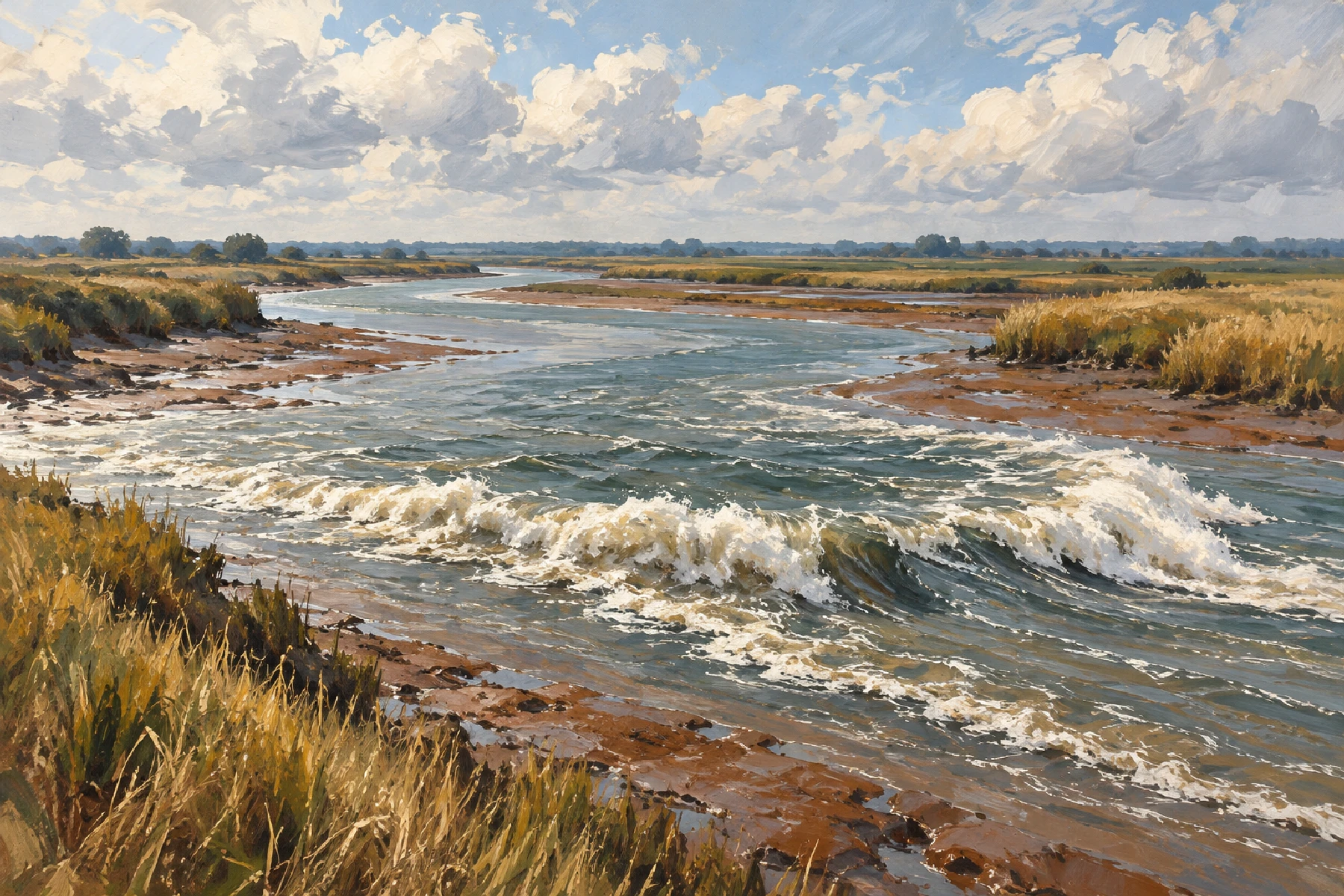
Tidal Bore at the Reed Bend
A long tidal bore enters an estuary between reed shelves and mud shoals. Opaque gouache strokes connect the curling water with layers of riverbank.
Remix this referenceTidal Bore at the Reed Bend
- Form language
- Simplify complex forms into interlocking, uneven masses; preserve distinctive bends while allowing small details to vary.
- Contour
- Build contours from adjacent brush shapes, alternating blunt opaque edges with broken, softly disappearing passages.
- Mark-making
- Use loose flat-brush sweeps, uneven bristle tracks, and occasional blunt dabs; vary pressure and stroke length naturally.
- Surface rendering
- Layer opaque gouache over earlier strokes; use dry scumbles and stepped tonal patches, leaving revisions visibly embedded.
Priority
Keep loose gouache and visible opaque brushwork unmistakable.
What to avoid & what to check
Exact prompt for this example
MODULE OWNERSHIP
subject: Subject count, type, stable proportions and landmarks, resting face geometry, hair shape, physical materials, garment construction and permanent marks. No emotion, movement, color assignment or rendering recipe.
expression: Facial soft-tissue displacement and pupil direction, muscle coordination, regional intensity, asymmetry and onset/peak/release. No head/body pose, stable appearance, skin color or rendering.
gesture: Head/neck/body/limb orientation, joint movement, support, contact and pose-caused occlusion using existing anatomy. No eye/pupil movement, emotion, identity, props inventory or camera.
props: Prop count, type, construction, physical material and scale relative to the subject. Holding/contact belongs to gesture, position to composition, color to palette.
scene: Environment elements, terrain, backdrop/floor presence and structural detail. No canvas positions, camera, lighting, assigned colors or render texture.
camera: Projection, focal-length impression, camera elevation/yaw/roll, viewing distance and crop. No actor pose, world placement, lighting or canvas aspect ratio.
composition: Normalized 0-100% canvas positions, scale in frame, depth/overlap, focal hierarchy and margins. No joint pose, camera projection, rendering, subject/prop inventory or emotion.
palette: Color anchors, hue/saturation/value ranges, colors assigned to parts and approximate color coverage. No illumination direction, shading algorithm, physical material or layout.
lighting: Light-source direction/softness/intensity, ambient illumination, physical shadow direction/length and highlight position. Absence of directional illumination is allowed. No shading technique, palette or material changes.
style: Reusable form abstraction, contour weight/taper/edge quality, medium and mark scale/density/direction, surface rendering and tonal transition technique. No fixed subject proportions, anatomy, identity, expression, pose, palette, light-source direction, camera or layout.
output: Image count, aspect ratio, size, file/alpha requirements and global lettering/logo/watermark restrictions. No background scenery, crop, style, identity or pose.

SUBJECT
inventory: No people, animals, or discrete focal objects.
geometry: No independent subject proportions or landmarks apply.
resting-face: No faces are present.
appearance: No separate subject appearance, garments, or permanent marks apply.

PRIORITY


AVOID


CHECK


PROPS
inventory: No separate props.
construction: No prop construction applies.

PRIORITY


AVOID


CHECK


SCENE
inventory: An estuary with a tidal bore, exposed mud shoals, reed shelves, and a low floodplain beneath open sky.
structure: A hooked tide front enters the winding channel; side creeks notch the wet banks, and foam gathers along the crest.

PRIORITY


AVOID


CHECK


CAMERA
projection: Natural perspective with a moderately wide lens impression and gentle depth expansion.
viewpoint: Look obliquely upstream from the height of a low bank, with a level horizon and no roll.
crop: Use an immersive wide view; crop nearby reeds and banks while retaining the distant floodplain.

PRIORITY


AVOID


CHECK


COMPOSITION
placement: The tide front hooks across the lower middle toward the right; the channel recedes toward the upper left.
depth: Overlapping banks establish successive distances; the crest is primary, with the distant channel secondary.
spacing: Let uneven reed masses enclose the water loosely, with a broad quiet sky and breathing room around the bend.

PRIORITY


AVOID


CHECK


PALETTE
colors: Use slate teal, rusty clay, straw ochre, and chalk cream with restrained saturation.
assignment: Assign teal to water, rusty clay to mud, ochre to reeds, and cream to foam and sky.
balance: Earth and water hues dominate; reserve the palest values for the crest and a quieter sky.

PRIORITY


AVOID


CHECK


LIGHTING
sources: Broad cloud-filtered daylight enters from the upper left, supported by ample ambient light.
shadows: Bank shadows fall softly toward the lower right; shallow recesses retain gentle shade.
highlights: Broad highlights catch the crest tops and upward-facing banks, without sharp glints.

PRIORITY


AVOID


CHECK


STYLE GUIDE
form-language: Simplify complex forms into interlocking, uneven masses; preserve distinctive bends while allowing small details to vary.
contour: Build contours from adjacent brush shapes, alternating blunt opaque edges with broken, softly disappearing passages.
mark-making: Use loose flat-brush sweeps, uneven bristle tracks, and occasional blunt dabs; vary pressure and stroke length naturally.
surface-rendering: Layer opaque gouache over earlier strokes; use dry scumbles and stepped tonal patches, leaving revisions visibly embedded.

PRIORITY
Keep loose gouache and visible opaque brushwork unmistakable.

AVOID


CHECK


OUTPUT
format: One finished image, landscape 3:2 aspect ratio, 1800 × 1200 pixels, opaque PNG.
restrictions: No lettering, logos, signatures, or watermarks.

PRIORITY


AVOID


CHECK
Model information comes from image provenance. The same prompt may produce a different result.