Text to imagePortraitStyle guide
Man with His Cheek Against the Glass
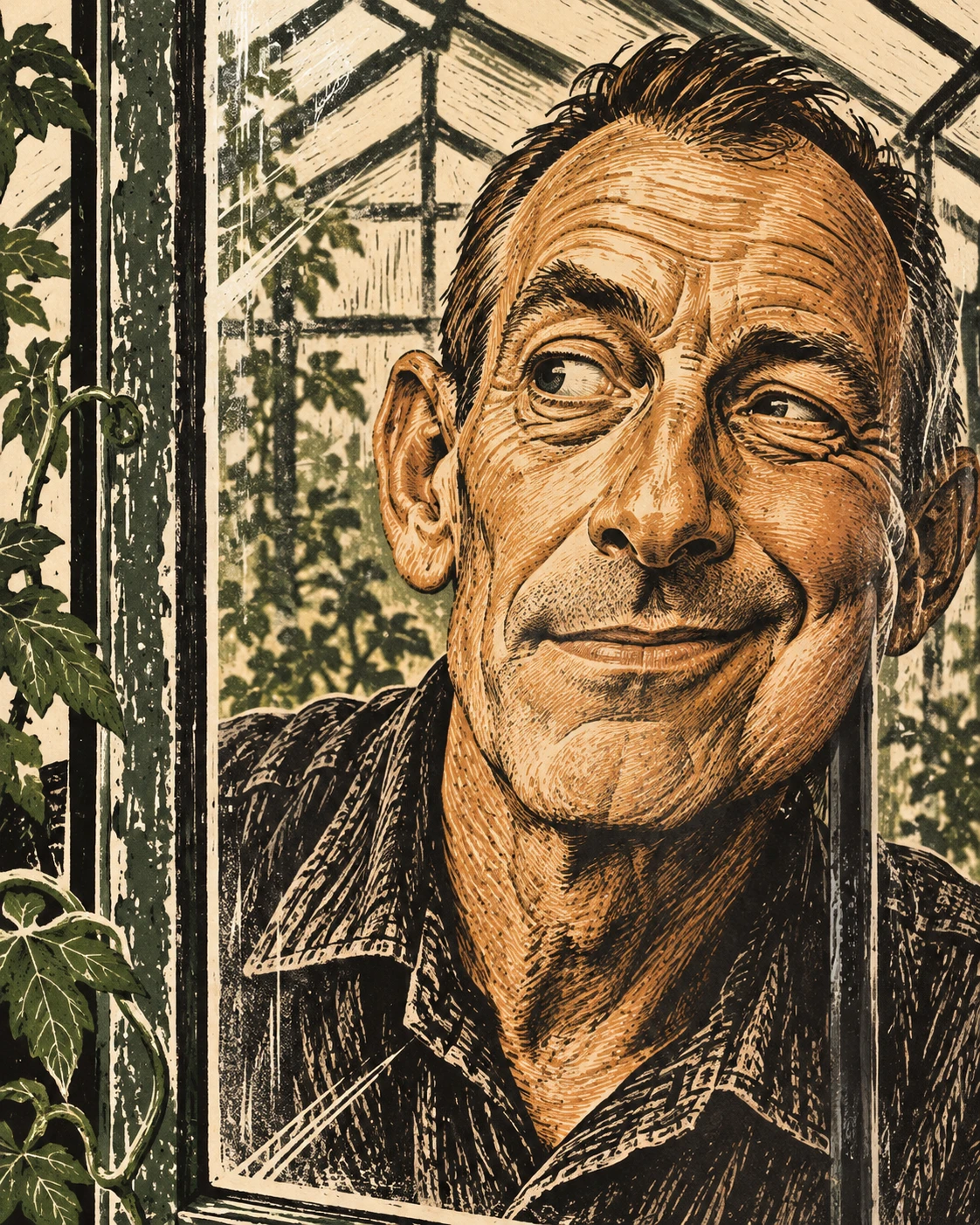
An intimate linocut portrait of a man pressing his cheek against greenhouse glass, an emerging smile caught in bold masses and rhythmic cuts.
Remix this referenceMan with His Cheek Against the Glass
- Form language
- Build forms from interlocking positive masses and carved openings, simplifying small details into decisive wedges.
- Contour
- Use weighty, slightly notched outer edges and tapered cut-ins; allow occasional interruptions where forms merge.
- Mark-making
- Carve rhythmic fans of short gouges, alternating close clusters with open passages and naturally uneven spacing.
- Surface rendering
- Let solid ink fields meet exposed paper through stepped cuts; slight ink starvation and imperfect overprints retain the pulled-print feel.
Priority
Bold linocut with carved rhythmic marks must remain the defining visual treatment.
What to avoid & what to check
Exact prompt for this example
MODULE OWNERSHIP
subject: Subject count, type, stable proportions and landmarks, resting face geometry, hair shape, physical materials, garment construction and permanent marks. No emotion, movement, color assignment or rendering recipe.
expression: Facial soft-tissue displacement and pupil direction, muscle coordination, regional intensity, asymmetry and onset/peak/release. No head/body pose, stable appearance, skin color or rendering.
gesture: Head/neck/body/limb orientation, joint movement, support, contact and pose-caused occlusion using existing anatomy. No eye/pupil movement, emotion, identity, props inventory or camera.
props: Prop count, type, construction, physical material and scale relative to the subject. Holding/contact belongs to gesture, position to composition, color to palette.
scene: Environment elements, terrain, backdrop/floor presence and structural detail. No canvas positions, camera, lighting, assigned colors or render texture.
camera: Projection, focal-length impression, camera elevation/yaw/roll, viewing distance and crop. No actor pose, world placement, lighting or canvas aspect ratio.
composition: Normalized 0-100% canvas positions, scale in frame, depth/overlap, focal hierarchy and margins. No joint pose, camera projection, rendering, subject/prop inventory or emotion.
palette: Color anchors, hue/saturation/value ranges, colors assigned to parts and approximate color coverage. No illumination direction, shading algorithm, physical material or layout.
lighting: Light-source direction/softness/intensity, ambient illumination, physical shadow direction/length and highlight position. Absence of directional illumination is allowed. No shading technique, palette or material changes.
style: Reusable form abstraction, contour weight/taper/edge quality, medium and mark scale/density/direction, surface rendering and tonal transition technique. No fixed subject proportions, anatomy, identity, expression, pose, palette, light-source direction, camera or layout.
output: Image count, aspect ratio, size, file/alpha requirements and global lettering/logo/watermark restrictions. No background scenery, crop, style, identity or pose.

SUBJECT
inventory: A is one older adult man with short hair and a woven work shirt.
geometry: A long face, prominent cheekbones, generous ears and a slightly crooked nasal bridge establish his identity.
resting-face: Wide-set eyes, a long upper lip and an uneven cupid's bow define the resting facial structure.
appearance: Hair forms a short crest between receding temples; the soft shirt has a loose collar and overlapping front placket.

PRIORITY


AVOID


CHECK


EXPRESSION — ACTOR A
brows: The brow opposite the pressed cheek lifts slightly.
lids: The pressed-side eye narrows softly; the other stays comfortably open.
cheeks: The pressed cheek spreads outward and bunches upward; the other cheek rises faintly.
nose: The nostrils remain relaxed without a deliberate flare.
mouth: Closed lips bend into a small smile, stronger at the corner opposite the pressed cheek.
jaw: The jaw remains loose with no tooth exposure.
gaze: Both pupils glance toward the left.
coordination: Uneven cheek compression and the opposite mouth corner create a restrained, lopsided smile.
timing: Catch the smile just beginning, before it opens into laughter.

PRIORITY


AVOID


CHECK


GESTURE
head: Turn the head enough to rest one cheek against the pane, with the neck slightly inclined.
torso: The upper torso leans gently toward the glass, with one shoulder carried forward.
limbs: No specific arm or hand movement is prescribed.
contact: The fleshy cheek makes broad contact with the pane while the nose remains free.

PRIORITY


AVOID


CHECK


PROPS
inventory: No separate props.
construction: No prop construction applies.

PRIORITY


AVOID


CHECK


SCENE
inventory: A greenhouse window, its narrow frame, and a few climbing stems form the setting.
structure: The intact pane belongs to a simple metal-framed wall; greenhouse ribs form a continuous supporting framework.

PRIORITY


AVOID


CHECK


CAMERA
projection: Use a natural portrait-lens perspective with little near-to-far exaggeration.
viewpoint: Look through the pane from outside, close to eye level and slightly oblique to its surface.
crop: Frame tightly across the hairline and lower shoulder, retaining the entire mouth and chin while excluding arms and hands.

PRIORITY


AVOID


CHECK


COMPOSITION
placement: The facial mass sits near 65% across the canvas; a narrow frame interrupts the left edge.
depth: The cheek and adjacent eye lead, the mouth follows, and distant greenhouse ribs behind the man stay subordinate.
spacing: Let the face crowd the right boundary while a slim breathing space separates it from the left frame.

PRIORITY


AVOID


CHECK


PALETTE
colors: Use soot black, warm chalk cream, burnt amber and a restrained moss green.
assignment: Cream and amber carry the face, black anchors hair and shirt, and moss green belongs to the stems.
balance: Black and cream dominate; amber gathers in facial passages and green remains a minor accent.

PRIORITY


AVOID


CHECK


LIGHTING
sources: Broad daylight enters from the upper left with a soft, moderately strong directional presence.
shadows: The nose and chin cast soft shadows down and right; ambient daylight keeps the eye sockets legible.
highlights: Broad highlights touch the upper cheek and brow; one faint reflection crosses the pane.

PRIORITY


AVOID


CHECK


STYLE GUIDE
form-language: Build forms from interlocking positive masses and carved openings, simplifying small details into decisive wedges.
contour: Use weighty, slightly notched outer edges and tapered cut-ins; allow occasional interruptions where forms merge.
mark-making: Carve rhythmic fans of short gouges, alternating close clusters with open passages and naturally uneven spacing.
surface-rendering: Let solid ink fields meet exposed paper through stepped cuts; slight ink starvation and imperfect overprints retain the pulled-print feel.

PRIORITY
Bold linocut with carved rhythmic marks must remain the defining visual treatment.

AVOID


CHECK


OUTPUT
format: Deliver one image.
restrictions: One 4:5 portrait image, 1600 × 2000 pixels, opaque PNG; no lettering, logos or watermarks.

PRIORITY


AVOID


CHECK
Model information comes from image provenance. The same prompt may produce a different result.