Text to imageIllustrationStyle guide
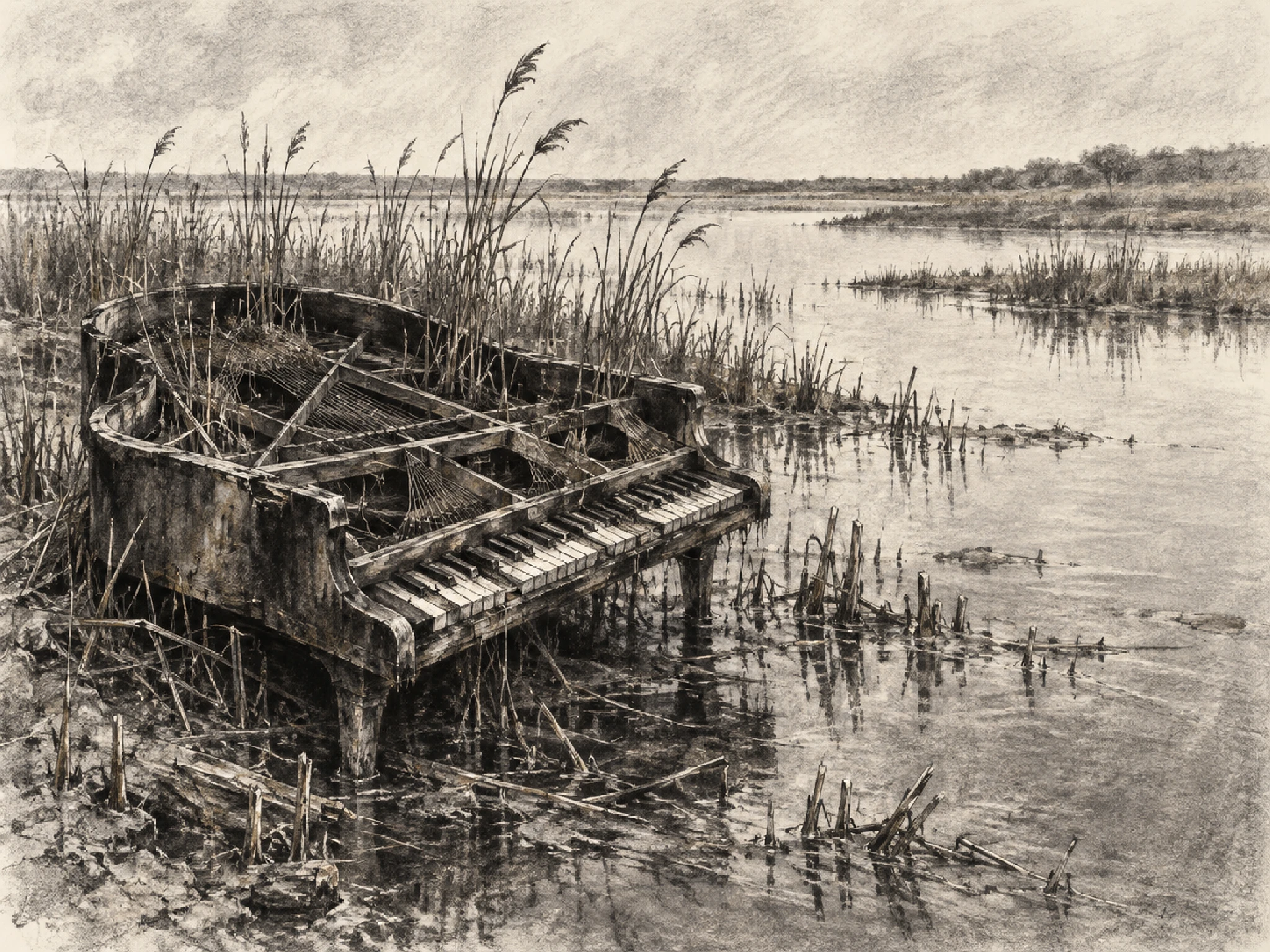
Reeds Through a Grand Piano
Reeds rise through the strings of a grand piano abandoned in shallow water. Dense charcoal masses, spacious open water and erased glints on the keys give the scene a quiet, weathered presence.
Remix this referenceReeds Through a Grand Piano
- Form language
- Use observational mass drawing: simplify broad volumes while letting a few accurately observed interruptions establish their construction.
- Contour
- Alternate blunt, pressure-heavy edges with lost contours; reserve thin, brittle lines for selective structural accents.
- Mark-making
- Drag the charcoal stick sideways for broad strokes, then add uneven directional scratches; allow searching lines and natural mark variation.
- Surface rendering
- Rub charcoal into smoky half-tones and lift light with a kneaded eraser; broken paper tooth should interrupt both smudges and dense passages.
Priority
Observational charcoal with visible smudges and erased light must define the finished image.
What to avoid & what to check
Exact prompt for this example
MODULE OWNERSHIP
subject: Subject count, type, stable proportions and landmarks, resting face geometry, hair shape, physical materials, garment construction and permanent marks. No emotion, movement, color assignment or rendering recipe.
expression: Facial soft-tissue displacement and pupil direction, muscle coordination, regional intensity, asymmetry and onset/peak/release. No head/body pose, stable appearance, skin color or rendering.
gesture: Head/neck/body/limb orientation, joint movement, support, contact and pose-caused occlusion using existing anatomy. No eye/pupil movement, emotion, identity, props inventory or camera.
props: Prop count, type, construction, physical material and scale relative to the subject. Holding/contact belongs to gesture, position to composition, color to palette.
scene: Environment elements, terrain, backdrop/floor presence and structural detail. No canvas positions, camera, lighting, assigned colors or render texture.
camera: Projection, focal-length impression, camera elevation/yaw/roll, viewing distance and crop. No actor pose, world placement, lighting or canvas aspect ratio.
composition: Normalized 0-100% canvas positions, scale in frame, depth/overlap, focal hierarchy and margins. No joint pose, camera projection, rendering, subject/prop inventory or emotion.
palette: Color anchors, hue/saturation/value ranges, colors assigned to parts and approximate color coverage. No illumination direction, shading algorithm, physical material or layout.
lighting: Light-source direction/softness/intensity, ambient illumination, physical shadow direction/length and highlight position. Absence of directional illumination is allowed. No shading technique, palette or material changes.
style: Reusable form abstraction, contour weight/taper/edge quality, medium and mark scale/density/direction, surface rendering and tonal transition technique. No fixed subject proportions, anatomy, identity, expression, pose, palette, light-source direction, camera or layout.
output: Image count, aspect ratio, size, file/alpha requirements and global lettering/logo/watermark restrictions. No background scenery, crop, style, identity or pose.

SUBJECT
inventory: One ruined grand piano; no people or animals.
geometry: A curved case, exposed string bed, projecting keyboard shelf and tapered legs retain a recognizable grand-piano construction.
resting-face: No face or facial landmarks apply.
appearance: Weathered timber, metal strings and chipped key veneers; the lid is missing and the soundboard has irregular openings.

PRIORITY


AVOID


CHECK


PROPS
inventory: No separate props.
construction: No prop construction applies.

PRIORITY


AVOID


CHECK


SCENE
inventory: A shallow reed marsh with exposed silt, an open-water channel and a low earthen bank.
structure: Broken reed beds alternate with still water; scattered cut stalks and small silt shelves suggest a receding waterline.

PRIORITY


AVOID


CHECK


CAMERA
projection: Natural perspective with a normal-lens impression and restrained depth compression.
viewpoint: An elevated three-quarter view reveals the keyboard and the open string bed without becoming overhead.
crop: A medium-wide environmental view includes the complete piano silhouette and generous surrounding water.

PRIORITY


AVOID


CHECK


COMPOSITION
placement: The piano occupies the lower-left third, its keyboard diagonal leading inward toward a loose fan of reeds.
depth: Reeds emerge through the piano's openings and cross its far rim; the low bank remains a subordinate distant interruption.
spacing: Broad open water fills the upper and right areas; the keyboard is the first focal stop, followed by the reed tips.

PRIORITY


AVOID


CHECK


PALETTE
colors: Warm paper ivory, cool charcoal gray and deep carbon black form a nearly monochrome palette.
assignment: Black anchors the piano interior; gray describes reeds and silt; ivory remains prominent in water and pale keys.
balance: Keep most values light or middle gray, with a concentrated dark mass and a few near-white accents.

PRIORITY


AVOID


CHECK


LIGHTING
sources: Broad, soft daylight enters from the upper left under a bright overcast sky.
shadows: Short, diffuse shadows fall toward the lower right, deepening beneath the case and inside its cavities.
highlights: Gentle highlights catch the sky-facing keys, exposed rim and occasional water ripples.

PRIORITY


AVOID


CHECK


STYLE GUIDE
form-language: Use observational mass drawing: simplify broad volumes while letting a few accurately observed interruptions establish their construction.
contour: Alternate blunt, pressure-heavy edges with lost contours; reserve thin, brittle lines for selective structural accents.
mark-making: Drag the charcoal stick sideways for broad strokes, then add uneven directional scratches; allow searching lines and natural mark variation.
surface-rendering: Rub charcoal into smoky half-tones and lift light with a kneaded eraser; broken paper tooth should interrupt both smudges and dense passages.

PRIORITY
Observational charcoal with visible smudges and erased light must define the finished image.

AVOID


CHECK


OUTPUT
format: One finished illustration, landscape 4:3, 2048 × 1536 pixels, opaque PNG.
restrictions: No lettering, logos, signatures or watermarks.

PRIORITY


AVOID


CHECK


FINAL INTEGRATION
composition + style: Let the contrast between worked charcoal passages and barely touched paper strengthen the spacious arrangement.
subject + scene + composition: The environmental overlaps should make the instrument feel absorbed into the marsh while preserving its readable construction.
Model information comes from image provenance. The same prompt may produce a different result.