Text to imageCharacterStyle guide
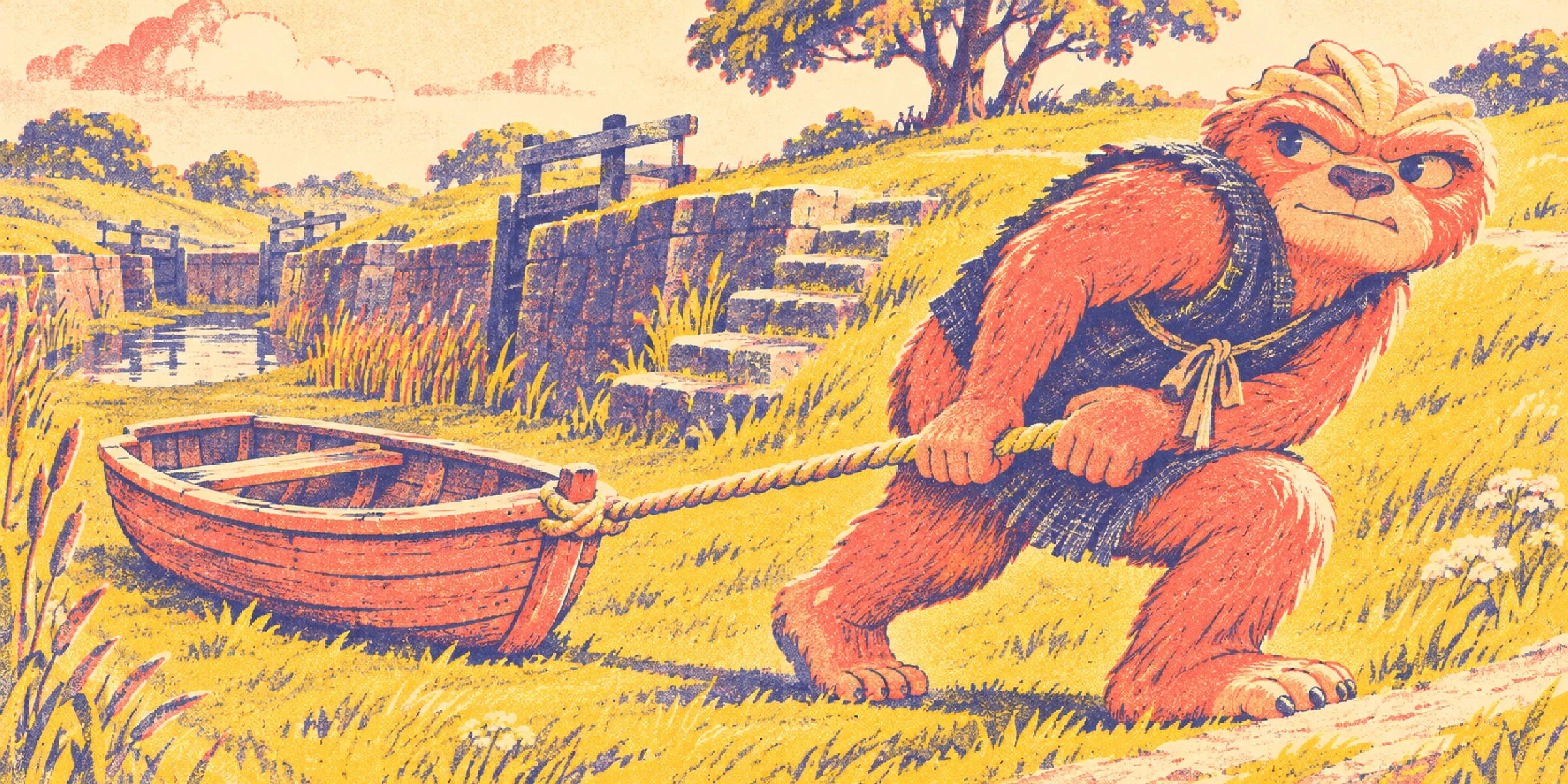
A Round-Backed Creature Towing a Boat
A round-backed creature tows an empty boat through the grass of a drained canal. A winding channel and rising towpath carry the journey across a panoramic riso illustration.
Remix this referenceA Round-Backed Creature Towing a Boat
- Form language
- Simplify volumes into soft cut shapes with a few chunky internal divisions; let small irregularities vary within the same rounded vocabulary.
- Contour
- Use blunt, lightly ragged boundaries and intermittent thick contour fragments; allow colored edges to slip playfully past one another.
- Mark-making
- Scatter uneven riso grain through ink fields and add loose directional hatch clusters; keep the hand's changing pressure apparent.
- Surface rendering
- Build tones with porous ink layers, grainy fades, and overprint mixtures; registration slips may produce narrow doubled edges. Leave some substrate unprinted.
Priority
Make riso grain, ink overlap, and playful registration offsets visibly integral to the print.
What to avoid & what to check
Exact prompt for this example
MODULE OWNERSHIP
subject: Subject count, type, stable proportions and landmarks, resting face geometry, hair shape, physical materials, garment construction and permanent marks. No emotion, movement, color assignment or rendering recipe.
expression: Facial soft-tissue displacement and pupil direction, muscle coordination, regional intensity, asymmetry and onset/peak/release. No head/body pose, stable appearance, skin color or rendering.
gesture: Head/neck/body/limb orientation, joint movement, support, contact and pose-caused occlusion using existing anatomy. No eye/pupil movement, emotion, identity, props inventory or camera.
props: Prop count, type, construction, physical material and scale relative to the subject. Holding/contact belongs to gesture, position to composition, color to palette.
scene: Environment elements, terrain, backdrop/floor presence and structural detail. No canvas positions, camera, lighting, assigned colors or render texture.
camera: Projection, focal-length impression, camera elevation/yaw/roll, viewing distance and crop. No actor pose, world placement, lighting or canvas aspect ratio.
composition: Normalized 0-100% canvas positions, scale in frame, depth/overlap, focal hierarchy and margins. No joint pose, camera projection, rendering, subject/prop inventory or emotion.
palette: Color anchors, hue/saturation/value ranges, colors assigned to parts and approximate color coverage. No illumination direction, shading algorithm, physical material or layout.
lighting: Light-source direction/softness/intensity, ambient illumination, physical shadow direction/length and highlight position. Absence of directional illumination is allowed. No shading technique, palette or material changes.
style: Reusable form abstraction, contour weight/taper/edge quality, medium and mark scale/density/direction, surface rendering and tonal transition technique. No fixed subject proportions, anatomy, identity, expression, pose, palette, light-source direction, camera or layout.
output: Image count, aspect ratio, size, file/alpha requirements and global lettering/logo/watermark restrictions. No background scenery, crop, style, identity or pose.

SUBJECT
inventory: One original furred bipedal creature, A; no other characters or animals.
geometry: A rounded back, compact belly, long forearms, short sturdy legs, broad wedge muzzle, and folded crown ridge define its silhouette.
resting-face: Wide-set oval eyes sit beneath heavy brow pads; a flat triangular nose rests above a broad, shallow mouth.
appearance: Short dense fur meets a bare fleshy crown ridge; a coarse woven wrap vest closes with a simple fabric tie.

PRIORITY


AVOID


CHECK


EXPRESSION — ACTOR A
brows: Brow pads draw inward and slightly downward.
lids: Lower lids tighten while the upper lids stay steadily open.
cheeks: Cheeks compress subtly beside the mouth.
nose: Nostrils widen slightly without a nose wrinkle.
mouth: Lips press together, with one corner tucked inward.
jaw: The jaw stays closed with a small visible set.
gaze: Pupils look back toward the boat's bow.
coordination: Brow compression and the closed mouth share an even effort, with slight mouth asymmetry.
timing: Hold the apex of sustained effort, without a sudden grimace.

PRIORITY


AVOID


CHECK


GESTURE
head: The neck turns back over the near shoulder, leaving a readable three-quarter face.
torso: The torso leans into the uphill pull, with the back rounded and the hips following the stride.
limbs: Both hands gather the rope near the hip; one foot plants uphill while the trailing heel lifts.
contact: Hands pull the taut rope attached to the bow; the planted foot presses into turf and the hull rests on grass.

PRIORITY


AVOID


CHECK


PROPS
inventory: One empty skiff about twice the creature's body length, plus one towrope; no oars or cargo.
construction: The skiff has a low planked wooden hull and a simple crossbench; the rope is thick twisted hemp.

PRIORITY


AVOID


CHECK


SCENE
inventory: A drained rural canal with a grassy bed, old lock walls, a remnant pool, and a towpath climbing a low ridge.
structure: The channel bends between earthen banks; exposed lock steps and reeds distinguish the former waterway from an ordinary field.

PRIORITY


AVOID


CHECK


CAMERA
projection: A broad, gently compressed perspective rather than an extreme wide-angle view.
viewpoint: Observe obliquely along the canal from slightly above the creature's chest height, with a level horizon.
crop: Show the complete creature and boat within an expansive environmental view.

PRIORITY


AVOID


CHECK


COMPOSITION
placement: The creature anchors the right foreground, the boat trails across the middle, and the canal winds toward the far-left pool.
depth: The rope bridges the foreground pair; overlapping banks carry the route into smaller, more distant lock structures.
spacing: The creature reads first and the journey second; keep clear intervals around the face and rope, with room beyond the uphill stride.

PRIORITY


AVOID


CHECK


PALETTE
colors: Coral, deep indigo, butter yellow, and warm cream form a limited palette.
assignment: Coral belongs to fur and the hull, indigo to the vest and lockwork, yellow to grass; cream opens the sky and pale passages.
balance: Cream and yellow provide the broad field; coral stays assertive while indigo supplies compact dark anchors.

PRIORITY


AVOID


CHECK


LIGHTING
sources: Soft afternoon light comes from upper right, supported by broad ambient sky light.
shadows: Short, soft shadows fall leftward beneath the feet, hull, and canal ledges.
highlights: Broad highlights touch the right-facing crest, shoulder, and upper gunwale.

PRIORITY


AVOID


CHECK


STYLE GUIDE
form-language: Simplify volumes into soft cut shapes with a few chunky internal divisions; let small irregularities vary within the same rounded vocabulary.
contour: Use blunt, lightly ragged boundaries and intermittent thick contour fragments; allow colored edges to slip playfully past one another.
mark-making: Scatter uneven riso grain through ink fields and add loose directional hatch clusters; keep the hand's changing pressure apparent.
surface-rendering: Build tones with porous ink layers, grainy fades, and overprint mixtures; registration slips may produce narrow doubled edges. Leave some substrate unprinted.

PRIORITY
Make riso grain, ink overlap, and playful registration offsets visibly integral to the print.

AVOID


CHECK


OUTPUT
format: One finished image, 2:1 aspect ratio, 2400 × 1200 pixels, opaque PNG.
restrictions: No lettering, logos, signatures, or watermarks.

PRIORITY


AVOID


CHECK


FINAL INTEGRATION
gesture + props + composition: Let the towing action connect the character's readable silhouette to the environment's visual journey.
expression + style: Allow print irregularity around the acting while preserving the essential facial distinctions.
Model information comes from image provenance. The same prompt may produce a different result.