Text to imageIllustrationStyle guide
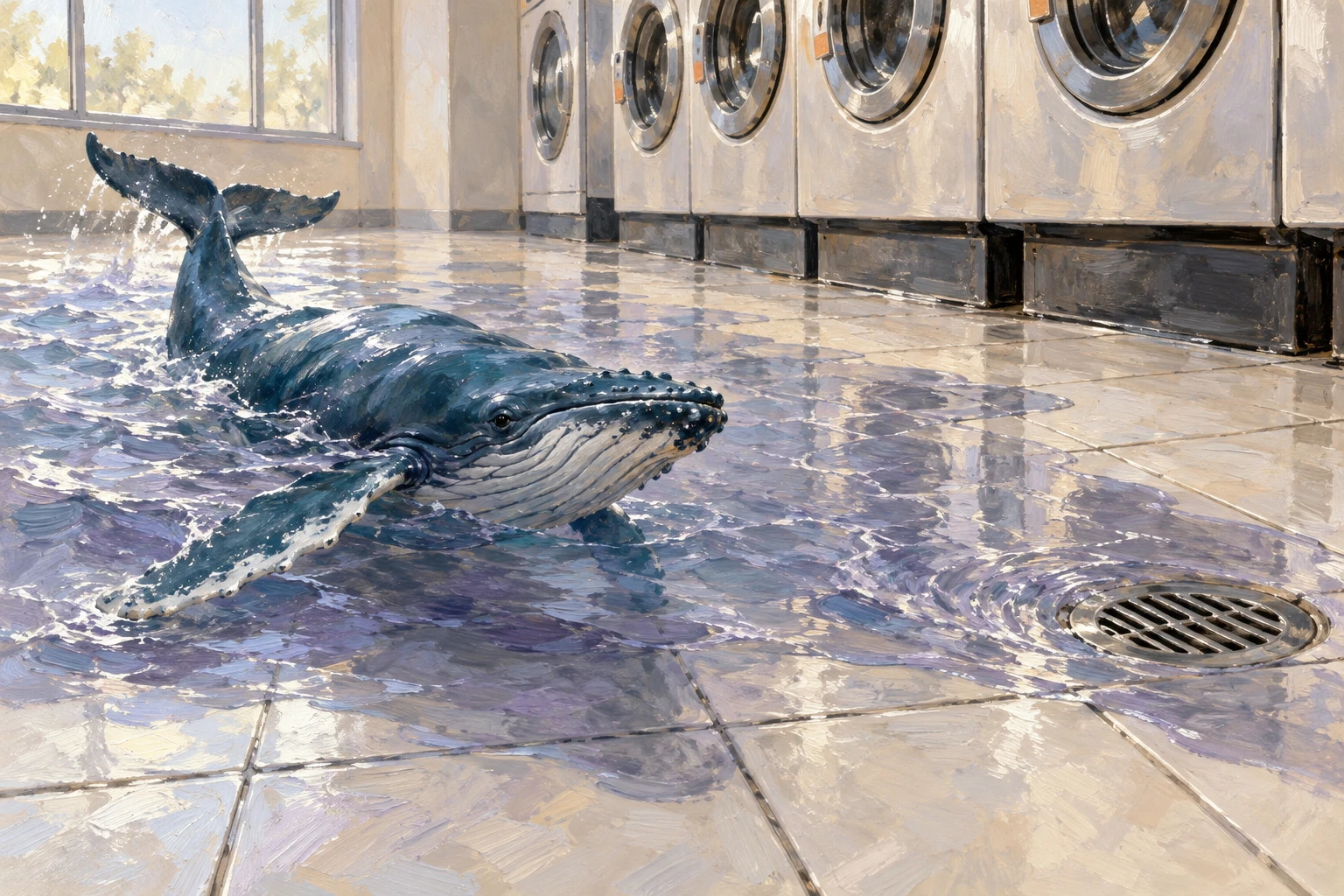
Whale in a Laundromat Puddle
A hand-length whale swims toward a drain through a shallow laundromat puddle. A low viewpoint and luminous painterly tones turn the familiar room into an immense shoreline.
Remix this referenceWhale in a Laundromat Puddle
- Form language
- Simplify forms into supple volumes and broad planar masses; retain recognition while allowing small details to vary naturally.
- Contour
- Build silhouettes from paint edges rather than enclosing outlines; alternate soft lost edges with a few crisp tapered accents.
- Mark-making
- Use flowing oil-like brush sweeps, translucent dragged strokes and occasional broken scumbles; vary pressure and leave selective strokes visible.
- Surface rendering
- Layer luminous continuous tones through thin glazes and gently blended transitions, preserving painterly irregularity within modeled surfaces.
Priority
Make luminous continuous-tone painting and fluid visible brushwork the defining rendering emphasis.
What to avoid & what to check
Exact prompt for this example
MODULE OWNERSHIP
subject: Subject count, type, stable proportions and landmarks, resting face geometry, hair shape, physical materials, garment construction and permanent marks. No emotion, movement, color assignment or rendering recipe.
expression: Facial soft-tissue displacement and pupil direction, muscle coordination, regional intensity, asymmetry and onset/peak/release. No head/body pose, stable appearance, skin color or rendering.
gesture: Head/neck/body/limb orientation, joint movement, support, contact and pose-caused occlusion using existing anatomy. No eye/pupil movement, emotion, identity, props inventory or camera.
props: Prop count, type, construction, physical material and scale relative to the subject. Holding/contact belongs to gesture, position to composition, color to palette.
scene: Environment elements, terrain, backdrop/floor presence and structural detail. No canvas positions, camera, lighting, assigned colors or render texture.
camera: Projection, focal-length impression, camera elevation/yaw/roll, viewing distance and crop. No actor pose, world placement, lighting or canvas aspect ratio.
composition: Normalized 0-100% canvas positions, scale in frame, depth/overlap, focal hierarchy and margins. No joint pose, camera projection, rendering, subject/prop inventory or emotion.
palette: Color anchors, hue/saturation/value ranges, colors assigned to parts and approximate color coverage. No illumination direction, shading algorithm, physical material or layout.
lighting: Light-source direction/softness/intensity, ambient illumination, physical shadow direction/length and highlight position. Absence of directional illumination is allowed. No shading technique, palette or material changes.
style: Reusable form abstraction, contour weight/taper/edge quality, medium and mark scale/density/direction, surface rendering and tonal transition technique. No fixed subject proportions, anatomy, identity, expression, pose, palette, light-source direction, camera or layout.
output: Image count, aspect ratio, size, file/alpha requirements and global lettering/logo/watermark restrictions. No background scenery, crop, style, identity or pose.

SUBJECT
inventory: One hand-length humpback whale, actor A. No people or additional animals.
geometry: A broad blunt head joins a tapering trunk, long paired flippers and horizontal tail flukes with a central notch.
resting-face: Small lateral eyes and a gently arcing mouth line retain ordinary whale facial construction.
appearance: Smooth biological skin, shallow throat pleats and sparse head tubercles; no clothing or permanent decorative marks.

PRIORITY


AVOID


CHECK


EXPRESSION — ACTOR A
brows: No readable brow action is prescribed.
lids: The visible eye stays softly open without widening or a tense squint.
cheeks: The visible cheek region stays relaxed, without a smile-driven lift.
nose: No readable nasal soft-tissue action is prescribed.
mouth: Keep the mouth closed and its corners unstretched.
jaw: The jaw rests without opening, protrusion or visible clenching.
gaze: The visible pupil turns slightly forward toward the drain.
coordination: Keep eye and mouth tension quiet together; convey attention through pupil direction alone.
timing: Capture the apex of a sustained neutral state, without a transitional grimace.

PRIORITY


AVOID


CHECK


GESTURE
head: A keeps its snout slightly above the water, following the body's turn toward the drain.
torso: The trunk bends in a broad swimming curve, with the tail stock arching out of the water.
limbs: One flipper trails through the water while the other opens outward; the tail flukes lift in mid-stroke.
contact: Water conceals the belly and immersed flipper; A floats above the tiles without touching the drain.

PRIORITY


AVOID


CHECK


PROPS
inventory: No separate props.
construction: No prop construction applies.

PRIORITY


AVOID


CHECK


SCENE
inventory: An ordinary laundromat with front-loading washers, a tiled floor, a circular floor drain and a high side window.
structure: A shallow irregular puddle connects washer bases to the drain; grout lines and recessed machine bases remain recognizable.

PRIORITY


AVOID


CHECK


CAMERA
projection: Perspective with a moderately wide, roughly 35 mm lens impression and clear near-to-far size change.
viewpoint: Look diagonally along the floor from just above puddle height, with a slight downward view and no roll.
crop: Keep the entire whale and drain visible; crop the upper washer bodies.

PRIORITY


AVOID


CHECK


COMPOSITION
placement: A occupies the lower-left third; the drain sits farther right, while the washer row crosses the upper-right field.
depth: The whale is the first focal point, the drain the second; overlapping machine bases recede behind their open floor corridor.
spacing: Generous water around A forms a connected foreground passage, with an open gap toward the drain; broad foreground tiles carry the scale contrast.

PRIORITY


AVOID


CHECK


PALETTE
colors: Use pearl ivory, muted petrol blue and smoky violet, with a restrained apricot accent and ample middle values.
assignment: Assign ivory to tiles and washer casings, petrol blue to A, violet to water, and apricot to small casing details.
balance: Ivory occupies most of the image; blue and violet occupy smaller areas, with apricot used sparingly.

PRIORITY


AVOID


CHECK


LIGHTING
sources: Broad soft daylight enters from the left-side window, supported by gentle ambient illumination throughout the room.
shadows: Soft shadows extend rightward from machine bases; a short submerged shadow falls beneath A.
highlights: Broad highlights fall across A's back on the window side; smaller glints catch the tail and ripple crests.

PRIORITY


AVOID


CHECK


STYLE GUIDE
form-language: Simplify forms into supple volumes and broad planar masses; retain recognition while allowing small details to vary naturally.
contour: Build silhouettes from paint edges rather than enclosing outlines; alternate soft lost edges with a few crisp tapered accents.
mark-making: Use flowing oil-like brush sweeps, translucent dragged strokes and occasional broken scumbles; vary pressure and leave selective strokes visible.
surface-rendering: Layer luminous continuous tones through thin glazes and gently blended transitions, preserving painterly irregularity within modeled surfaces.

PRIORITY
Make luminous continuous-tone painting and fluid visible brushwork the defining rendering emphasis.

AVOID


CHECK


OUTPUT
format: Deliver one finished illustration as an opaque PNG, 1536 × 1024 pixels, with a 3:2 landscape aspect ratio.
restrictions: No lettering, logos, signatures or watermarks.

PRIORITY


AVOID


CHECK


FINAL INTEGRATION
subject + scene + camera + composition: Let environmental familiarity and spatial presentation work together to make the unexpected scale immediately legible.
expression + gesture + lighting + style: Coordinate restrained facial acting with the swimming action, letting illumination and paint handling articulate the same living form.
Model information comes from image provenance. The same prompt may produce a different result.