Text to imageIllustrationStyle guide
Heron Puppet on a Sleeve
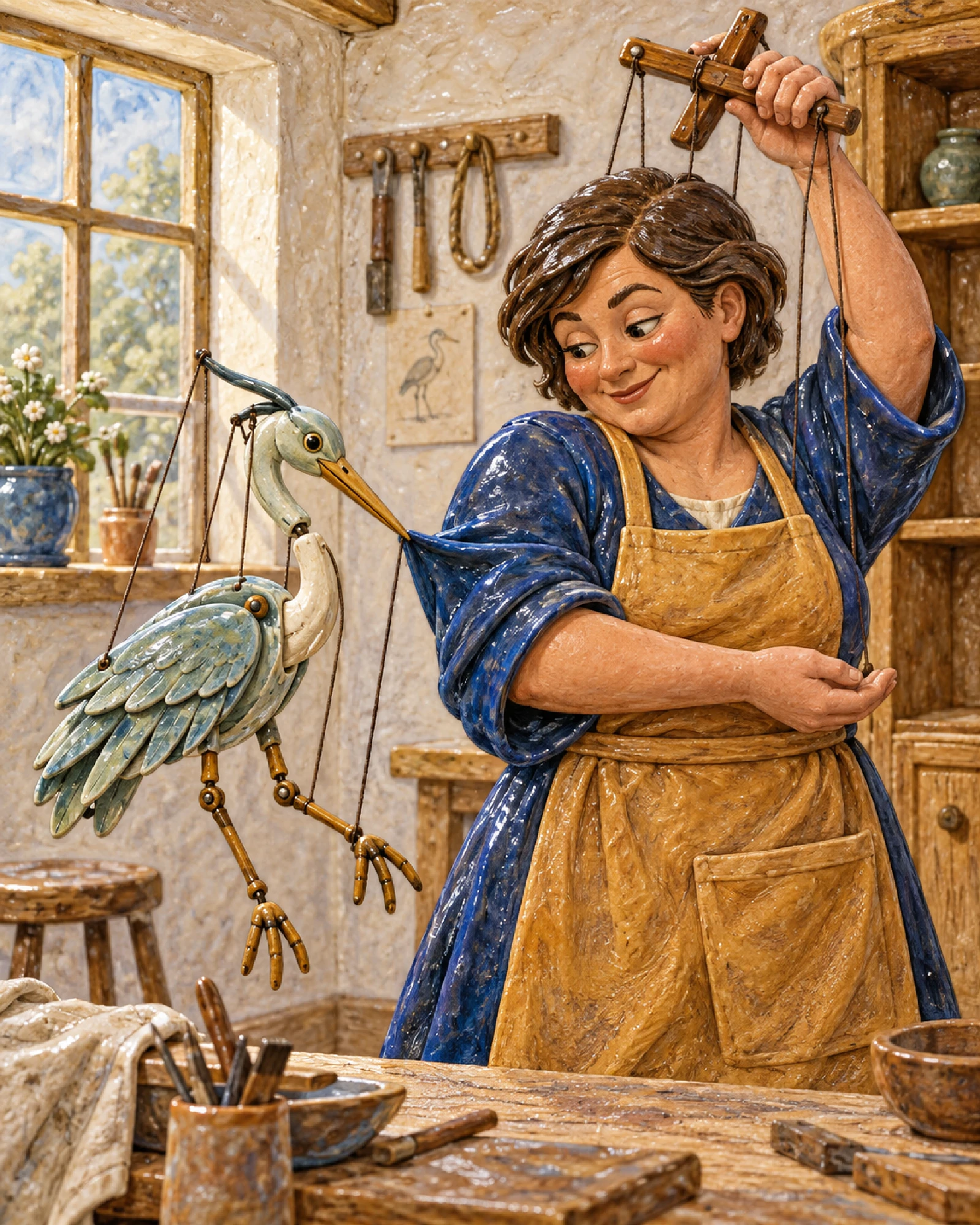
A puppeteer suppresses a smile as a heron marionette catches her sleeve. Overlapping forms and glaze gathered in hollows turn a workshop mishap into a ceramic relief illustration.
Remix this referenceHeron Puppet on a Sleeve
- Form language
- Build a ceramic relief illustration from swelling planes and shallow interlocking slabs; retain hand-shaped irregularity rather than mechanically repeated forms.
- Contour
- Use rounded raised rims for outer edges and fine incised channels for selected interior divisions; edge thickness may vary naturally.
- Mark-making
- Leave occasional broad tool drags and sparse fan-shaped impressions, allowing their spacing and pressure to vary across otherwise quiet surfaces.
- Surface rendering
- Model translucent glaze with deeper pools in hollows and thinner veils over ridges; blend rounded tonal transitions with occasional uneven glaze boundaries.
Priority
Make modeled glaze and raised ceramic edges visibly define the illustration's medium.
What to avoid & what to check
Exact prompt for this example
MODULE OWNERSHIP
subject: Subject count, type, stable proportions and landmarks, resting face geometry, hair shape, physical materials, garment construction and permanent marks. No emotion, movement, color assignment or rendering recipe.
expression: Facial soft-tissue displacement and pupil direction, muscle coordination, regional intensity, asymmetry and onset/peak/release. No head/body pose, stable appearance, skin color or rendering.
gesture: Head/neck/body/limb orientation, joint movement, support, contact and pose-caused occlusion using existing anatomy. No eye/pupil movement, emotion, identity, props inventory or camera.
props: Prop count, type, construction, physical material and scale relative to the subject. Holding/contact belongs to gesture, position to composition, color to palette.
scene: Environment elements, terrain, backdrop/floor presence and structural detail. No canvas positions, camera, lighting, assigned colors or render texture.
camera: Projection, focal-length impression, camera elevation/yaw/roll, viewing distance and crop. No actor pose, world placement, lighting or canvas aspect ratio.
composition: Normalized 0-100% canvas positions, scale in frame, depth/overlap, focal hierarchy and margins. No joint pose, camera projection, rendering, subject/prop inventory or emotion.
palette: Color anchors, hue/saturation/value ranges, colors assigned to parts and approximate color coverage. No illumination direction, shading algorithm, physical material or layout.
lighting: Light-source direction/softness/intensity, ambient illumination, physical shadow direction/length and highlight position. Absence of directional illumination is allowed. No shading technique, palette or material changes.
style: Reusable form abstraction, contour weight/taper/edge quality, medium and mark scale/density/direction, surface rendering and tonal transition technique. No fixed subject proportions, anatomy, identity, expression, pose, palette, light-source direction, camera or layout.
output: Image count, aspect ratio, size, file/alpha requirements and global lettering/logo/watermark restrictions. No background scenery, crop, style, identity or pose.

SUBJECT
inventory: One original adult woman puppeteer, actor A.
geometry: A sturdy adult build with broad palms, an oval head and a distinct, gently projecting nose.
resting-face: The resting face has shallow brow arches, almond eye openings, full cheeks and a softly rounded jaw.
appearance: Short side-swept hair, a woven wrap tunic with roomy sleeves and a plain cloth bib apron; no permanent markings.

PRIORITY


AVOID


CHECK


EXPRESSION — ACTOR A
brows: One brow rises slightly while the other keeps a relaxed arc.
lids: Lower lids rise gently with the cheeks; upper lids remain comfortably open.
cheeks: Both cheeks lift modestly, with a little more compression on the left.
nose: Nose wings remain relaxed, without wrinkling or flaring.
mouth: Closed lips curve upward, the left corner slightly higher as she contains a laugh.
jaw: The jaw stays loose without dropping or pushing forward.
gaze: Pupils look downward toward her left cuff.
coordination: The stronger left lip corner and cheek lift work together beneath the gently raised lower lid.
timing: Capture the apex of restrained amusement, before the lips open into laughter.

PRIORITY


AVOID


CHECK


GESTURE
head: A inclines her head toward the caught sleeve, keeping the neck comfortably extended.
torso: Her torso eases backward while remaining upright, countering the sleeve's gentle tug.
limbs: Her right hand lifts the control bar; her bent left arm crosses her torso with its palm turned upward.
contact: Right fingers grip the bar; the heron's beak hooks the left cuff, its hinged neck extended and legs dangling apart.

PRIORITY


AVOID


CHECK


PROPS
inventory: One torso-length wooden heron marionette, including its control bar and suspension strings.
construction: A carved oval body, jointed slender neck, long beak and hinged stick legs connect to a simple crossed wooden bar by cord.

PRIORITY


AVOID


CHECK


SCENE
inventory: A compact puppet workshop with a workbench, plaster wall, broad window and an empty open cabinet.
structure: The deep window reveal and cabinet recess establish a usable room.

PRIORITY


AVOID


CHECK


CAMERA
projection: Use restrained perspective with a normal-lens impression and little near-edge enlargement.
viewpoint: View from just above chest height at a gentle three-quarter yaw, with no roll.
crop: Frame at medium distance from the raised control bar through the hips; crop the bench along the lower edge and keep the floor outside the frame.

PRIORITY


AVOID


CHECK


COMPOSITION
placement: Place A right of center, the heron across the left-middle and the control bar in the upper-right, with generous upper-left space.
depth: Overlap the heron with the apron and the bench with the lower figure; keep the room behind this interlocking foreground.
spacing: The beak-and-cuff junction leads, followed by the face; preserve open gaps around the strings and clear margins above the bar.

PRIORITY


AVOID


CHECK


PALETTE
colors: Anchor the image in cobalt, pale celadon, warm ochre and creamy ivory, with terracotta and deep umber accents.
assignment: Cobalt tunic, ochre apron, celadon heron, terracotta skin, umber hair and cords; ivory walls and muted ochre woodwork.
balance: Let quiet ivory occupy the largest area; concentrate stronger saturation in the clothing and keep the heron pale but distinct.

PRIORITY


AVOID


CHECK


LIGHTING
sources: Broad, soft daylight enters from the upper left, supported by gentle ambient illumination.
shadows: Short shadows fall toward the lower right, with deeper shade beneath projecting rims and overlaps.
highlights: Soft highlights gather on upper-left-facing ridges, with a few smaller glints on rounded high points.

PRIORITY


AVOID


CHECK


STYLE GUIDE
form-language: Build a ceramic relief illustration from swelling planes and shallow interlocking slabs; retain hand-shaped irregularity rather than mechanically repeated forms.
contour: Use rounded raised rims for outer edges and fine incised channels for selected interior divisions; edge thickness may vary naturally.
mark-making: Leave occasional broad tool drags and sparse fan-shaped impressions, allowing their spacing and pressure to vary across otherwise quiet surfaces.
surface-rendering: Model translucent glaze with deeper pools in hollows and thinner veils over ridges; blend rounded tonal transitions with occasional uneven glaze boundaries.

PRIORITY
Make modeled glaze and raised ceramic edges visibly define the illustration's medium.

AVOID


CHECK


OUTPUT
format: One finished image, portrait 4:5, 1600 × 2000 pixels, PNG with an opaque background.
restrictions: No lettering, logos, signatures or watermarks.

PRIORITY


AVOID


CHECK


FINAL INTEGRATION
gesture + props + composition: Let the constructed articulation support the contact, while the arrangement keeps the small mishap immediately readable.
style + lighting + palette: Let illumination reveal the relief treatment while the color roles remain legible through the glaze transitions.
Model information comes from image provenance. The same prompt may produce a different result.