Text to imageCafe & brandStyle guide
Wet Paper Above the Vat
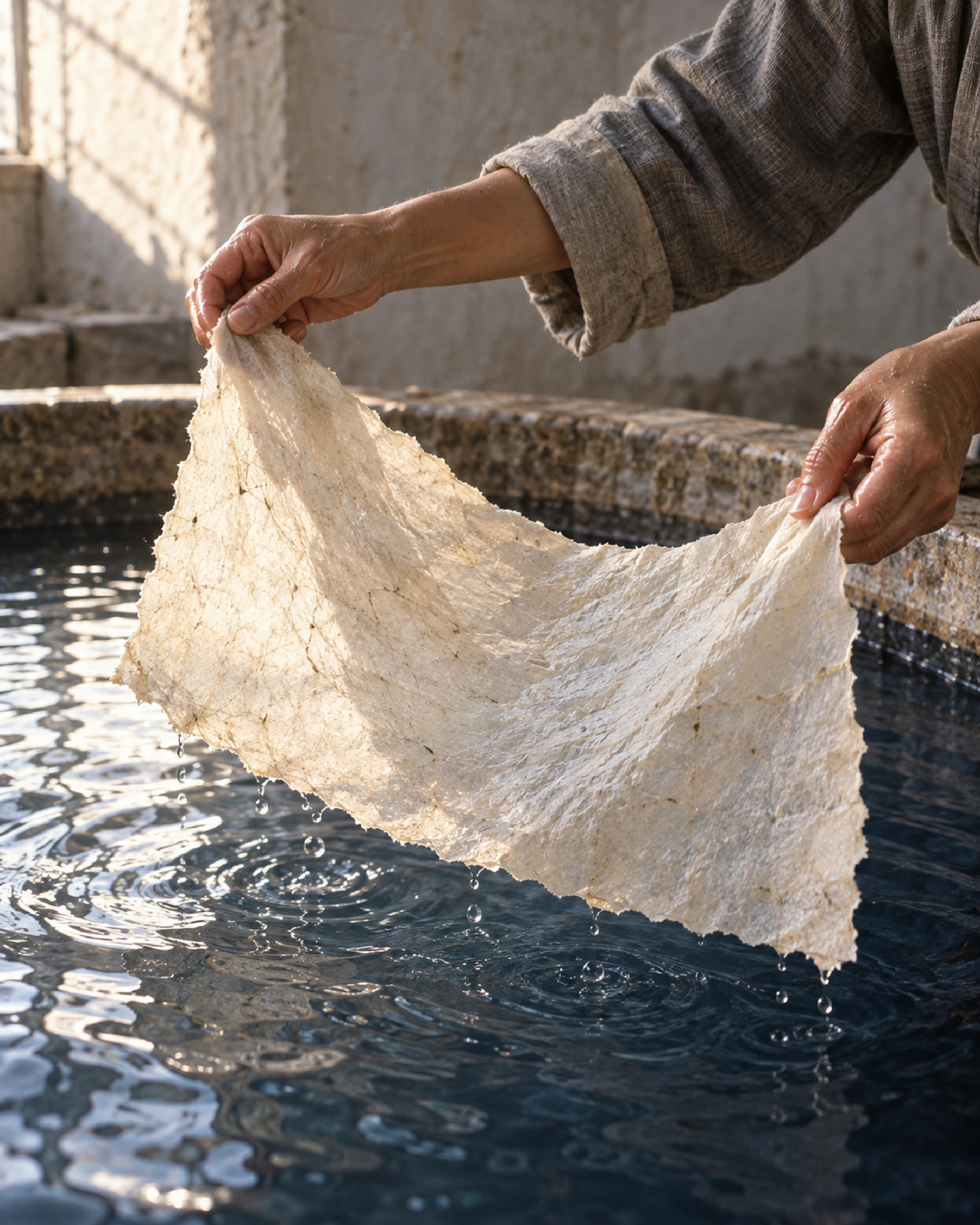
A photographic campaign image for a handmade paper studio: two hands lift a translucent wet sheet above deep water, opening a generous field of quiet space.
Remix this referenceWet Paper Above the Vat
- Form language
- Use observational photographic forms with broad continuous masses and small irregularities; incidental detail may vary naturally.
- Contour
- Alternate delicate crisp edges with softly dissolved boundaries; let edge definition fade gradually without drawn outlines.
- Mark-making
- Fine irregular film grain remains visible in quiet fields; occasional softened specks suggest an analog print without heavy distress.
- Surface rendering
- Use a color-negative print response with compressed pale tones, gently open dark tones and subtle halation around the brightest tonal transitions.
Priority
Preserve the expressive depth and imperfect tonal continuity of an analog photographic print.
What to avoid & what to check
Exact prompt for this example
MODULE OWNERSHIP
subject: Subject count, type, stable proportions and landmarks, resting face geometry, hair shape, physical materials, garment construction and permanent marks. No emotion, movement, color assignment or rendering recipe.
expression: Facial soft-tissue displacement and pupil direction, muscle coordination, regional intensity, asymmetry and onset/peak/release. No head/body pose, stable appearance, skin color or rendering.
gesture: Head/neck/body/limb orientation, joint movement, support, contact and pose-caused occlusion using existing anatomy. No eye/pupil movement, emotion, identity, props inventory or camera.
props: Prop count, type, construction, physical material and scale relative to the subject. Holding/contact belongs to gesture, position to composition, color to palette.
scene: Environment elements, terrain, backdrop/floor presence and structural detail. No canvas positions, camera, lighting, assigned colors or render texture.
camera: Projection, focal-length impression, camera elevation/yaw/roll, viewing distance and crop. No actor pose, world placement, lighting or canvas aspect ratio.
composition: Normalized 0-100% canvas positions, scale in frame, depth/overlap, focal hierarchy and margins. No joint pose, camera projection, rendering, subject/prop inventory or emotion.
palette: Color anchors, hue/saturation/value ranges, colors assigned to parts and approximate color coverage. No illumination direction, shading algorithm, physical material or layout.
lighting: Light-source direction/softness/intensity, ambient illumination, physical shadow direction/length and highlight position. Absence of directional illumination is allowed. No shading technique, palette or material changes.
style: Reusable form abstraction, contour weight/taper/edge quality, medium and mark scale/density/direction, surface rendering and tonal transition technique. No fixed subject proportions, anatomy, identity, expression, pose, palette, light-source direction, camera or layout.
output: Image count, aspect ratio, size, file/alpha requirements and global lettering/logo/watermark restrictions. No background scenery, crop, style, identity or pose.

SUBJECT
inventory: One adult papermaker.
geometry: Ordinary adult hands with recognizable knuckles, broad palms and naturally uneven fingertips.
resting-face: Facial geometry and hair are unspecified.
appearance: Bare hands with wet fingertips and plain woven sleeves with loosely turned cuffs; minor garment details may vary.

PRIORITY


AVOID


CHECK


GESTURE
head: No head or neck gesture is prescribed.
torso: No torso gesture is prescribed.
limbs: Both forearms reach forward together; the wrists gently turn outward as the hands separate.
contact: Each hand pinches an upper corner of the wet sheet, lifting it while its unsupported middle sags.

PRIORITY


AVOID


CHECK


PROPS
inventory: One broad handmade paper sheet, roughly as wide as an adult's outstretched forearms.
construction: Thin, water-saturated plant-fiber paper with irregular deckled edges and translucent patches.

PRIORITY


AVOID


CHECK


SCENE
inventory: A built-in rinsing vat, its water surface and a plain plaster workshop wall; no floor is visible.
structure: The vat has a thick rounded rim; expanding ripples and a few falling droplets interrupt the water.

PRIORITY


AVOID


CHECK


CAMERA
projection: Natural photographic perspective with a normal-lens impression and shallow depth of field.
viewpoint: A close oblique view looking slightly downward across the vat, with the camera held level.
crop: Include the whole sheet and both hands; crop the arms at the forearms and exclude the face.

PRIORITY


AVOID


CHECK


COMPOSITION
placement: The paper sweeps diagonally through the lower half; the upper-left field remains spacious and quiet.
depth: The sheet leads attention, followed by the hands; the vat rim and wall form successive background layers.
spacing: Keep an open crescent of water beneath the sheet and ample breathing room above its highest edge.

PRIORITY


AVOID


CHECK


PALETTE
colors: Deep indigo, warm ivory, muted amber and pale mineral gray form a restrained palette.
assignment: Assign ivory to the paper, indigo to the water, amber to the hands and mineral gray to sleeves and plaster.
balance: Gray occupies the largest share, indigo a substantial secondary share; ivory supplies the strongest value contrast.

PRIORITY


AVOID


CHECK


LIGHTING
sources: Broad soft daylight enters from behind at upper left, with weak frontal ambient fill.
shadows: Soft shadows fall toward the lower right; the vat interior retains deeper shade.
highlights: Light passes through the sheet's thinner areas and catches its upper folds and the fingertips.

PRIORITY


AVOID


CHECK


STYLE GUIDE
form-language: Use observational photographic forms with broad continuous masses and small irregularities; incidental detail may vary naturally.
contour: Alternate delicate crisp edges with softly dissolved boundaries; let edge definition fade gradually without drawn outlines.
mark-making: Fine irregular film grain remains visible in quiet fields; occasional softened specks suggest an analog print without heavy distress.
surface-rendering: Use a color-negative print response with compressed pale tones, gently open dark tones and subtle halation around the brightest tonal transitions.

PRIORITY
Preserve the expressive depth and imperfect tonal continuity of an analog photographic print.

AVOID


CHECK


OUTPUT
format: One opaque PNG, 2400 × 3000 pixels, portrait 4:5.
restrictions: Deliver one image at 4:5, 2400 × 3000 pixels, as an opaque PNG; no lettering, logos or watermarks.

PRIORITY


AVOID


CHECK
Model information comes from image provenance. The same prompt may produce a different result.