Text to imageAnimationStyle guide
Rain Inside the Planetarium
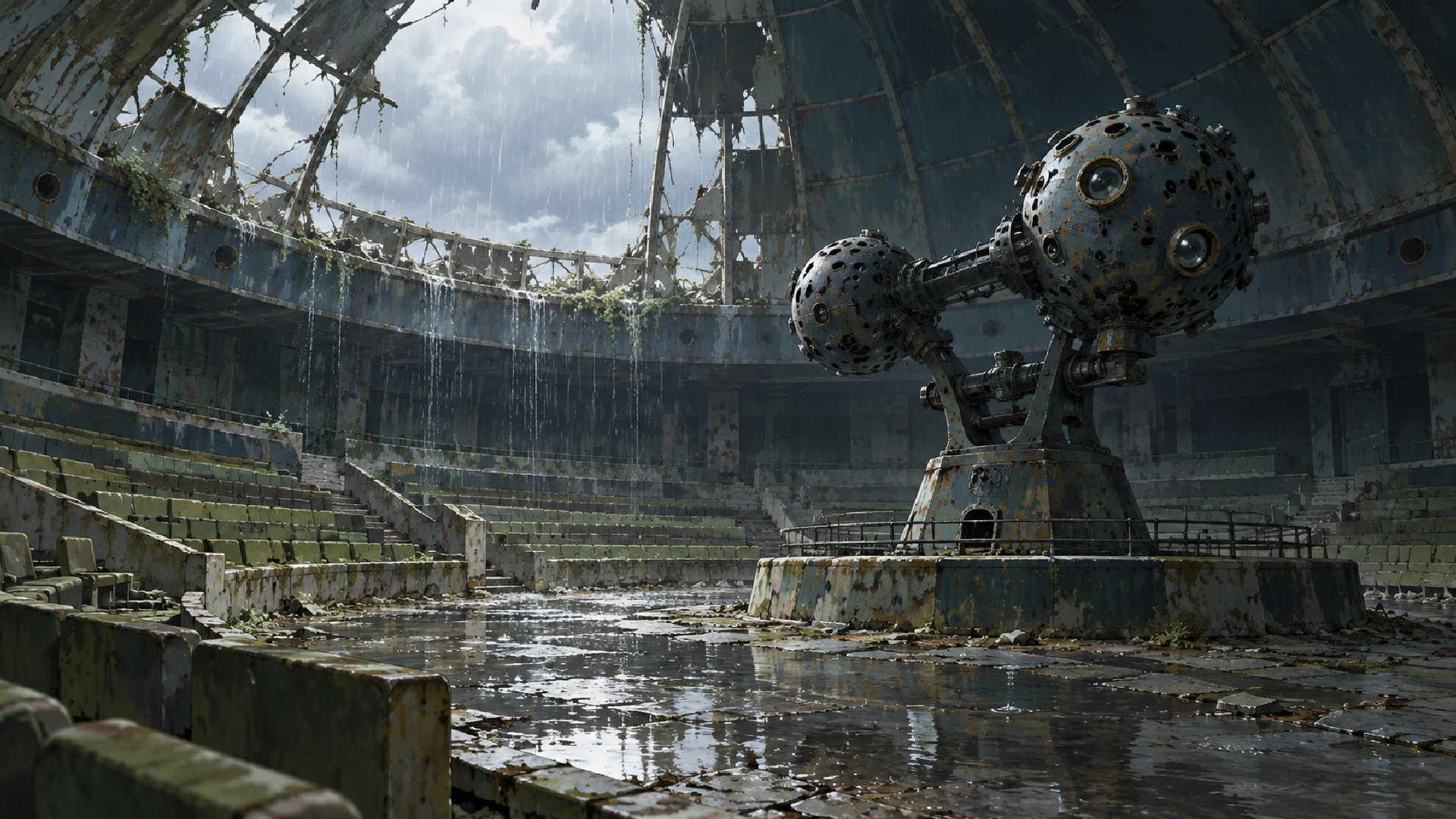
Rain enters an old planetarium through its broken dome. Beyond the silent star projector, the wet floor receives the real sky.
Remix this referenceRain Inside the Planetarium
- Form language
- Build broad interlocking painted planes before small descriptive patches; simplify incidental detail while allowing coherent irregularity.
- Contour
- Alternate firm painted edges with soft lost boundaries; use occasional tapered accents instead of continuous enclosing outlines.
- Mark-making
- Layer visible brush traces along surface planes, with sparse dry-brush breaks; vary stroke length and density naturally.
- Surface rendering
- Use opaque hand-painted layers, shallow paper-and-pigment grain and uneven patches joined by gently blended tonal transitions.
Priority
Rendering medium: 2D hand-painted animated-film background illustration; formal rendering reference: Studio Ghibli · 2020s · The Boy and the Heron (2023), background art
What to avoid & what to check
Exact prompt for this example
MODULE OWNERSHIP
subject: Subject count, type, stable proportions and landmarks, resting face geometry, hair shape, physical materials, garment construction and permanent marks. No emotion, movement, color assignment or rendering recipe.
expression: Facial soft-tissue displacement and pupil direction, muscle coordination, regional intensity, asymmetry and onset/peak/release. No head/body pose, stable appearance, skin color or rendering.
gesture: Head/neck/body/limb orientation, joint movement, support, contact and pose-caused occlusion using existing anatomy. No eye/pupil movement, emotion, identity, props inventory or camera.
props: Prop count, type, construction, physical material and scale relative to the subject. Holding/contact belongs to gesture, position to composition, color to palette.
scene: Environment elements, terrain, backdrop/floor presence and structural detail. No canvas positions, camera, lighting, assigned colors or render texture.
camera: Projection, focal-length impression, camera elevation/yaw/roll, viewing distance and crop. No actor pose, world placement, lighting or canvas aspect ratio.
composition: Normalized 0-100% canvas positions, scale in frame, depth/overlap, focal hierarchy and margins. No joint pose, camera projection, rendering, subject/prop inventory or emotion.
palette: Color anchors, hue/saturation/value ranges, colors assigned to parts and approximate color coverage. No illumination direction, shading algorithm, physical material or layout.
lighting: Light-source direction/softness/intensity, ambient illumination, physical shadow direction/length and highlight position. Absence of directional illumination is allowed. No shading technique, palette or material changes.
style: Reusable form abstraction, contour weight/taper/edge quality, medium and mark scale/density/direction, surface rendering and tonal transition technique. No fixed subject proportions, anatomy, identity, expression, pose, palette, light-source direction, camera or layout.
output: Image count, aspect ratio, size, file/alpha requirements and global lettering/logo/watermark restrictions. No background scenery, crop, style, identity or pose.

SUBJECT
inventory: One obsolete mechanical star projector, permanently installed; no people or animals.
geometry: Two unequal perforated spherical heads connect through a narrow bridge above a stout forked pedestal.
resting-face: No face or facial landmarks.
appearance: Cast-metal housings, inset glass lenses and a steel pedestal bear pitted corrosion and flaking enamel.

PRIORITY


AVOID


CHECK


PROPS
inventory: No separate props.
construction: No prop construction applies.

PRIORITY


AVOID


CHECK


SCENE
inventory: A disused planetarium contains curved seating terraces, a projector dais, a domed ceiling and shallow standing rainwater.
structure: Missing dome panels expose open sky between ribs; rain falls through the breach onto a cracked floor with softened terrace edges.

PRIORITY


AVOID


CHECK


CAMERA
projection: Natural perspective with a moderately wide lens impression and restrained edge expansion.
viewpoint: View from a standing visitor's height at an oblique angle across the hall, with a slight upward pitch and no roll.
crop: A spacious interior view includes the dome breach and the entire projector; nearby seating continues beyond the frame.

PRIORITY


AVOID


CHECK


COMPOSITION
placement: Set the projector off-center in the right third, with the dome opening high to its left and a broad wet floor below.
depth: Foreground seating overlaps the lower dais; receding terrace arcs carry depth toward the far wall.
spacing: The rain-filled opening leads attention, followed by the projector silhouette and its reflection; keep generous breathing room between them.

PRIORITY


AVOID


CHECK


PALETTE
colors: Use deep petrol, weathered sage, pearl gray and restrained rusty ochre, with mostly subdued saturation.
assignment: Petrol anchors the interior and projector; sage belongs to seating, pearl gray to sky and water, ochre to corroded edges.
balance: Let dark cool colors dominate, interrupted by a broad pale opening and small warm corrosion accents.

PRIORITY


AVOID


CHECK


LIGHTING
sources: Soft overcast daylight enters from the upper-left dome breach; weak ambient bounce reaches the enclosed hall.
shadows: Broad, faint shadows extend toward the lower right; enclosed seating recesses remain deeply shaded.
highlights: The water catches the opening's reflection; upper-left metal edges and lens rims receive sparse soft highlights.

PRIORITY


AVOID


CHECK


STYLE GUIDE
form-language: Build broad interlocking painted planes before small descriptive patches; simplify incidental detail while allowing coherent irregularity.
contour: Alternate firm painted edges with soft lost boundaries; use occasional tapered accents instead of continuous enclosing outlines.
mark-making: Layer visible brush traces along surface planes, with sparse dry-brush breaks; vary stroke length and density naturally.
surface-rendering: Use opaque hand-painted layers, shallow paper-and-pigment grain and uneven patches joined by gently blended tonal transitions.

PRIORITY
Rendering medium: 2D hand-painted animated-film background illustration; formal rendering reference: Studio Ghibli · 2020s · The Boy and the Heron (2023), background art

AVOID


CHECK


OUTPUT
format: Deliver one finished image, 16:9 landscape, 1920 × 1080 pixels, opaque PNG.
restrictions: No lettering, logos or watermarks.

PRIORITY


AVOID


CHECK


FINAL INTEGRATION
scene + composition + lighting: Let the architectural breach connect the interior's spatial rhythm with the visible weather and reflected daylight.
subject + style: Preserve the projector's recognizable construction while letting small wear patterns vary through the painted language.
Art direction
스튜디오 지브리 / Studio Ghibli · 2020s · 그대들은 어떻게 살 것인가(2023)의 배경 미술 / The Boy and the Heron (2023), background art ↗- Establish broad form planes before describing smaller surface variations with painted patches
- Use hard and soft painted boundaries rather than strong continuous outlines
- Overlapping brush traces following the plane direction with sparse dry-brush marks
- Shallow paper-and-pigment texture, uneven painted planes and blended tonal transitions
Model information comes from image provenance. The same prompt may produce a different result.