Text to imageCafe & brandStyle guide
Three Hives in a Hollyhock Garden
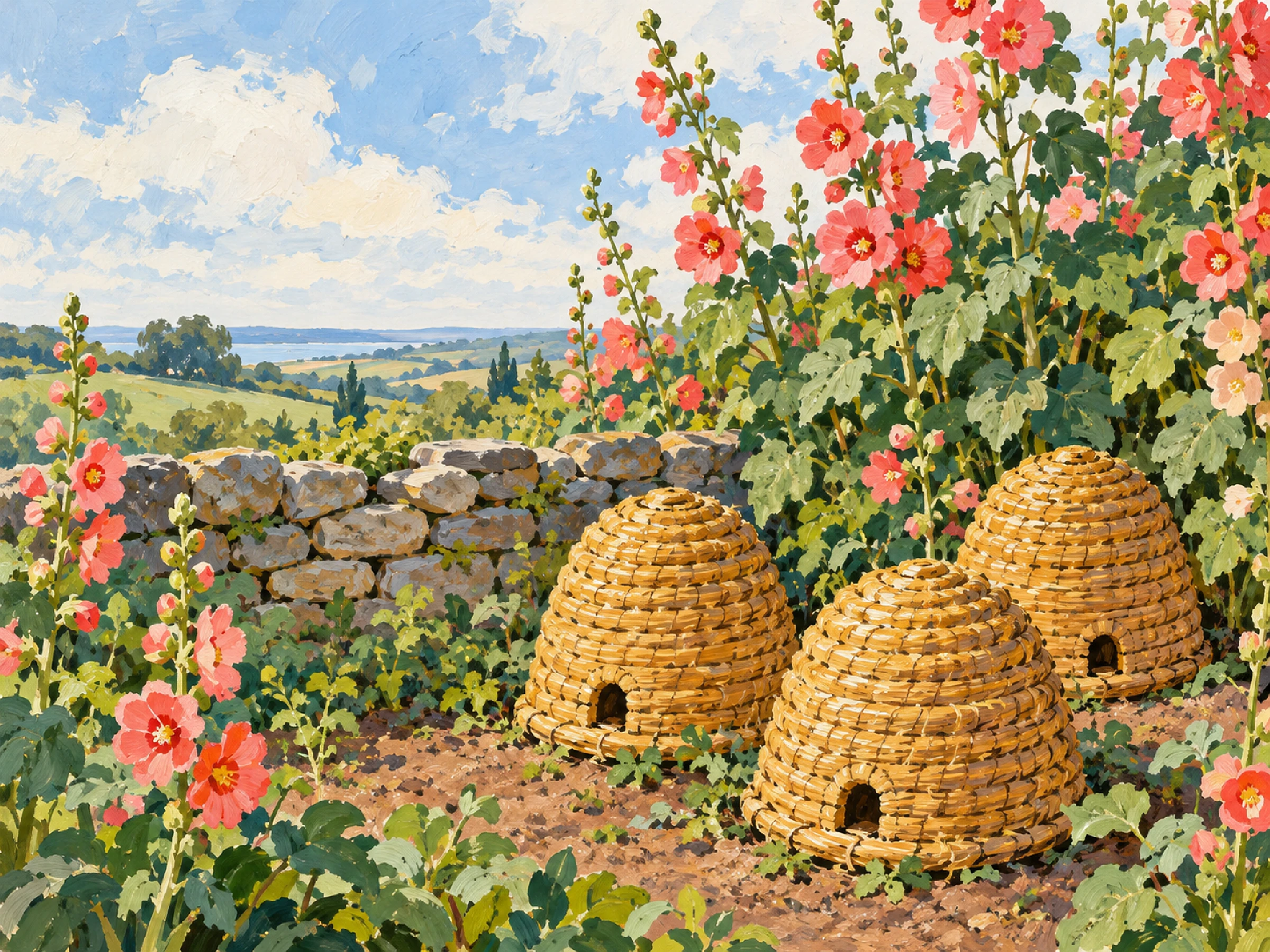
A honey brand illustration of three straw hives among hollyhocks and a low garden wall. An asymmetric garden and generous breathing room give the lively folk painting a warm, handmade presence.
Remix this referenceThree Hives in a Hollyhock Garden
- Form language
- Use naive folk simplification: broad interlocking shapes and freely varied decorative repetitions.
- Contour
- Let opaque brush edges wobble gently; occasional narrow outlines should break and rejoin.
- Mark-making
- Visible gouache strokes form loose dashes, scallops and leaflike marks with natural changes in pressure.
- Surface rendering
- Layer matte opaque patches over a lightly showing ground; use broken overlaps rather than smooth modeling.
Priority
The defining treatment is lively decorative folk painting with visible handmade variation.
What to avoid & what to check
Exact prompt for this example
MODULE OWNERSHIP
subject: Subject count, type, stable proportions and landmarks, resting face geometry, hair shape, physical materials, garment construction and permanent marks. No emotion, movement, color assignment or rendering recipe.
expression: Facial soft-tissue displacement and pupil direction, muscle coordination, regional intensity, asymmetry and onset/peak/release. No head/body pose, stable appearance, skin color or rendering.
gesture: Head/neck/body/limb orientation, joint movement, support, contact and pose-caused occlusion using existing anatomy. No eye/pupil movement, emotion, identity, props inventory or camera.
props: Prop count, type, construction, physical material and scale relative to the subject. Holding/contact belongs to gesture, position to composition, color to palette.
scene: Environment elements, terrain, backdrop/floor presence and structural detail. No canvas positions, camera, lighting, assigned colors or render texture.
camera: Projection, focal-length impression, camera elevation/yaw/roll, viewing distance and crop. No actor pose, world placement, lighting or canvas aspect ratio.
composition: Normalized 0-100% canvas positions, scale in frame, depth/overlap, focal hierarchy and margins. No joint pose, camera projection, rendering, subject/prop inventory or emotion.
palette: Color anchors, hue/saturation/value ranges, colors assigned to parts and approximate color coverage. No illumination direction, shading algorithm, physical material or layout.
lighting: Light-source direction/softness/intensity, ambient illumination, physical shadow direction/length and highlight position. Absence of directional illumination is allowed. No shading technique, palette or material changes.
style: Reusable form abstraction, contour weight/taper/edge quality, medium and mark scale/density/direction, surface rendering and tonal transition technique. No fixed subject proportions, anatomy, identity, expression, pose, palette, light-source direction, camera or layout.
output: Image count, aspect ratio, size, file/alpha requirements and global lettering/logo/watermark restrictions. No background scenery, crop, style, identity or pose.

SUBJECT
inventory: Three traditional woven-straw beehives; no human or animal subjects.
geometry: Low bell-shaped bodies have broad skirts, blunt domes and one small arched entrance each.
resting-face: No faces or anthropomorphic features.
appearance: Bound straw coils form the hive walls; slight handmade differences distinguish the three hives.

PRIORITY


AVOID


CHECK


PROPS
inventory: No separate props.
construction: No prop construction applies.

PRIORITY


AVOID


CHECK


SCENE
inventory: A cottage garden with hollyhocks, broad leaves, a low dry-stone wall and an open sky backdrop.
structure: An uneven wall encloses a shallow planted bed; exposed earth connects the flower stems and hive bases.

PRIORITY


AVOID


CHECK


CAMERA
projection: A gently flattened perspective with a natural lens impression.
viewpoint: View slightly downward from just above the wall, with a mild oblique yaw and no roll.
crop: A wide garden view includes all three hives; peripheral flower stalks may continue beyond the crop.

PRIORITY


AVOID


CHECK


COMPOSITION
placement: Cluster the hives loosely across the lower right; preserve a broad, quiet opening in the upper left.
depth: The wall passes behind the hives; overlapping flower stalks create a shallow enclosing garden.
spacing: Read the hives first, then the irregular flower rhythm; leave small breathing gaps between their silhouettes.

PRIORITY


AVOID


CHECK


PALETTE
colors: Honey ochre, hollyhock coral, deep leaf green and warm ivory, with muted stone gray.
assignment: Use ochre for the hives, coral for blossoms, green for foliage, gray for stone and ivory for the sky.
balance: Ivory provides the largest quiet area; ochre carries the main color weight and coral supplies small accents.

PRIORITY


AVOID


CHECK


LIGHTING
sources: Broad, soft daylight arrives from the upper left with generous ambient fill.
shadows: Short, gentle shadows settle to the lower right beneath the hives and wall stones.
highlights: Keep restrained highlights along the upper-left hive shoulders and exposed leaf edges.

PRIORITY


AVOID


CHECK


STYLE GUIDE
form-language: Use naive folk simplification: broad interlocking shapes and freely varied decorative repetitions.
contour: Let opaque brush edges wobble gently; occasional narrow outlines should break and rejoin.
mark-making: Visible gouache strokes form loose dashes, scallops and leaflike marks with natural changes in pressure.
surface-rendering: Layer matte opaque patches over a lightly showing ground; use broken overlaps rather than smooth modeling.

PRIORITY
The defining treatment is lively decorative folk painting with visible handmade variation.

AVOID


CHECK


OUTPUT
format: One finished image, landscape 4:3, 2400 × 1800 pixels, opaque PNG.
restrictions: No lettering, logos, signatures or watermarks.

PRIORITY


AVOID


CHECK


FINAL INTEGRATION
composition + style: Decorative repetition should support the open arrangement without filling every available gap.
Model information comes from image provenance. The same prompt may produce a different result.